How do you avoid bots on Meta Ads?
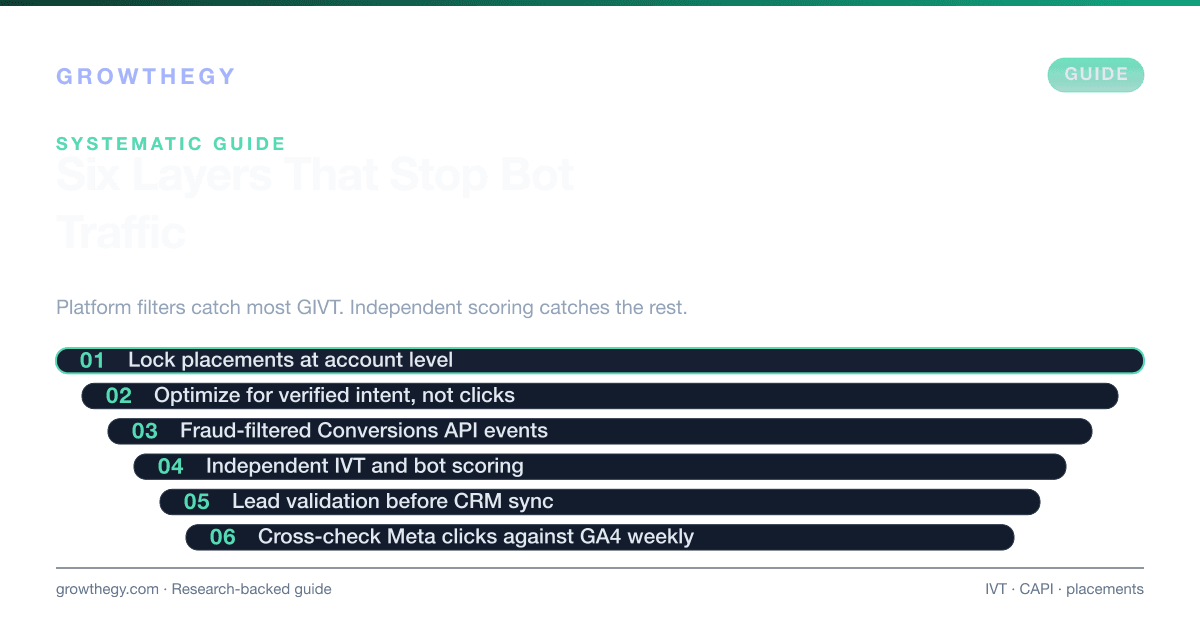
Meta Ads bot traffic — Use a stacked defense: lock Audience Network at account level, optimize to verified conversions, send only fraud-filtered Conversions API events, exclude scored invalid traffic, validate leads before CRM/CAPI, and audit Meta clicks against GA4 weekly. Platform filters catch most GIVT but miss much SIVT—so independent scoring and clean learning signals matter as much as IP blocks.
Benchmarks
Average ecommerce conversion rate is often ~2–3% (varies widely by industry and traffic mix).
Source: IRP Commerce — Ecommerce Market Data (Jan 2026)
Key takeaways
- Meta’s average IVT rate is ~8.2%; sophisticated bots still evade platform filters and poison Advantage+ learning.
- Academic surveys show ML/DL (Random Forest, XGBoost, LSTM hybrids, graph models) outperform rule-only detection—especially for stealthy fraud.
- Stealthy Facebook like farms defeated graph co-clustering (~47% precision) but timeline/lexical features reached ≥99% precision in research.
- Practical defense is layered: account placement locks, conversion optimization, fraud-filtered CAPI, third-party IVT scoring, lead validation, and Meta↔GA4 mismatch audits.
On this topic: Ecommerce Simulator · Meta Ads for Ecommerce: What 100+ Studies Say Works
Bots do not only waste Meta budget—they teach Advantage+ the wrong customer. Every invalid click, fake engagement, or junk Instant Form lead that lands as a “conversion” becomes a training example. Delivery then finds more of the same. This guide synthesizes peer-reviewed research on click fraud and social bots with a practical six-layer defense you can implement on Facebook and Instagram ads—without generic “watch your CTR” advice.
Model the spend impact of cleaner traffic and higher conversion quality in the Ecommerce Simulator after you tighten measurement, so ROAS and CAC reflect humans—not automation.
1. Executive summary: the size of the problem
The Media Rating Council (MRC) defines invalid traffic (IVT) as traffic or associated media activity that fails quality or completeness criteria, or that should not be included in measurement counts. That covers bots, botnets, click farms, accidental clicks, malware-driven activity, competitor sabotage, and some pre-fetch behaviors—not merely “low-intent humans.”
Industry measurement (Lunio Global Invalid Traffic Report, 2026) estimates ~8.51% average IVT across major platforms and ~$63 billion lost to IVT in 2025. Meta sits near the better end of major platforms at ~8.20% IVT (Google ~7.57%; TikTok ~24.2%; LinkedIn ~19.9%). At Meta’s advertising scale, even a mid-single-digit rate is enormous. Imperva’s Bad Bot Report (2026) puts automated traffic above 53% of all web traffic, with “bad bots” a large share—so landing pages that trust every Pixel fire are measuring a majority-machine web.
| Signal | Figure | Source type |
|---|---|---|
| Meta average IVT | ~8.20% | Industry IVT report (2026) |
| Global digital IVT loss (2025) | ~$63B | Industry estimate |
| Automated share of web traffic | ~53% | Imperva Bad Bot Report 2026 |
| Platform filters vs SIVT | ~95% GIVT / ~40% SIVT | MRC-aligned industry framing |
| Lead gen vs ecommerce IVT | ~32% higher on lead gen | Industry IVT report (2026) |
MRC splits IVT into GIVT (general: known crawlers, obvious bots, accidental duplicates) and SIVT (sophisticated: residential proxies, human-like biometrics, agentic bots). Platform filters catch most GIVT; more than half of SIVT can pass. Soft invalids are rarely refunded and still pollute learning.
2. What researchers and experts actually do (systematic review)
Below is a condensed systematic review of peer-reviewed and preprint work on click fraud and social-media bot detection—mapped to what Meta advertisers should copy in production.
2.1 Bot generations: from cURL scripts to behavioral hijacking
Sadeghpour & Vlajic (2021), Click Fraud in Digital Advertising: A Comprehensive Survey (Computers 10(12):164), remains the most complete academic survey of click-bot evolution. They classify application-layer bots into four generations:
- Gen 1: simple request scripts (e.g. cURL), few IPs, no cookies/JS—blocked by IP/UA blacklists.
- Gen 2: headless browsers (cookies + JS)—detectable via browser fingerprint and unnatural click-paths.
- Gen 3: full browser mode with crude mouse/keystroke automation—caught by interaction analysis when sequences are programmatic.
- Gen 4: human-like mouse paths and click-paths, rotating UAs across thousands of IPs, often using behavioral hijacking (recorded human gestures from compromised apps)—hard to separate from real users with rules alone.
Implication for Meta: IP exclusion lists and “obvious bot” filters are necessary but insufficient. Defenses must score session behavior and conversion legitimacy, not only network origin.
2.2 Click-fraud taxonomy researchers use
The same survey (and related work by Pooranian et al.; Metwally et al.) groups automated click fraud into:
- Badvertising: malicious JS that silently loads ad iframes / simulates clicks after a legitimate page render.
- Hit inflation: publishers (or coalitions) inflate clicks for revenue or to burn a competitor’s budget—including cookieless, single-cookie/multi-IP, and multi-cookie/multi-IP patterns.
- Hit shaving: under-reporting conversions to advertisers (publisher-side deflation).
- Botnet click campaigns:malware on infected devices (historical examples include Clickbot.A, ZeroAccess, Methbot, 3ve, HyphBot—surveyed with damage estimates in Sadeghpour & Vlajic, Table 2).
Crowd fraud (paid humans / click farms) is harder than pure bots because behavior is human. Xu et al. (ESORICS 2014) and others note that methods tuned for automation under-detect man-made fraud—hence Meta Lead Ads spam often needs lead-quality validation, not CAPTCHA alone.
2.3 Detection methods that outperform rules (systematic findings)
Vir & Upadhyay (2024), Smart Guard: A Comprehensive Approach to Ad Click Fraud Detection (IJSRCSEIT), systematically review AI approaches and conclude that machine learning and deep learning typically outperform rule-based systems, with effectiveness gated by training-data quality and diversity. Directions they emphasize match production needs: real-time detection, behavioral interaction features, adversarial robustness, unsupervised anomaly detection for novel fraud, and multi-modal fusion.
Representative results and methods from the literature:
| Approach | What researchers found | Cite |
|---|---|---|
| Random Forest / ensembles | ~88% accuracy in comparative ML studies; strong on tabular click features | Vir & Upadhyay survey; Aljabri & Mohammad (2023) |
| LightGBM / XGBoost | Strong on large, imbalanced clickstreams (e.g. 200M-click public sets) | Minastireanu & Mesnita (2019); Thejas et al. (2021) |
| RF + LSTM hybrid + SHAP | 97.6% accuracy, 71% fraud recall; top features: clicks/IP, time gap, app | Niharika et al. (IJNTI, 2026) |
| Multimodal contrastive (MCCF) | +7.2% AUC, +15.6% F1 vs SOTA on 3.29M Alibaba clicks | Li & Zhong (2021) |
| Traffic analysis (Clicktok) | NMF partitioning of click traffic for fraud clusters | Nagaraja & Shah (WiSec 2019) |
| Bluff ads / premium clicks | Active traps and cryptographic “good click” authentication | Haddadi (2010); Juels et al. (USENIX Security 2007) |
Aljabri & Mohammad (2023) (Egyptian Informatics Journal) and related work confirm supervised classifiers on engineered click features remain the workhorse; hybrid DL catches temporal sequences rules miss. Production systems used by advertisers (browser-level scoring in <100ms, exclusion audiences) are the applied form of this research: score every click, block or exclude before budget and learning are poisoned.
2.4 Facebook-specific evidence: like farms and stealthy fraud
Ikram et al. (2017), Measuring, Characterizing, and Detecting Facebook Like Farms (arXiv:1707.00190; earlier IMC’14 honeypot study), ran empty honeypot Pages promoted via Facebook ads and four commercial like farms. Key findings advertisers still use:
- Two farm modes: (1) “quick and dirty”—burst likes in hours, sparse social graphs, more bot-like; (2) stealthy—slow delivery, dense friendship graphs, liking popular Pages to mimic normals (e.g. BoostLikes-like behavior).
- Graph co-clustering defenses akin to Facebook’s CopyCatch/SynchroTrap ideas struggled on stealthy farms (~47% precision in their BL-USA experiment) because lockstep patterns were deliberately diluted.
- Timeline lexical + non-lexical features (word count, vocabulary richness, readability ARI/Flesch, share ratio, comment/like inflation) trained an SVM with ≥99% precision and ~93–97% recall on farm accounts. Farm posts had ~43% fewer words, poorer vocabulary, and more reshared content.
Takeaway: Meta’s native synchronized-action filters help against noisy farms; stealthy IVT needs content and session quality signals—or independent scoring on your site—because graph timing alone is gamed.
2.5 Social bot detection: graphs, communities, and humans
Chen et al. (2024), CACL: Community-Aware Heterogeneous Graph Contrastive Learning for Social Media Bot Detection (ACL Findings), show why simple GNNs fail: community structure creates hard negatives (bots that look like humans in the same community) and hard positives (same-class nodes across communities). Their community-aware contrastive framework improves GNN backbones on Cresci-15, Twibot-20, and Twibot-22.
Wang et al. (NDSS 2013), Social Turing Tests: Crowdsourcing Sybil Detection, showed expert humans outperform average turkers; scalable crowdsourcing can complement automated Sybil filters when profiles look human.
La Gatta et al. (2026), Human, AI, and Hybrid Ensembles for Detection of Adaptive, RL-based Social Bots, is critical for 2026: bots trained with reinforcement learning adapt to evade static detectors. Individuals often show bot-class F1 below 0.5; unexpectedly, older and native-speaker participants outperformed some “digital native” groups; active engagement with bots improved detection more than passive exposure; and hybrid human+AI aggregation beat humans or AI alone. Platforms and brands should not rely on a single static classifier.
Related Instagram/social work (e.g. InstaGuard frameworks using RF/XGBoost + BERT/LSTM pipelines; text SVM fraud-ad classifiers with high F2 for recall) reinforces multi-signal stacks: behavior + language + graph.
2.6 Expert / industry consensus mapped to research
What practitioners and verification vendors implement aligns with the papers:
- Pre-click / browser-level scoring(not only post-click refunds)—matches real-time ML recommendations in Vir & Upadhyay (2024).
- 200–800+ features:device fingerprint, datacenter/VPN reputation, velocity, mouse/scroll entropy—operationalizes Gen-3/4 detection from Sadeghpour & Vlajic.
- Fraud-filtered Conversions API—stops poisoning the optimization loop (the Meta-specific failure mode rules-based IP blocks never address).
- Audience exclusions for repeat invalid profiles—practical version of collaborative / shared fraud intelligence discussed in surveys.
3. Meta Ads–specific attack surfaces
3.1 Audience Network and placement leakage
Meta Audience Network extends delivery to third-party apps and sites. Independent analyses consistently flag higher IVT and brand-suitability risk versus Feed/Stories. Meta itself exposes inventory filters and block lists for Audience Network—acknowledgement that quality varies.
Placement control is no longer a one-checkbox story. Meta has moved toward algorithmic placement and, for many accounts, ad-set exclusions can still allow limited spend on excluded surfaces (reported as up to 5% per excluded placement when the “improve performance” override is left on). Account-level Placement Controls (Advertising Settings → Account Controls) are the hard block practitioners use today.
3.2 Lead Ads Instant Forms
Instant Forms convert in two taps with pre-filled profile data. That UX is ideal for humans—and for bots and click farms. Because forms live inside Meta’s walled garden, you lack on-page behavioral context unless you add custom questions, OTP, or post-submit validation. Rejecting junk in the CRM after Meta counted a Lead event does not un-teach the algorithm.
3.3 Advantage+ / conversion learning poisoning
On Meta, fraud steers budget—not only burns CPC. Pixel and default CAPI fire for bots and humans alike. High Event Match Quality on a bot still means Meta confidently matched a bot. Only an upstream validation gate on server events keeps Advantage+ learning from verified buyers or sales-qualified leads.
3.4 New campaigns and soft signals
Learning-phase campaigns optimized to soft events (clicks, landing-page views, raw leads) attract cheap automation. Research and practitioner data agree: optimize to hard outcomes and validate those outcomes.
4. Six-layer defense system (what to implement)
Treat this as a stacked control system. Skipping the learning-signal layer (Layer 3) while only blocking IPs leaves Advantage+ corrupted.
Layer 1 — Account placement lock
- Ads Manager → Advertising settings → Account controls → Placement controls.
- Restrict to Facebook/Instagram Feed, Stories, Reels as needed; exclude Audience Network, and critically review Right Column, Messenger, Instant Articles, in-stream inventory for your objective.
- At ad-set level (while still available), deselect any “spend limited budget on excluded placements” override so exclusions are not soft.
- Prefer data-driven cuts: if you must test Audience Network for ecommerce purchases, use automation rules to pause placements with spend and near-zero conversion—see also ROAS levers for placement hygiene.
Layer 2 — Optimize for intent, not click volume
- Prefer Purchase, Subscribe, or CRM-qualified events over Link Clicks or Landing Page Views.
- For lead gen, move toward conversion-leads / offline upload of sales-qualified outcomes once volume allows.
- Separate prospecting vs retargeting; retargeting bots you already clicked wastes budget twice.
Layer 3 — Fraud-filtered Conversions API (CAPI)
Meta’s developer guidance recommends a redundant Pixel + CAPI setup with shared event_id / eventID and matching event_namefor deduplication within 48 hours; send events near real time (delays >2 hours hurt optimization). That alone is not antifraud.
Fraud-filtered CAPI: on your server (or middleware), before POST /{pixel-id}/events:
- Drop datacenter / known-fraud IPs and proxy-tor patterns when paired with bad device fingerprints.
- Drop disposable emails, recycled phones, and impossible form-fill velocities.
- Require a coherent session (click ID ↔ landing session) for website events.
- Pass only enriched, consented
user_data(hashed em/ph, fbp/fbc) for match quality.
Result: Pixel may still observe the visit for diagnostics; Meta’s optimization path only receives humans you would want more of.
Layer 4 — Independent IVT / bot scoring
Deploy a third-party or first-party scorer that evaluates browser-level signals in real time (aligned with TrafficGuard / Lunio / similar architectures: pre-click or immediate post-landing classification). Typical operator workflow on Meta:
- Tag every landing visit with a quality score or Legitimate/Suspicious class.
- Build a Custom Audience of suspicious users/devices.
- Exclude that audience from ad sets continuously.
- Keep audit logs for disputes and for retraining your own thresholds.
This implements the research consensus that SIVT needs ML behavioral models, not static IP lists—and that exclusion is how you act when you cannot hard-block inside Meta’s auction.
Layer 5 — Lead validation (if you use Lead Ads or forms)
- Real-time email/phone validation; reject disposable domains.
- OTP or SMS verify for high-ticket offers.
- Custom questions that raise friction for farms without killing true intent.
- Invisible reCAPTCHA v3 on site forms you control (Instant Forms still need server validation).
- Only send validated leads through CAPI / conversion APIs—teams report large junk-rate reductions (often cited in the 40–70% range within ~60 days when paired with CRM feedback).
Layer 6 — Analytics cross-verification
- Weekly: Meta link clicks vs GA4 sessions (and engaged sessions). Large gaps (e.g. Meta 1,000 clicks → GA4 ~150 sessions) are a classic IVT fingerprint.
- Flag spikes in leads/clicks with flat sales conversations; multi-submit same IP; sub-second form fills; abnormal hour bursts.
- Enable Meta Events Manager bot filtering / Filter Events where available—necessary but not sufficient for SIVT.
- Edge bot fight (e.g. WAF bot modes) on your domain for non-Meta scrapers hitting the same storefront.
5. Implementation checklist (prioritized)
| When | Actions | Success metric |
|---|---|---|
| Day 1 | Account Placement Controls; kill 5% exclusion override; switch bid events to hard conversions | Audience Network spend → ~0; CPA volatility drops |
| Week 1 | Pixel+CAPI with event_id; insert validation gate; lead validation live | EMQ healthy on clean events only; junk lead % down |
| Week 2–4 | IVT tool + exclusion audiences; GA4 mismatch dashboard; placement rules | IVT rate trend down; Meta↔GA4 gap narrows |
| Ongoing | Retrain exclusions; CRM→Meta qualified events; creative/offer tests on clean data | Stable ROAS/CPA; sales accept rate up |
Re-forecast contribution profit after IVT cleanup in the Ecommerce Simulator—cleaner conversion rates often look “worse” on vanity CPC but better on margin.
6. Diagnostic playbook: is it bots?
- CTR up, CVR and time-on-site down simultaneously.
- Placement breakdown: cheap CPC on Audience Network / obscure apps with zero purchases.
- Geo or device slices with spend and no downstream CRM activity.
- Lead quality: free-mail + nonsense company fields + duplicate phones.
- Learning phase that “converges” on cheap leads that sales reject—classic poisoned optimization.
When diagnosing, change one layer at a time (placements first, then event quality) so you can attribute lifts—same experimental discipline as ROAS lever testing.
7. Research-backed future directions
Vir & Upadhyay (2024) and related security work point to where defenses are heading—and what you should demand from vendors:
- Streaming / real-time RL-aware detection against adaptive bots (La Gatta et al., 2026).
- Behavioral biometrics: mouse trajectories, scroll entropy, keystroke dynamics—features Gen-4 bots still imperfectly forge at scale.
- Adversarial ML: train detectors on evasion attempts (GANs / adversarial examples).
- Unsupervised anomaly detection for novel fraud without labeled SIVT.
- Community-aware graph models (CACL-style) for social engagement fraud beyond simple clickstreams.
- Human–AI hybrid review for high-value accounts and edge cases—ensembles beat either alone against RL bots.
8. Bottom line
Avoiding bots on Meta Ads is not a single toggle. Academic evidence shows fraud evolved from naive scripts to stealthy, human-mimicking, and now RL-adaptive agents; rule-only and lockstep-graph filters are incomplete; ML/hybrid systems and quality-gated conversion signals are what work. On Meta specifically, lock placements, stop optimizing to soft fakes, validate before CAPI, add independent IVT scoring with exclusions, validate leads, and audit Meta against your analytics every week. That stack is what researchers’ methods imply—and what high-performing media teams actually run.
References
- Sadeghpour, S., & Vlajic, N. (2021). Click Fraud in Digital Advertising: A Comprehensive Survey. Computers, 10(12), 164. https://doi.org/10.3390/computers10120164
- Vir, A., & Upadhyay, S. (2024). Smart Guard: A Comprehensive Approach to Ad Click Fraud Detection. International Journal of Scientific Research in Computer Science, Engineering and Information Technology, 10(6), 2018–2024. https://doi.org/10.32628/CSEIT2410612403
- Ikram, M., Onwuzurike, L., Farooqi, S., De Cristofaro, E., Friedman, A., Jourjon, G., Kaafar, D., & Shafiq, M. Z. (2017). Measuring, Characterizing, and Detecting Facebook Like Farms. arXiv:1707.00190. https://doi.org/10.48550/arXiv.1707.00190
- Chen, S., Feng, S., Liang, S., Zong, C., Li, J., & Li, P. (2024). CACL: Community-Aware Heterogeneous Graph Contrastive Learning for Social Media Bot Detection. Findings of the ACL. https://aclanthology.org/2024.findings-acl.617/
- La Gatta, V., Subrahmanian, N., Wang, K., Birnbaum, L., & Subrahmanian, V. S. (2026). Human, AI, and Hybrid Ensembles for Detection of Adaptive, RL-based Social Bots. arXiv:2603.23796. https://doi.org/10.48550/arXiv.2603.23796
- Wang, G., et al. (2013). Social Turing Tests: Crowdsourcing Sybil Detection. NDSS.
- Aljabri, M., & Mohammad, R. M. A. (2023). Click fraud detection for online advertising using machine learning. Egyptian Informatics Journal, 24(2), 341–350. https://doi.org/10.1016/j.eij.2023.05.006
- Minastireanu, E.-A., & Mesnita, G. (2019). Light GBM Machine Learning Algorithm to Online Click Fraud Detection. Journal of Information Assurance & Cybersecurity.
- Thejas, G. S., et al. (2021). A hybrid and effective learning approach for Click Fraud detection. Machine Learning with Applications, 3, 100016.
- Li, W., & Zhong, Q. (2021). Multimodal and Contrastive Learning for Click Fraud Detection.
- Nagaraja, S., & Shah, R. (2019). Clicktok: Click Fraud Detection Using Traffic Analysis. WiSec.
- Haddadi, H. (2010). Fighting Online Click-Fraud Using Bluff Ads. ACM SIGCOMM CCR, 40(2), 21–25.
- Juels, A., Stamm, S., & Jakobsson, M. (2007). Combating Click Fraud via Premium Clicks. USENIX Security.
- Xu, H., Liu, D., Koehl, A., Wang, H., & Stavrou, A. (2014). Click Fraud Detection on the Advertiser Side. ESORICS.
- Dave, V., Guha, S., & Zhang, Y. (2012/2013). Measuring and Fingerprinting Click-Spam; Viceroi. SIGCOMM / CCS.
- Niharika, M., et al. (2026). Hybrid Model for Ad Click Fraud Detection with Explainable AI. IJNTI.
- Meta Platforms. Conversions API End-to-End Implementation. Meta for Developers. developers.facebook.com/docs/marketing-api/conversions-api/…
- Media Rating Council (MRC). Invalid Traffic Detection and Filtration Guidelines. Industry standard definition of IVT / GIVT / SIVT.
- Lunio. Global Invalid Traffic Report (2026); Meta Ads IVT commentary (~8.20% Meta IVT; ~$63B industry loss framing).
- Imperva. Bad Bot Report (2026). Automated traffic share of total web traffic.