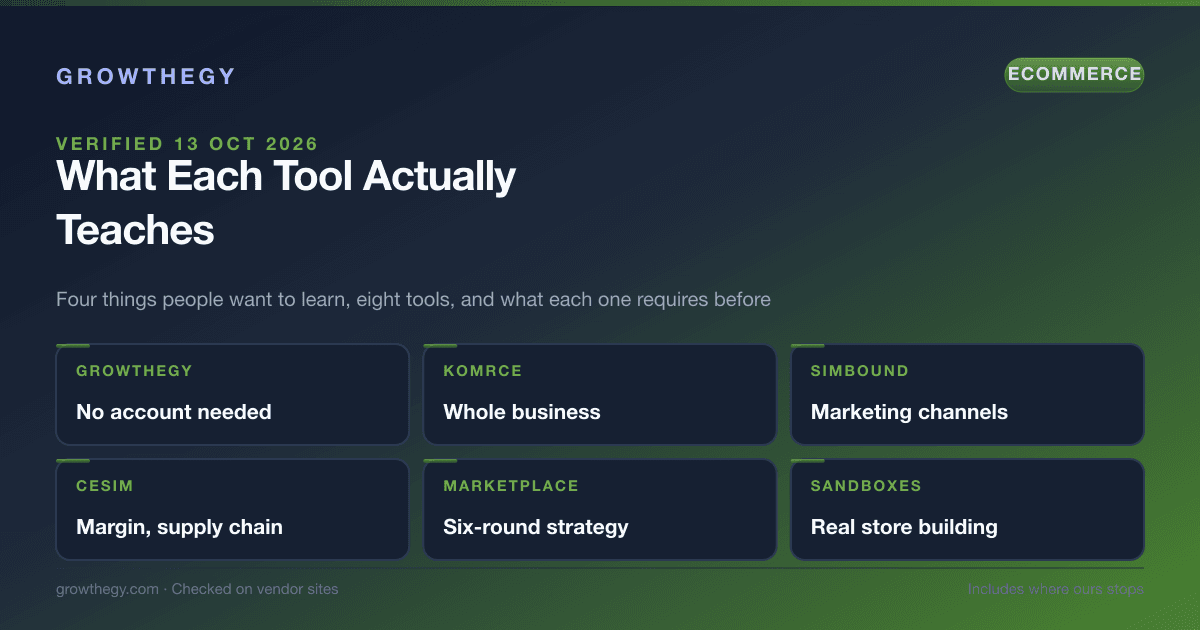
A verified comparison of ecommerce simulators and learning tools — what each teaches, what it needs before you can use it, and where it stops. Access and pricing checked 13 October 2026.
Benchmarks
Average ecommerce conversion rate is often ~2–3% (varies widely by industry and traffic mix).
Source: IRP Commerce — Ecommerce Market Data (Jan 2026)
Average ecommerce cart abandonment rate is 70.19%.
Source: Baymard Institute — Cart Abandonment Rate Statistics (2024)
Key takeaways
- Four of the eight tools compared require an institution, an organisation, a quote or a purchase order before you can play.
- Growthegy is the only one that needs no account, no credits and no install.
- Simbound grades your sales-forecast accuracy across ten rounds, not only your decisions.
- Komrce models segment pricing, financing, headcount and brand equity — genuinely deeper than a unit-economics model.
- Simulators teach judgement; development stores and WooCommerce teach mechanics. You need both.
On this topic: Ecommerce Simulator · Ecommerce Simulator Niche Baselines: What the Teaching Model Assumes (2026), What Is an Ecommerce Simulator? How It Works and When to Use One
Most ecommerce simulators are not built for individuals, and almost none of them are free.Of the tools people use to learn the trade, one runs in a browser with no account at all, two offer a free demo but sell the real product to organisations, and the rest are sold to universities and businesses by quote. We checked each vendor’s site directly on 13 October 2026: four of the access gates below are quote-only or login-walled, and one widely-quoted price table turned out to belong to a page that no longer exists.
This is a comparison by access and scope, not a ranking. It is meant to answer one question — which tool can you actually open today, and what will it not teach you? — and it includes where Growthegy falls short, because a comparison that only praises itself is not worth reading.
There are four different things people are trying to learn
Before comparing tools it helps to name the job, because no single simulator does all four and that is the most common source of disappointment.
| What you want to learn | What it actually involves | Typical tools |
|---|---|---|
| Unit economics | How traffic, conversion, AOV and margin turn into cash — and what breaks when one moves | Turn-based simulators |
| Marketing channels | Splitting budget across search, social, email and SEO against a shifting demand pool | Channel simulations |
| Whole-business operations | Pricing by segment, stock, headcount, financing, brand equity and reputation | Consultancy-led business simulations |
| Platform mechanics | Building a real store: products, themes, checkout, payments, shipping | Developer sandboxes and trials |
Pick the row you are actually in. If you cannot name which one, the unit-economics tools will teach you fastest, because every other row assumes you already have those numbers.
The access reality, checked 13 October 2026
This is the part most “best tools” lists get wrong. Here is what each vendor actually gates, taken from their own pages on the date above.
| Tool | Teaches | What you need to start |
|---|---|---|
| Growthegy Ecommerce Simulator | Unit economics: traffic, conversion, pricing, AOV, margin, cash | Nothing. A browser. No account, no card, no install |
| Komrce | Whole business: segment pricing, stock, headcount, financing, brand equity | Free 2-round demo by email. Full programme is facilitator-led and quoted |
| Simbound | Marketing channels: web/SEO, search, email, social, brand community, affiliate | Credits. Pricing is not publicly disclosed |
| Cesim Ecommerce | Margin, AOV, ROAS and supply-chain efficiency in a market simulation | An institution. Sold to 1,000+ universities by quote |
| Marketplace Simulations | E-commerce strategy over six rounds (bicycle companies) | Instructor account + student subscription |
| Finsimco E-Commerce | Product strategy, marketing, supply chain and finance for organisations | A booked demo. Business schools, banks, enterprises |
| Shopify development store | Real platform mechanics: products, themes, apps, checkout | A free Shopify Partner account |
| Local + WooCommerce | Real open-source store building, entirely offline | A download and local disk space |
The pattern: four of the eight require an institution, an organisation, a quote or a purchase order before you can play. Two more require only a free signup. Exactly one requires nothing at all.
Simbound — a marketing-channel simulator that grades your forecasting
Simbound runs ten rounds in which you promote a tablet-PC brand in two markets (US and South-East Asia). Its most distinctive mechanic is that it scores your forecasts, not only your decisions. Before each run you estimate future sales for all ten rounds, and you are graded on how much that accuracy improves across them:
“For each round, enter your estimate of future sales by selecting a value between 0 and 500. Try to improve the accuracy of your forecasts with each round.”
That is a different skill from picking the right action. It trains calibration — noticing when you do not know — which most business games skip entirely.
Two further details worth knowing before you sign up:
- Modules unlock progressively. Round 1 exposes only the web/SEO module. Search advertising, email, social, brand community and affiliate arrive in later rounds, so you are not choosing between channels before you understand any of them.
- Search demand moves. The keyword research view gives competition level, average search volume and top-of-page bid for each term — and a per-round volume series. For one term in our check, volume swung from 290,000 to 1,280,000 and back to 240,000 across the ten rounds. Spending is a timing problem as well as a targeting problem.
What it does not do:it does not model your P&L. There is no cash constraint, no contribution margin, no payback period. It is excellent at marketing and silent on whether the marketing was profitable.
On price: we could not find a public price. The dedicated pricing page returns a 404 and both the licensing page and the licence-auction page redirect to a login screen. Search engines still surface a detailed euro table for that dead URL; treat it as unverified and check with the vendor directly.
Komrce — the deepest model, sold to organisations
Komrce is the most comprehensive tool we tested. You run an online store across four customer segments — wealthy and modest, each split into city and rural — and set price, forecast, delivery tier, advertising split and acquisition rate separately for each.
Effects are modelled with unusual specificity. Delivery is a tier with a conversion and reputation cost attached; packaging is a company-wide choice that lifts conversion and NPS; advertising split between direct response and brand, where brand spend pays off a quarter or two later rather than immediately. You also hire and lay off warehouse and support staff, take loans, arrange inventory loans, pay dividends and invest in capacity — and inventory you order today arrives next round.
Outputs include earnings, costs, marketing performance, NPS and brand equity. The application shows estimated revenue per segment as you type and warns you when a setting is impossible, which is unusually good practice for a teaching tool.
Three things to know:
- Rounds are long. A round is a simulated quarter with a two-hour window. Teams are split into roles — marketing, sales — and must reach consensus before submitting. Unsubmitted rounds fall back to default values.
- The demo is genuinely free and self-serve — two rounds, an email address, no card. We confirmed this by entering one.
- The full product is not self-serve. Their own description: a dedicated session, a mutually chosen date, a Komrce facilitator, and invoicing to the organisation. There is no public price.
What it does not do:it is heavy. If your question is simply “what happens to cash if I raise AOV?”, a two-hour facilitated quarter is a large machine for that question.
The academic simulators
Cesim Ecommerce is a microsimulation focused on operating margin, average order value, ROAS and supply-chain efficiency. It is excellent, and it is sold to educational institutions and corporate training — 1,000+ universities use the wider Cesim portfolio, and there is no public price. If you are already enrolled in a course, ask your department whether you have access.
Marketplace Simulations runs six rounds in which student teams launch web-based bicycle companies and compete on organic search, paid search, social and customer experience. Each round takes one and a half to two hours per student. Access is arranged through your course, and students need a subscription.
Finsimco sells an e-commerce simulation to business schools, banks and enterprises, built around market analysis, channel allocation, inventory and financial interpretation. Access is via a booked demo.
All three are legitimate routes to learning. All three are sold to institutions rather than to individuals, and all three assume you already understand unit economics.
The platform sandboxes — for learning the platform, not the business
If your gap is mechanics rather than judgement, use the real thing:
- Shopify development stores. A free Shopify Partner account gives you development stores for building products, themes, checkout flows and apps. Place test orders to walk the full customer journey without processing real payments.
- Local plus WooCommerce. Download Local, install WordPress and WooCommerce locally, and build, break and rebuild a store entirely offline. The best way to learn plugins, themes and technical store management safely.
Neither will teach you whether a price is right or whether cash will survive a bad quarter. They teach you where the buttons are.
Growthegy — what it is, and where it stops
Growthegy is a browser-based, turn-based model of a store. Each turn you make a decision — marketing budget, price, channel mix, product focus — and traffic, conversion, AOV, margin and cash update immediately. Data stays on your device, and there is no account.
The parts that go beyond a slider-and-graph model: every turn produces a decision trace explaining what your choice actually changed and why; a counterfactual replay lets you branch the same turn and run the decision you did not make, so you can price a regret; a forecast mode scores how accurate your revenue and cash predictions were before the round resolved; and practice scenarios, working-capital mechanics and runway phases cover the situations that quietly end most stores.
And the limits, which are real:
- It does not teach supply chain, fulfilment or logistics. There is no warehouse, no lead time and no shipping operation.
- It does not teach store building. There is no theme, no checkout configuration and no app ecosystem. For that, use a development store.
- It does not model headcount, financing or dividends, so it will not teach you about financing structure or operating leverage.
- It is single-player. You will not be ranked against other teams, which is exactly what makes it comfortable to experiment in.
If you need financing, organisational design or competitive ranking, Komrce is genuinely the deeper tool and we would rather say so than pretend otherwise.
How we checked this
Every access gate and price in this article was verified directly on the vendor’s own website on 13 October 2026, by opening each page rather than relying on search results. That process changed the article twice:
- A widely-quoted euro price table for Simbound belongs to a URL that now returns 404, and both replacement pages redirect to a login wall. Those figures are not included above because we could not confirm them.
- Komrce’s access model is only visible from inside a session. We entered the free demo to confirm that the two-round trial really is self-serve and that the full product is facilitator-led.
Where a vendor does not publish a price, we have written “not publicly disclosed” rather than estimating. If a figure here is ever out of date, it is out of date rather than wrong — and we would rather say that than publish something we have not seen.
Where to start
If you are starting from zero and want to understand the financial math of running a store, the Growthegy simulator is the fastest route to understanding why margin and cash behave the way they do. It takes seconds per turn and costs nothing.
If your problem is channel allocation and you already know your unit economics, Simbound is the specialist tool, and worth asking for a quote.
If you are running a team and need to teach segment pricing, financing and staffing, ask Komrce for a facilitated session.
If your gap is that you have never actually built a store, stop simulating and open a free Shopify Partner account. You will learn more in an afternoon of building than in a quarter of modelling.