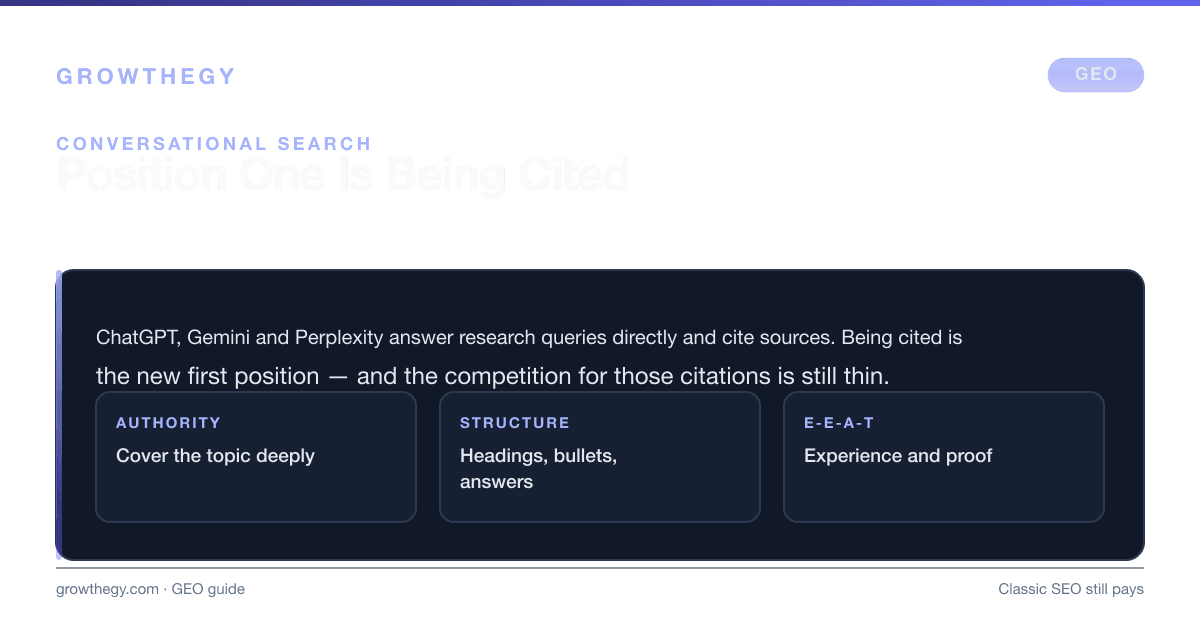
How conversational search engines like ChatGPT and Gemini change SEO—and how to optimize pages for AI answers, citations, and classic rankings together.
Benchmarks
Users clicked a link inside a Google AI summary in just 1% of visits to pages that showed one (Pew browsing data from 900 US adults, March 2025).
Source: Pew Research Center — Google users are less likely to click on links when an AI summary appears in the results (2025)
Key takeaways
- Conversational Search SEO: ChatGPT & Gemini — focus on one metric or lever at a time; validate with data before scaling spend.
On this topic: Ecommerce Simulator · Best GEO Courses for Generative Engine SEO, Generative Engine Optimisation (GEO) for the AI Era
Conversational search means users ask questions in natural language and get direct answers—often from AI tools like ChatGPT, Google Gemini, or Claude—instead of only a list of blue links. That changes how visibility works: you want your content to be cited or linked in those answers, not just to rank in traditional search. This is often called conversational search SEO or GEO (Generative Engine Optimization).
The scale of the shift is significant. OpenAI reported that ChatGPT crossed 100 million weekly active users in early 2024. Google stated that Gemini handles billions of queries per month. Perplexity disclosed 15 million daily active users by late 2024. While these platforms don't yet replace Google for the majority of searches, they are capturing a growing share of research-intensive, multi-step queries—precisely the type that traditionally drove the most valuable SEO traffic.
1. How Conversational Search Engines Work
Traditional search engines use an index-and-rank model: they crawl and index billions of web pages, then rank them by relevance to a query using hundreds of signals. Conversational search engines use a fundamentally different process. They use large language models (LLMs) trained on text corpora to generate answers directly, often drawing on indexed web content in real time via retrieval-augmented generation (RAG).
The key difference: traditional SEO gets you a link in a ranked list; conversational search SEO gets your content synthesized into an answer, with a source citation. The citation is the new "position 1." According to research from Princeton University and the Allen Institute for AI (2024), only 2–3 sources are typically cited per AI-generated answer, making citation a highly competitive and highly valuable outcome.
2. Market Share and Usage Data
| Platform | Type | Monthly Active Users (2024–2025) | Search/Query Volume | Citation Behavior |
|---|---|---|---|---|
| Google (traditional) | Classic + AI Overviews | ~8.5 billion searches/day | ~5.6 trillion/year | Ranks pages; AI Overview cites 3–8 sources |
| ChatGPT (OpenAI) | LLM conversational | 100M+ weekly active users | Not disclosed | Citations via Browse with Bing; varies by mode |
| Google Gemini | LLM + Google Search | Integrated with Google Search | Billions/month | Cites sources inline with AI Overviews |
| Perplexity AI | AI search engine | 15M+ daily active users | ~100M queries/month (est.) | Always cites sources; 3–5 per answer |
| Microsoft Copilot (Bing) | LLM + Bing Search | 100M+ daily active users (Bing) | Not disclosed | Citations via Bing index; numbered references |
| Claude (Anthropic) | LLM conversational | Not disclosed | Not disclosed | Limited web access; no consistent citation |
Sources: OpenAI, Google, Perplexity disclosures; Statista 2025; SimilarWeb 2024.
3. Why It Matters for SEO
When answers are generated from models trained on the open web, clear, authoritative, and well-structured content is more likely to be referenced. So SEO for conversational search focuses on: being a reliable source the model can cite, answering questions directly, and using structure (headings, lists, definitions) that fits how answers are composed.
The impact on traditional search traffic is real but nuanced. Semrush (2025) found an average 8.9% CTR decline for positions 1–3 when Google AI Overviews were present. For broad informational queries, the decline can reach 20–30%. But for transactional and navigational queries, AI Overviews rarely appear and click-through remains strong. The implication: diversify your content strategy across intent types.
4. How AI Overviews and Conversational Engines Select Sources
Research into what makes a page more likely to be cited in AI-generated answers is still emerging, but several factors are consistently identified:
- Topical authority – Sites that cover a subject comprehensively and consistently are more likely to be cited than sites with a single relevant page.
- Content structure – Pages with clear headings, short paragraphs, bullet points, and direct answers to questions are easier for AI to extract and synthesize.
- Cited statistics and sources – Content that itself cites named sources (studies, reports, data) is perceived as more authoritative by both human readers and AI ranking signals.
- E-E-A-T signals – Google's framework of Experience, Expertise, Authoritativeness, and Trustworthiness applies directly to AI Overview source selection.
- Page speed and crawlability – Pages that are slow or have crawl issues are less likely to be indexed in a way that enables real-time retrieval for AI answers.
5. Practical Steps to Optimize for Conversational Search
Create content that clearly answers specific questions. Use concise definitions and step-by-step explanations. Cite sources and data where relevant. Ensure technical SEO (crawlability, mobile experience) is solid so your pages can be discovered and used. For a deeper framework, see our guide to GEO for the AI era and our GEO audit checklist on priority URLs.
- Audit your existing content for "question-answer" gaps. For each key page, identify the primary question it should answer. Is that question stated explicitly in the first paragraph? Is the answer direct and unambiguous? AI systems favor pages that answer a question within the first 100–200 words.
- Add FAQ sections to authoritative pages.FAQ schema markup and Q&A sections increase both featured snippet eligibility and AI Overview citation probability. Each FAQ item should have a concise, complete answer (2–4 sentences).
- Build topical depth, not just page breadth. Create a cluster of related pages around your core topics. Link them together with descriptive anchor text. Topical authority signals help both traditional Google rankings and AI citation likelihood.
- Cite your data explicitly. When you use statistics, name the source and year (e.g., "McKinsey 2024" or "Statista 2025"). This signals the content is grounded in verifiable evidence, which AI systems learn to associate with reliability.
- Optimize page speed and Core Web Vitals. A page that loads slowly is a liability for both traditional SEO and AI source retrieval. Use Google PageSpeed Insights to identify and fix LCP, CLS, and FID issues.
- Monitor your AI citation performance. Search for your key topics in ChatGPT, Perplexity, and Google with AI Overviews enabled. Are you being cited? If not, identify which competitors are being cited and analyze what their cited pages do differently.
- Run the GEO checklist on your highest-value pages. Use our GEO audit checklist to surface structural gaps AI systems care about before you rewrite entire pages.
6. The Conversational Search Opportunity: Citation as a Brand Asset
Being cited in conversational search answers is not just about traffic—it's brand positioning. When ChatGPT or Perplexity cites your site in an answer read by millions of users, that is brand visibility that occurs entirely independently of whether the user clicks through to your page. It's the equivalent of being quoted in a widely-read publication, and it compounds over time as AI systems are fine-tuned on data that includes their own outputs.
Early movers who establish citation authority now are building a durable competitive advantage. For a broader view of your growth strategy and how conversational search fits in, try our Ecommerce Simulator.
Key Takeaways
- Conversational search platforms (ChatGPT, Gemini, Perplexity) are capturing a growing share of research queries previously served by Google.
- Being cited in AI-generated answers is the new "position 1"—and competition for those citations is still relatively low compared to traditional search.
- Content optimized for GEO (clear structure, direct answers, cited sources, topical authority) performs better in both traditional SEO and conversational search.
- The impact on traditional search clicks is real but concentrated on informational queries; transactional queries remain strong for organic traffic.
- Monitoring and auditing your AI citation performance is now as important as tracking your traditional search rankings.