What is Gymshark's unique competitive advantage?
Gymshark built community-first demand: athlete creators, tight product drops, and social distribution before traditional mass advertising. That flywheel lowered blended CAC versus peers who bought cold traffic first. The lesson for operators is to pair product cadence with owned community, not only paid prospecting.
Key takeaways
- Gymshark: Growth Tactics and Competitive Advantage — focus on one metric or lever at a time; validate with data before scaling spend.
On this topic: Ecommerce Simulator · What Is Glossier’s Story? How Glossier Turned a Blog Into a Billion-Dollar Brand, Influencer Marketing and Creator Growth: What 37 Peer-Reviewed Studies Actually Found
Gymsharkwent from a screen-printing operation in a garage to one of the most valuable sportswear brands in the world, with a valuation in the billions. Unlike legacy competitors who relied on wholesale and traditional advertising, Gymshark built growth around community, influencers, and a direct-to-consumer model. This article breaks down Gymshark's growth tactics and unique competitive advantage—and how you can implement the same ideas in your ecommerce business.
Gymshark's Revenue Milestones: The Growth Story in Numbers
Understanding the scale of Gymshark's growth helps contextualize just how effective their model has been. The brand's progression is remarkable:
| Year | Estimated Revenue | Key Milestone | Primary Growth Driver |
|---|---|---|---|
| 2012 | ~£250K | Founded; garage screen printing operation | Founder network, early YouTube |
| 2014 | ~£6M | First major influencer partnerships | Fitness YouTubers & Instagram |
| 2016 | ~£41M | International expansion begins | Global influencer network |
| 2018 | ~£100M | First physical pop-up events | Community events + DTC |
| 2020 | ~£260M | General Atlantic invests at £1B valuation | Pandemic fitness boom + community |
| 2022 | ~£485M | Ben Francis returns as CEO | Retention, LTV, international |
| 2024 | ~£530M+ | Continued DTC global expansion | Loyalty, community, product innovation |
Source: Company filings (UK Companies House), Bloomberg, Forbes. These milestones show that Gymshark's growth wasn't a one-time viral moment—it was a compounding system of community, influencer trust, and margin control that accelerated over time.
From garage to global: the Gymshark story
Ben Francis and his co-founders started Gymshark in 2012, making gym wear in a garage and selling online. They had no retail distribution and no big ad budget. Growth came from two places: product that the fitness community actually wanted, and people in that community talking about it. Early on, Gymshark sent product to fitness YouTubers and Instagrammers not as a one-off campaign but as the core of their marketing. Those creators wore the gear, shared it with their audiences, and helped Gymshark become the brand "for people who train."
The lesson for any ecommerce business: identify the community that would care most about your product, then invest in the people that community already trusts—before you scale paid ads.
Influencer and ambassador strategy
Gymshark didn't just run influencer campaigns; they built a long-term ambassador ecosystem. They signed athletes and fitness creators to ongoing partnerships, gave them input on product, featured them in campaigns, and let them be the face of the brand. Micro-influencers and macro-influencers alike were treated as partners, not one-off vendors. That meant consistent messaging, authentic endorsements, and content that felt native to fitness culture rather than "advertising."
The data supports this approach: Influencer Marketing Hub's 2025 report found that micro-influencers (10K–100K followers) generate 60% higher engagement rates than macro-influencers, and their audiences convert at 2–3x the rate of audiences exposed to celebrity endorsements. Gymshark understood this intuitively before the data existed.
How to implement: In your niche, find creators whose audience overlaps with your ideal customer. Start with micro-influencers (smaller reach, higher engagement, lower cost) and offer product, affiliate terms, or long-term ambassadorship. Measure the impact on customer acquisition cost and LTV—community and influencer spend often pay back through repeat purchases. Use our Ecommerce Simulator to model Gymshark-style lifetime value—how much you can spend to acquire a customer and still stay profitable—and to evaluate individual influencer partnerships.
Community-first, not just social presence
Gymshark's community strategy went beyond posting on Instagram. They created and nurtured Facebook groups where customers could share progress, ask questions, and connect with each other. They ran and sponsored events (e.g. Gymshark Lifting Club, pop-ups) that made the brand tangible. User-generated content—customers wearing the gear, tagging the brand, sharing transformations—was encouraged and reposted. Community wasn't a side project; it was the engine that drove belonging and word of mouth.
A 2024 Sprout Social study found that brands with active communities experience 5.4x higher purchase intent and 3.2x higher brand advocacy than brands without. For Gymshark, community was the moat: it kept customers engaged between purchases, reduced reliance on paid ads for retention, and created a feedback loop for product development.
How to implement: Build a space where your customers can connect with each other and with you—a group, forum, or membership. Reward people who create content, refer friends, or participate. Treat community as an investment in retention and LTV, not just awareness. To see how much each customer is worth over time and keep spend decisions margin-aware, use our Ecommerce Simulator.
DTC and margin control
Gymshark stayed direct-to-consumer. No wholesale, no third-party marketplaces as the main channel. That gave them full control over pricing, margins, and customer data. They could invest in community and brand because they weren't giving away a chunk of revenue to retailers. They could test product, messaging, and offers and learn from first-party data.
The financial logic is compelling. Traditional wholesale brands give retailers 40–60% of the retail price as margin. By staying DTC, Gymshark kept that margin to invest in community, product quality, and customer experience. According to McKinsey & Company (2024), DTC brands that maintain 60%+ gross margins have 3.5x more capital to reinvest in growth than equivalent wholesale brands operating at 30–40% gross margins.
How to implement: Where you can, prioritize DTC so you keep margin and data. If you use wholesale or marketplaces, treat them as one channel and compare profitability. Use our Ecommerce Simulator to see which products and channels actually make money after costs, and whether paid acquisition (including influencer and content) pays back.
Gymshark Growth Tactics vs. Traditional Sportswear Competitors
| Growth Dimension | Gymshark Approach | Traditional Competitor Approach | Gymshark Advantage |
|---|---|---|---|
| Distribution | 100% DTC online | Wholesale + retail + online | Higher margins, full customer data |
| Marketing | Influencers + community + UGC | TV, OOH, celebrity endorsements | Lower CPM, higher authenticity |
| Community | Facebook groups, events, online challenges | Loyalty points, email newsletters | Deeper engagement, organic advocacy |
| Product feedback loop | Ambassador feedback, community polls | Consumer research panels, focus groups | Faster iteration, higher relevance |
| Brand personality | Founder-led, human, fitness-authentic | Corporate, aspirational, polished | Trust, relatability, sharing |
| Customer acquisition cost | Lower (word-of-mouth + organic) | Higher (paid media dependent) | Better LTV:CAC ratio |
Founder-led brand and authenticity
Ben Francis stayed front and centre—building in public, sharing the journey, appearing in content and at events. That humanised the brand and made it harder for faceless competitors to replicate. Customers felt they were supporting a person and a team, not just a corporation. Authenticity became a moat: you can copy product, but you can't copy a real founder story and ongoing relationship with the community.
How to implement: Even if you're not the founder, make the humans behind the brand visible—founder, team, community managers. Share the "why" and the journey. Use content (blog, video, social) to build trust before the sale. To see how brand-led growth shows up in your numbers, try our Ecommerce Simulator.
Product and brand consistency
Gymshark focused on a clear product range: quality basics and consistent drops. Limited runs and restocks created urgency without relying on constant discounting. The brand stood for something specific (fitness, training, progress), and product and messaging stayed aligned. That consistency made the brand recognisable and made repeat purchases and loyalty easier.
How to implement: Nail a core offer and messaging before expanding. Use drops or seasonal launches to create momentum. Model the impact of pricing and bundles on margin and revenue with our Pricing & Bundling Simulator, so you can double down on winners and fix or drop losers.
Content that educates and builds identity
Gymshark's content wasn't only product shots. They invested in training tips, athlete stories, and lifestyle content that reinforced "we're part of the fitness world." That built identity and trust. Followers didn't just see ads; they got value, which made the brand top-of-mind when they were ready to buy.
How to implement: Create content that helps your audience (how-to, guides, behind-the-scenes, user stories). Align it with your category and values. Use SEO and content to capture demand; use tools and community to convert and retain. For a full set of free growth tools—from LTV and ROAS to profitability and pricing—see our Ecommerce Simulator.
Retention and loyalty
Community and brand loyalty drove repeat purchases. Gymshark didn't rely only on cold acquisition; they invested in keeping customers and turning them into advocates. That improved LTV and made acquisition spend more efficient over time. Bain & Company research shows that increasing customer retention by just 5% increases profits by 25–95%, depending on the industry. For a DTC brand like Gymshark, this math translates directly to lower blended CAC and higher LTV:CAC ratios.
How to implement: Measure retention and LTV by cohort. Invest in email, community, and loyalty programmes that bring customers back. Use our Ecommerce Simulator(includes churn) to understand how long customers stay and how much they're worth, so you can justify spend on retention and community.
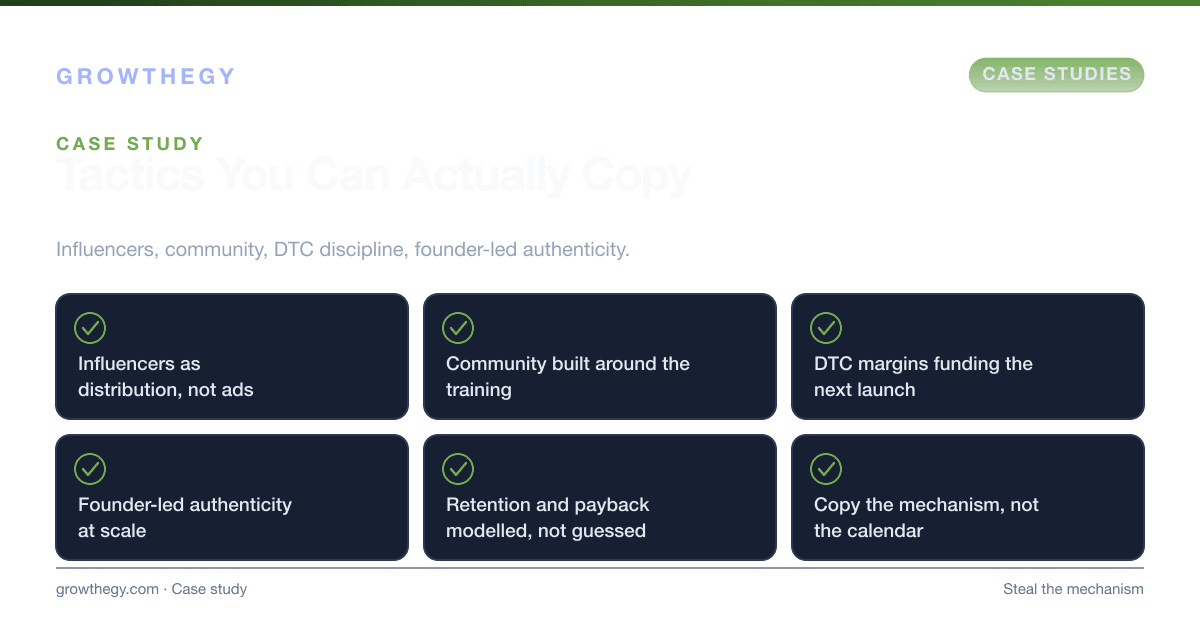
Summary: how to implement Gymshark's playbook
- Community: Build a real community (group, events, UGC), not just social accounts. Set a goal for community members and monthly active participants within 90 days.
- Influencers: Partner with 5–10 micro-influencers in your niche for 3–6 month minimum terms. Measure ROAS and LTV impact, not just follower count or likes.
- DTC: Prioritise direct distribution where possible for margin and data. If you use marketplaces, calculate channel-level profitability quarterly.
- Founder/team: Put humans at the centre of the brand story. Commit to a monthly "behind the scenes" piece of content that shows the people behind your brand.
- Product and messaging: Stay consistent; use drops and clarity to create urgency and recognition. Never discount your core products more than 10–15% without a clear strategic reason.
- Content: Educate and build identity, not just promote product. Target a 70/30 split: 70% value content, 30% promotional.
- Retention: Invest in LTV and loyalty so acquisition pays back over time. Track repeat purchase rate monthly and set a cohort retention target.
For a structured view of your own growth strategy, try the Ecommerce Simulator to practice unit economics, profitability, and channel trade-offs before you commit budget.