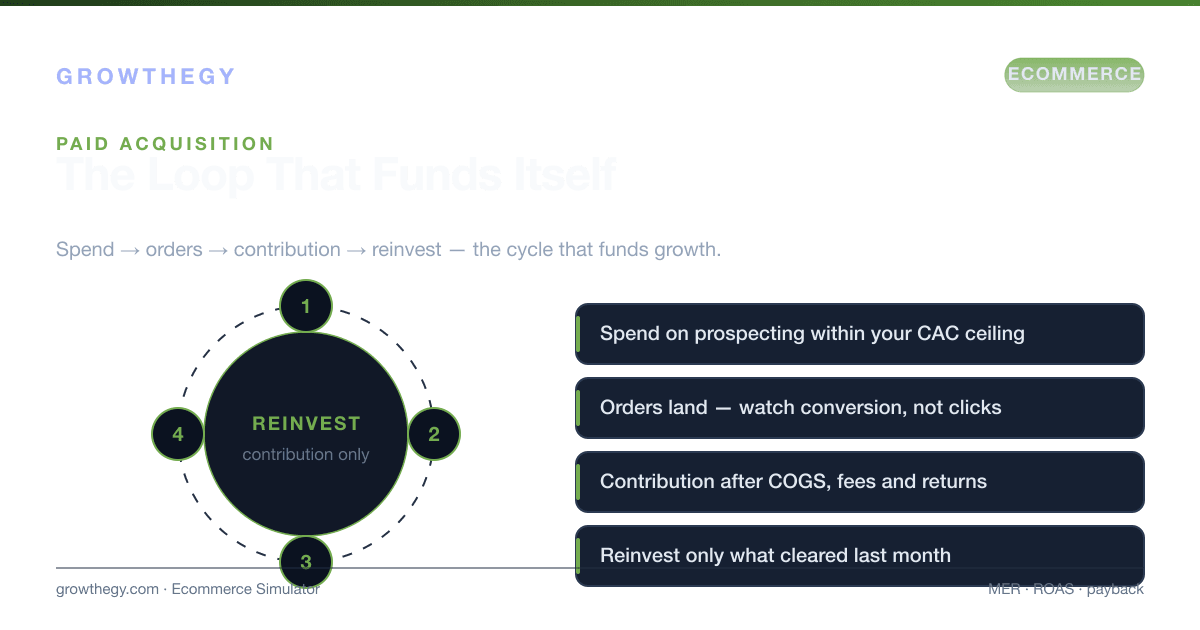
The paid acquisition loop for ecommerce: spend → orders → contribution → reinvest, payback and cash constraints, where the loop breaks, and MER/ROAS thresholds.
Key takeaways
- The Paid Acquisition Loop: How Ecommerce Brands Reinvest Contribution Margin … — focus on one metric or lever at a time; validate with data before scaling spend.
On this topic: Ecommerce Simulator · Meta Ads for Ecommerce: What 100+ Studies Say Works, Customer Metrics — Hub (LTV, CAC, Churn)
The paid acquisition loop is how growth brands turn ad spend into more ad spend: money out → orders in → contribution margin recovered → reinvest. It sounds automatic. It is not. The loop only compounds while contribution margin, CAC, and cash payback stay aligned. This article defines the loop, walks a worked example, shows where it breaks, and ties thresholds to MER and blended ROAS.
Loop definition: spend → orders → contribution → reinvest
Start with paid media. Spend buys sessions and, if the funnel works, orders. Each order should leave contribution after COGS, shipping, payment fees, and expected returns—not just gross revenue. That contribution, plus any working capital you choose to advance, funds the next flight of ads. Close the loop: reinvest. Open the loop: hold cash, fix the unit, or shift to retention.
Acquisition teams often narrate only the top half (spend → ROAS → revenue). Finance cares about the bottom half (contribution → cash → payback period). The paid acquisition loop is the full circuit. If you optimize ROAS while contribution collapses, you are spinning a vanity flywheel.
Payback and the cash constraint
Payback in orders ≈ CAC ÷ contribution margin per order. If CAC is $45 and contribution is $30, you need about 1.5 contributing orders before that customer is “even.” If only 35% of new buyers ever place a second order, most of the cohort never pays back—no matter how pretty last week’s ROAS looked.
Cash is the hard gate. Even a loop that pays back in 60 days can kill you if inventory and ad bills land in 7. The loop is not “infinite ROAS”; it is “can we float the gap?” Brands that ignore float scale into a cash crunch with a healthy-looking dashboard. Model the gap before you raise budgets.
Worked example
Suppose a replenishment brand: $70 AOV, $28 contribution per order after variable costs, $40 blended CAC on prospecting, 40% of new buyers place a second contributing order inside 90 days, almost nobody buys a third yet in that window.
- First-order contribution: $28 against $40 CAC → −$12 on day zero.
- Expected 90-day contributing orders per acquired buyer ≈ 1.0 + 0.4 = 1.4 → contribution LTV ≈ $39.20.
- LTV − CAC ≈ −$0.80: the average prospecting buyer is roughly flat to slightly underwater at 90 days.
At this point the loop is fragile. Reinvesting every dollar of last month’s contribution into more of the same prospecting mix scales a break-even machine. Better moves: lift contribution ($2–3 via shipping or mix), cut CAC with creative/landing work, or raise 90-day repeat so LTV clears CAC—then reopen the reinvest spigot. Practice the trade-offs in the Ecommerce Simulator before you spend.
Where the loop breaks
CAC creep
Auction inflation, broader targeting, and creative fatigue lift CPA. If AOV and conversion stay flat, payback stretches until cash cannot float it. The fix is not “more budget”; it is a better unit or a narrower efficient volume.
Margin compression
Sitewide discounts, free-shipping thresholds that destroy contribution, and rising return rates all shrink the dollars available to reinvest. Revenue can rise while the loop starves.
Returns and quality
A refund is a reverse order on the loop. High refund categories need contribution math that already embeds expected returns—otherwise you reinvest phantom margin.
Retention failure
If payback needs a second order you do not get, acquisition spend is the wrong lever. See the retention playbook and the retention-vs-acquisition simulator scenario.
MER, ROAS, and thresholds
Channel ROAS answers “did this campaign return revenue on ad spend?” Blended ROAS averages channels. Neither equals profit. Marketing efficiency ratio (MER) is total revenue ÷ total marketing spend across channels—useful as a company-level pulse. A rough break-even MER often sits near 1 / contribution margin % (if CM is 40%, break-even MER ≈ 2.5×), before fixed costs and growth ambitions. Above that band you may have room to feed the loop; below it, stop scaling and repair contribution or CAC.
Practical rule: use ROAS to debug channels, MER to sanity-check the whole marketing load, and contribution + payback to decide reinvestment. Never raise spend on ROAS alone when MER and cash are flashing red.
When to stop feeding the loop
- Incremental CAC payback exceeds your cash float.
- Contribution per order falls below the level implied by your MER and payback targets.
- Cohort LTV (contribution) no longer clears CAC for the channels you are scaling.
- Creative tests no longer move CPA, and you are only buying volume at a worse unit.
Stopping is not failure. It is how healthy brands protect the unit so the loop can restart. Park budget at last month’s efficient volume, fix margin or retention, then reinvest.
Reinvest rules of thumb
A simple operating policy many DTC teams use (then customize):
- Define a maximum prospecting CAC from contribution and expected repeat (from your cohorts, not a podcast benchmark).
- Cap weekly spend so that even if conversion dips 20%, cash runway still covers inventory and payroll float.
- Reinvest only the contribution that cleared last month’s efficient volume—not every revenue dollar.
- Hold a “repair budget” for creative, landing, and retention tests that do not require scaling volume.
That policy turns the loop from a mood (“we feel good about ROAS”) into a rule (“we may reinvest X because payback and MER cleared Y”). Write the rule where finance and growth both see it.
Loop vs brand and lifecycle spend
Not every marketing dollar is loop fuel. Brand, content, and lifecycle often support the numerator of MER without showing a clean campaign ROAS. Starving them to juice short-term ROAS can break the loop two months later when organic and email soft. Account for that in the denominator and in the reinvest rule: some spend is maintenance of the machine, not gasoline for this week’s auction.
Affiliate and retail doors can also distort the story if they land in revenue without matching acquisition cost definitions. Segment the loop by channel family so wholesale spikes do not unlock Meta budgets they did not earn.
Operating cadence
Weekly: contribution per order, CAC by channel, MER, cash runway. Monthly: cohort LTV and payback by acquisition source. Quarterly: decide whether the loop deserves more capital or whether activation and retention deserve the next dollar (see activation and acquisition hubs). For channel mix context, read common budget splits by channel. For practice without real spend, run a few turns in the Ecommerce Simulator focusing on cash after each “reinvest” decision.
The paid acquisition loop is a cash engine, not a slogan. Keep contribution honest, payback inside float, and MER/ROAS in their proper jobs—and reinvest only when the unit earns it. If someone asks “what is the paid acquisition loop?” in your next planning meeting, answer with the circuit and the kill criteria—not with a ROAS screenshot.