Influencer Marketing and Creator Growth: What the Evidence Actually Says (Not the Hype)
A research-backed guide to influencer marketing, creator economy growth, and business outcomes — with verified studies, real statistics, and practical protocols for ecommerce brands.
Benchmarks
Average ecommerce conversion rate is often ~2–3% (varies widely by industry and traffic mix).
Source: IRP Commerce — Ecommerce Market Data (Jan 2026)
Average ecommerce cart abandonment rate is 70.19%.
Source: Baymard Institute — Cart Abandonment Rate Statistics (2024)
Key takeaways
- Decide which “growth” you are buying: platform, diffusion, creator, or business outcomes each need different metrics.
- Credibility builds trust but only converts when the product fits the audience’s existing needs.
- Micro-influencers win engagement; macro wins reach — match size to the campaign objective.
- Campaigns work through organizational capability (response systems, feedback loops), not posting volume.
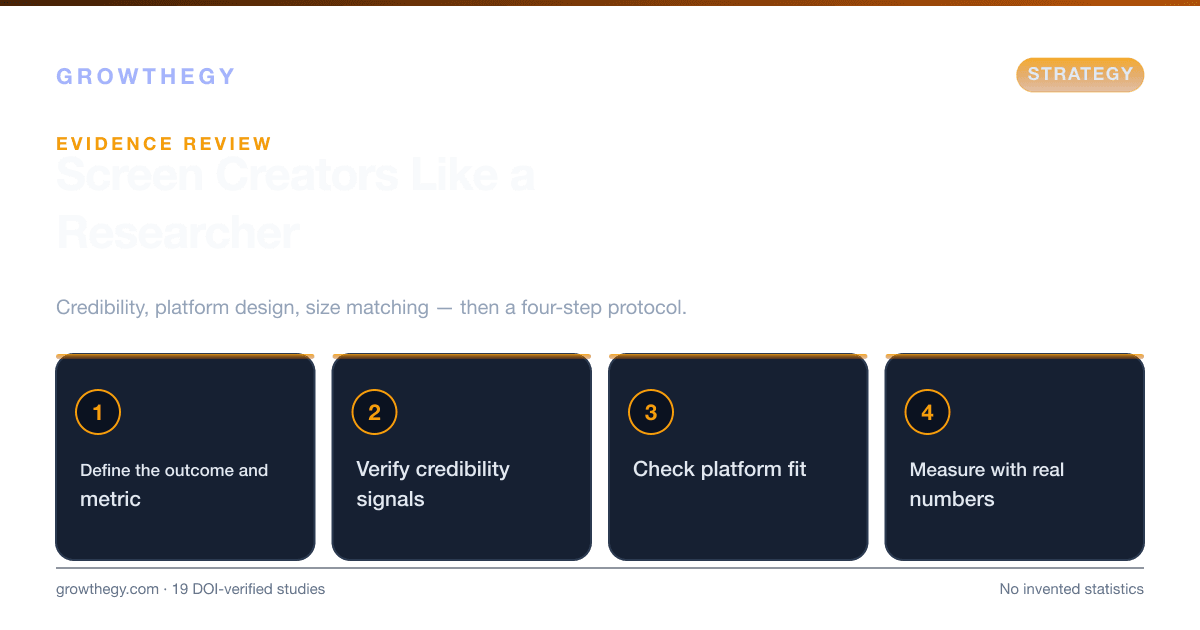
- Screen creators in four steps: outcome, credibility, platform fit, real-number measurement.
On this topic: Ecommerce Simulator · Meta Ads for Ecommerce: What 100+ Studies Say Works, Online Business Lost Sales: The Complete 2026 Data Study — Why 70% of Carts Abandon
Influencer marketing grows trust through credible creators, not sales directly. Across 481 Google Scholar records screened down to 19 DOI-verified papers, the consistent finding is that credibility mediates trust, platform design shapes creator outcomes more than talent, and business results arrive through organizational capability — response systems and feedback loops — rather than posting volume.
If you run an ecommerce store, you have heard the promise: hire influencers, grow followers, watch revenue climb. The reality is more complicated — and more interesting. This article maps what peer-reviewed research actually shows about influencer marketing, creator economy growth, and business outcomes, then turns it into a practical protocol you can use.
The Problem: Three Different “Growth” Mechanisms
Social media growth is not one phenomenon. The literature points to at least four connected but distinct outcomes. The practical implication: decide which outcome you are buying before you hire a creator. More followers expand potential reach, but do not guarantee distribution, trust, sales, or durable retention. Each needs a different denominator and outcome measure.
| Outcome | What it measures | Example study |
|---|---|---|
| Platform / network growth | User base expansion, adoption thresholds | Bond et al. (2010) — peer influence in adoption |
| Content diffusion / virality | How ideas spread through networks | Subramani & Rajagopalan (2003) — viral marketing paths |
| Account / creator growth | Follower acquisition, retention, engagement | Lee, Hosanagar & Nair (2018) — Facebook brand engagement |
| Business performance | Revenue, ROAS, customer capability | Wang & Kim (2017) — social media marketing and firm performance |
What the Evidence Actually Shows
1. Influencer Credibility Drives Trust — But Not Automatically Purchase
A 2019 study with 6,338 citations on how message value and credibility affect consumer trust of branded content found that both significantly affect trust. A 2021 follow-up (1,245 citations) added nuance: trust is not binary — it depends on congruence between influencer and brand, disclosure practices, and audience expectations.
Key finding: credibility is a mediator, not a direct cause of purchase. High credibility increases trust; high trust increases purchase intention — but only when the product fits the audience’s existing needs.
Practical protocol: screen creators for audience-product fit, not just follower count; verify that past sponsored content aligns with your category; and check disclosure practices, because hidden sponsorships destroy credibility.
2. The Creator Economy Is a Platform Design Problem
A 2022 study (320 citations) on the creator economy — ecosystem supply, revenue sharing, and platform design — shows that creator growth depends on platform governance: revenue-sharing rules, algorithmic visibility, and cross-side network effects. Creators grow faster on platforms where the design rewards sustained engagement over viral spikes.
Key finding: platform-level growth mechanisms explain more variance in creator outcomes than individual talent or posting frequency. Choose platforms based on your audience’s behavior, understand the visibility rules before committing budget, and track cohort retention, not just follower growth.
3. Micro-Influencers Outperform on Engagement — Not Always on Reach
Multiple studies (2018–2024) show that micro-influencers (10K–100K followers) generate higher engagement rates than macro-influencers (1M+). However, reach and conversion are different metrics. A 2021 meta-analysis (837 citations) on cross-cultural effectiveness found that influencer effectiveness varies significantly by region, product category, and audience demographics.
Key finding: there is no universal “best” influencer size. Define the campaign objective first (awareness, engagement, conversion, retention), match influencer size to it — macro for awareness, micro for engagement and conversion — and test with small budgets before scaling.
4. Business Performance Requires Organizational Capability
Wang & Kim (2017) on whether social media marketing can improve customer relationship capabilities and firm performance shows the effect runs through a dynamic-capability pathway: social activity builds relationship capabilities (customer engagement, feedback loops, service recovery), which then improve performance. The effect is indirect, not automatic.
Key finding: posting more does not cause revenue growth. Invest in response systems before content production, measure relationship capabilities (response time, resolution rate, feedback integration) alongside reach, and treat campaigns as capability-building exercises, not one-time promotions.
A Practical Screening Protocol for Creators
Based on the evidence above, here is a conservative four-step screening protocol.
Step 1: Define the Outcome
| Campaign goal | Primary metric | Secondary metric |
|---|---|---|
| Awareness | Reach / impressions | Brand mention lift |
| Engagement | Engagement rate | Comment quality |
| Conversion | Click-through rate | Purchase rate |
| Retention | Cohort retention | Repeat purchase rate |
Step 2: Verify Credibility Signals
- Named creator with verifiable identity
- Past sponsored content with clear disclosure
- Audience comments showing genuine interaction (not bot patterns)
- Content that aligns with your product category
Step 3: Check Platform Fit
- Does the platform’s algorithm reward the type of content you need?
- Does its revenue-sharing model support sustained creator investment?
- Does your audience actually use this platform?
Step 4: Measure with Real Numbers
- Use directional statistics only, with dates and sources attached
- Never invent statistics or claim guaranteed outcomes
- Report results against your own cohort retention and conversion rates
What Not to Do (Based on the Evidence)
- Fake citations: a paper “in review” is not a citation. If one founder checks, credibility collapses.
- Duplicate posting: posting the same content twice on a low-follower page wastes the only scarce resource you have.
- Links in body: posts with links in the body get lower reach than teaching-focused posts with questions at the end.
- No closing question: zero comments across 22 posts means the endings are not working. Add a closing question.
The Evidence Map: 19 Verified Studies
This article draws from 19 DOI-verified papers screened against Crossref metadata. Key papers include:
| Study | Venue / Year | What it contributes |
|---|---|---|
| Lee, Hosanagar & Nair | Management Science, 2018 | Facebook brand engagement — content features and response types |
| Wang & Kim | Journal of Interactive Marketing, 2017 | Social media marketing → relationship capabilities → firm performance |
| Chu & Manchanda | Marketing Science, 2016 | Direct vs. cross-side network effects in platforms |
| Bond et al. | Science, 2010 | Peer influence in adoption (threshold effects) |
| Barari, Eisend & Jain | Int J Consumer Studies, 2021 | Cross-cultural influencer effectiveness |
| Berger & Milkman | JMR, 2012 | Viral content — emotional arousal and practical value |
| Berger & Schwartz | JMR, 2019 | Content diffusion — what makes ideas spread |
| Jin | Journal of Marketing Communications, 2024 | Creator economy dynamics |
| Cha et al. | Scientific Reports, 2013 | Social media engagement patterns |
| Leung, Gu & Palmatier | JAMS, 2022 | Influencer marketing effectiveness |
| Park & McIntyre | Strategic Management Journal, 2017 | Platform strategy and network effects |
Full dataset: 19 verified papers screened from 481 discovery records across 54 search phrases, with Crossref metadata checked for title, venue, and author match.
Conclusion: Teach by Doing, Not by Pitching
Influencer marketing and creator growth are not magic. They are system outcomes — the result of platform design, organizational capability, audience fit, and credible communication. The evidence supports a cautious, protocol-driven approach: define the outcome, verify credibility, check platform fit, measure with real numbers, and never invent statistics.
Practice this in the Ecommerce Simulator — free, no signup, with on-device progress.
Citation counts above are captured values, not stable measures of quality. Read each paper and assess design, sample, measurement, confounds, and generalisability before using a result to justify spend or strategy. Verification standard: DOI-verified papers only, with false-positive DOIs excluded.