Does a lenient return policy increase ecommerce revenue?
Return policy leniency — Yes—when designed well. A 21-study meta-analysis found leniency lifts purchases more than returns; Petersen & Kumar showed returners often have higher lifetime value. Extend windows toward 60 days, offer full refunds with low friction, surface policy on product pages, and measure returner cohorts—not return rate × AOV alone.
Benchmarks
Average ecommerce conversion rate is often ~2–3% (varies widely by industry and traffic mix).
Source: IRP Commerce — Ecommerce Market Data (Jan 2026)
Key takeaways
- Customers who return products often have higher lifetime value than those who never return (Petersen & Kumar, 2009).
- Across 21 studies, lenient policies increase purchases more than returns (Janakiraman et al., 2016).
- Money and effort leniency drive conversion without proportionally increasing return volume.
- Roughly 81% of shoppers review return policy before buying—surface it on product pages, not only the footer.
- Start with a 60-day window, full refund option, and low-friction process; track returner LTV separately.
On this topic: Ecommerce Simulator · Why Shoppers Don't Buy From You (Even When Your Product Is Great): The Science of Trust in Ecommerce, Online Business Lost Sales: The Complete 2026 Data Study — Why 70% of Carts Abandon
The average Shopify store loses revenue not because of bad products—but because of a bad return policy. Two landmark studies explain exactly why, and the fix is simpler than you think.
The gut feeling every store owner has (and why it's wrong)
You've probably had this thought: “If I make returns easier, more people will abuse it and I'll lose money.” It's intuitive. It's also wrong.
A decade of academic research across tens of thousands of real customers says the opposite is true. Strict return policies don't protect your revenue—they actively shrink it.Lenient return policies—the ones that feel like a financial risk—consistently produce higher lifetime customer value and higher net revenue. This isn't marketing advice. This is what peer-reviewed science found when they ran the numbers.
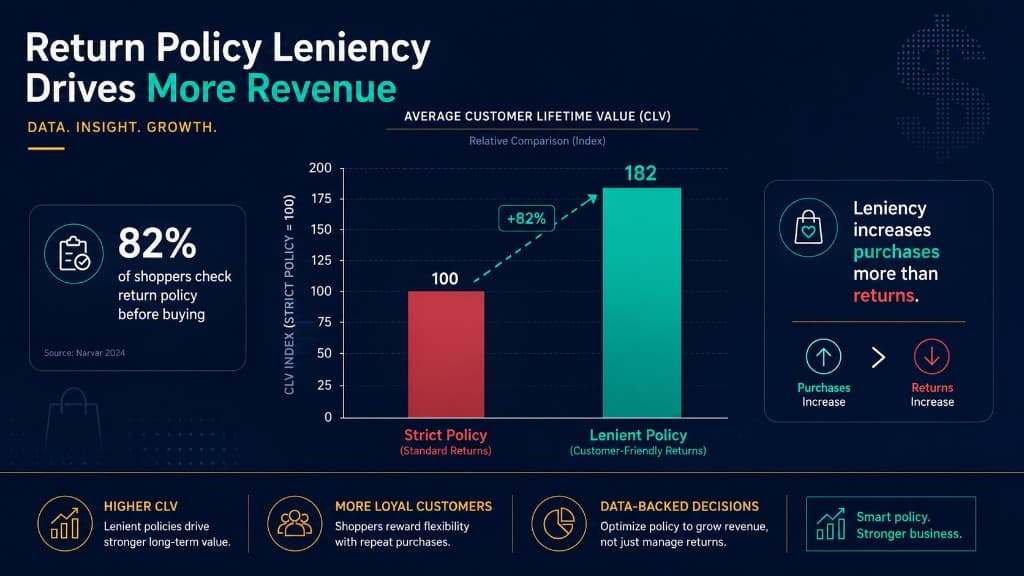
Study #1: The paper that changed how marketers think about returns
In 2009, researchers J. Andrew Petersen and V. Kumar published “Are Product Returns a Necessary Evil? Antecedents and Consequences” in the Journal of Marketing—one of the most rigorous marketing journals in the world.
They wanted to answer a question no one had studied properly: What actually happens to a customer's buying behaviour after they make a return?
The assumption going into the study was intuitive: customers who return things buy less, cost more to serve, and drag down profitability. That assumption was completely wrong.
What they found: Customers who return products go on to spend significantly more over their lifetime than customers who never return anything.
The reason is counterintuitive but makes sense once you hear it. A customer who returns a product is a customer who is highly engaged with your store. They bought, they cared enough about the fit to send it back, and—if your returns process wasn't a nightmare—they trust you enough to buy again. Returns are a signal of intent, not rejection.
The study also found that marketing spend aimed at high-returning customers was proportionally more effective. In other words, the same ad spend produces better ROI when directed at customers with return history compared to customers with none.
The implication for store owners is stark: the customer you're penalising with a strict policy is often your most valuable long-term customer. For LTV mechanics, see how to calculate and use customer lifetime value and the customer retention rate glossary entry.
Study #2: 21 papers, one clear answer
You might be thinking: that's one study, maybe an outlier. In 2016, researchers Narayan Janakiraman, Holly Syrdal, and Ryan Freling published a meta-analysis in the Journal of Retailing—a study of studies. They reviewed 21 academic papers on return policy leniency and purchase behaviour, then ran a quantitative analysis across all of them.
Their title: “The Effect of Return Policy Leniency on Consumer Purchase and Return Decisions: A Meta-Analytic Review.”
The finding, consistent across all 21 papers: leniency increases purchases more than it increases returns. The uplift in buying behaviour from a lenient policy outweighs the cost of additional returns.
They broke return policy leniency into five dimensions—and not all leniency is created equal:
| Dimension | What it means | Effect on purchases | Effect on returns |
|---|---|---|---|
| Money leniency | Full refund vs. partial refund | Increases purchases | Neutral |
| Effort leniency | No forms, no questions asked | Increases purchases | Neutral |
| Time leniency | 60 days vs. 30 days | Increases purchases | Reduces returns |
| Exchange leniency | Cash back vs. store credit only | Increases purchases | Reduces returns |
| Scope leniency | Includes sale items | Moderate increase | Slight increase |
The nuance here is important. Money and effort leniency (the ones that feel like the biggest financial risk) drive purchase behaviour without meaningfully increasing actual returns. Time and exchange leniency do the same—and actually reduce return rates.
The takeaway: a well-designed lenient policy increases conversion without proportionally increasing returns. The math works in your favour.
What the current data looks like in 2025
The academic findings align with where consumer behaviour has landed in 2025:
- The average ecommerce return rate is 20.8%—meaning roughly 1 in 5 online orders is returned regardless of policy strictness
- 82% of consumers say free returns are an important factor when deciding where to shop (up from 76% in 2024)
- 81% of shoppers review the return policy before making a purchase—your return policy is part of your product page conversion funnel, not just post-purchase logistics
- 71% of consumers say a bad return experience would stop them buying again—up from 67% in 2024
- 76%of first-time customers who have a smooth return say they'd come back and buy again
The consumer expectation has shifted. Free, easy returns are no longer a competitive advantage—they're table stakes. The stores that still treat returns as a deterrent are now losing customers to stores that have read this research. Track return economics with our refund rate definition and refund rate benchmarks guide.
The real cost calculation most stores get wrong
Here's where store owners consistently make a maths error. They calculate the cost of returns like this:
Return rate × Average order value = Revenue lost
That's wrong. That's not revenue lost—that's revenue deferred or redirected. A returned item can be restocked, resold, or exchanged. And the customer who returned it—per Petersen & Kumar—is statistically likely to buy again.
The actual cost equation should look like this:
(Return processing cost) + (Unsaleable inventory cost) − (Repeat purchase value of returning customers)
When you run it that way, the net number for most stores is far smaller than the gut-feel version—and in many cases, it tips positive. The stores losing money on returns are usually losing it on how they handle returns (slow refunds, poor communication, no exchange upsell), not on the policy itself. For post-purchase fixes, see post-purchase experience optimization for DTC brands.
What the research says a “good” return policy actually looks like
Based on the Janakiraman et al. meta-analysis, these are the elements that maximise purchase conversion without blowing out return rates:
Do these (they increase purchases without increasing returns)
- Offer a full cash refund, not store credit only
- Remove friction—no forms, no lengthy RMA processes, no “email us first”
- Extend your return window to 60 days minimum (counterintuitively, longer windows reduce return rates because the urgency to decide goes away)
- Accept returns on sale items—the scope signal matters to buyers at the moment of purchase
Watch these (they can increase both purchases and returns)
- Free return shipping—massive conversion driver, but does increase return volume; consider a hybrid model (free for exchanges, paid for refunds)
- No-questions-asked policy—great for conversion, but pairs well with soft friction like “help us improve” optional feedback
The optimal structure for most Shopify and WooCommerce stores based on the research: 60-day return window, full refund option, exchange-first with incentive (e.g. store credit bonus), low-effort process.
Why this matters more for small stores than big ones
Amazon, Zappos, and ASOS already know this research. They built their entire customer retention playbook around it. Zappos famously offered a 365-day return window—and built one of the most loyal customer bases in ecommerce history before being acquired by Amazon.
Small Shopify and WooCommerce stores are often the last to adopt what large retailers learned years ago, because the fear of returns feels proportionally larger when margins are tighter. But the research is not size-dependent. The customer psychology Petersen & Kumar identified applies whether you're doing $10K/month or $10M/month.
The store doing $50K/year with a “14-day returns, original packaging required, store credit only” policy is leaving conversion—and repeat purchase revenue—on the table every single day. Pair policy changes with a retention strategy framework and trust signals from the science of trust in ecommerce.
Practical steps to implement this week
- Audit your current policy against the five dimensions—Score yourself on time, money, effort, scope, and exchange leniency. Every dimension where you're restrictive is a measured friction point on your conversion rate.
- Extend your return window first—It has the highest purchase-to-return ratio of any policy change. Going from 30 to 60 days is almost free to implement and delivers measurable conversion lift.
- Add a full refund option—Even if you promote exchanges, giving customers the option of a full refund increases the likelihood they'll buy in the first place—and most will still choose the exchange if you make it attractive.
- Put your return policy on your product pages—81% of shoppers check it before buying. If they have to hunt for it, you're losing conversions before they even add to cart. See checkout flow optimization beyond cart abandonment for where trust copy belongs in the funnel.
- Track your returner segment separately in your analytics—Following Petersen & Kumar's insight, identify customers who've made returns and measure their LTV separately. You'll likely find they're your best long-term customers, which changes how you should market to them.
Rehearse margin and repeat-purchase assumptions with the Ecommerce Simulator after you change policy and messaging.
The bottom line
Two of the most rigorous studies ever published on ecommerce returns reached the same conclusion: A lenient return policy increases revenue. A strict return policy decreases it.
The mechanism is not mysterious. Buyers take on risk when they can't touch a product before purchasing. Your return policy is the instrument that reduces that perceived risk. The lower the risk, the higher the conversion. And the customers most willing to engage with that risk reduction—the ones who do return things—turn out to be your most valuable long-term buyers.
The stores that figured this out years ago are your biggest competitors. The ones that haven't are still calculating returns as a cost centre instead of a customer acquisition tool.
Sources: Petersen, J.A. & Kumar, V. (2009). “Are Product Returns a Necessary Evil? Antecedents and Consequences.” Journal of Marketing, 73(3), 35–51. | Janakiraman, N., Syrdal, H.A. & Freling, R. (2016). “The Effect of Return Policy Leniency on Consumer Purchase and Return Decisions: A Meta-Analytic Review.” Journal of Retailing, 92(2), 226–235. | National Retail Federation Consumer Returns Report 2024 | NRF & Happy Returns 2025.