How do anchoring and decoy pricing change what customers pay?
Pricing psychology — Shoppers judge price against the first reference they see and against nearby options—not intrinsic value. Credible high anchors (compare-at, top tier) plus a dominated middle tier priced like your target can steer most buyers to Premium without discounts—when comparisons are visible and anchors are believable.
Benchmarks
Average ecommerce conversion rate is often ~2–3% (varies widely by industry and traffic mix).
Source: IRP Commerce — Ecommerce Market Data (Jan 2026)
Average ecommerce cart abandonment rate is 70.19%.
Source: Baymard Institute — Cart Abandonment Rate Statistics (2024)
Key takeaways
- Willingness to pay is anchored by the first numbers shoppers see—not by “objective” product value (Ariely et al., 2003).
- A dominated middle tier priced like Premium can shift most buyers to Premium—the Economist bundle jumped from 32% to 84% with a decoy present.
- Combine high anchors first, then a visible decoy, with your target as the sensible middle (Williams-Sonoma bread-maker pattern).
- Fake or hidden anchors destroy the effect; feature comparison tables are required for asymmetric dominance to fire.
On this topic: Ecommerce Simulator · Online Business Lost Sales: The Complete 2026 Data Study — Why 70% of Carts Abandon, Your Return Policy Is Either Making or Losing You Money — Here's What the Science Actually Says
Two Nobel-adjacent studies revealed that the price customers are willing to pay has almost nothing to do with the product's actual value. Here's what the research says, and how to use it in your store.
The price in your customer's head isn't the one on your page
When a customer lands on your product page, they don't evaluate your price objectively. They can't. The human brain doesn't work that way.
What they actually do—every single time—is compare your price to the most recent number they encountered, ask themselves if the options in front of them feel like a good deal relative to each other, and make a decision they believe is rational but isn't.
Two of the most replicated findings in behavioural economics explain exactly how this works. Both have direct, testable implications for how you structure your pricing page, your product bundles, and your pricing tiers.
Finding #1: Your customers' willingness to pay is arbitrary—but consistent
In 2003, behavioural economists Dan Ariely, George Loewenstein, and Drazen Prelec published a paper in The Quarterly Journal of Economicstitled “Coherent Arbitrariness: Stable Demand Curves Without Stable Preferences.” It has since accumulated over 3,000 academic citations and is required reading in virtually every behavioural economics course worldwide.
The paper's central claim is alarming for anyone who believes pricing works on logic: initial valuations of familiar products and simple experiences are strongly influenced by arbitrary anchors—numbers that have no rational connection to the product being priced—and yet subsequent valuations remain internally consistent, creating a convincing illusion of ordered, stable preferences.
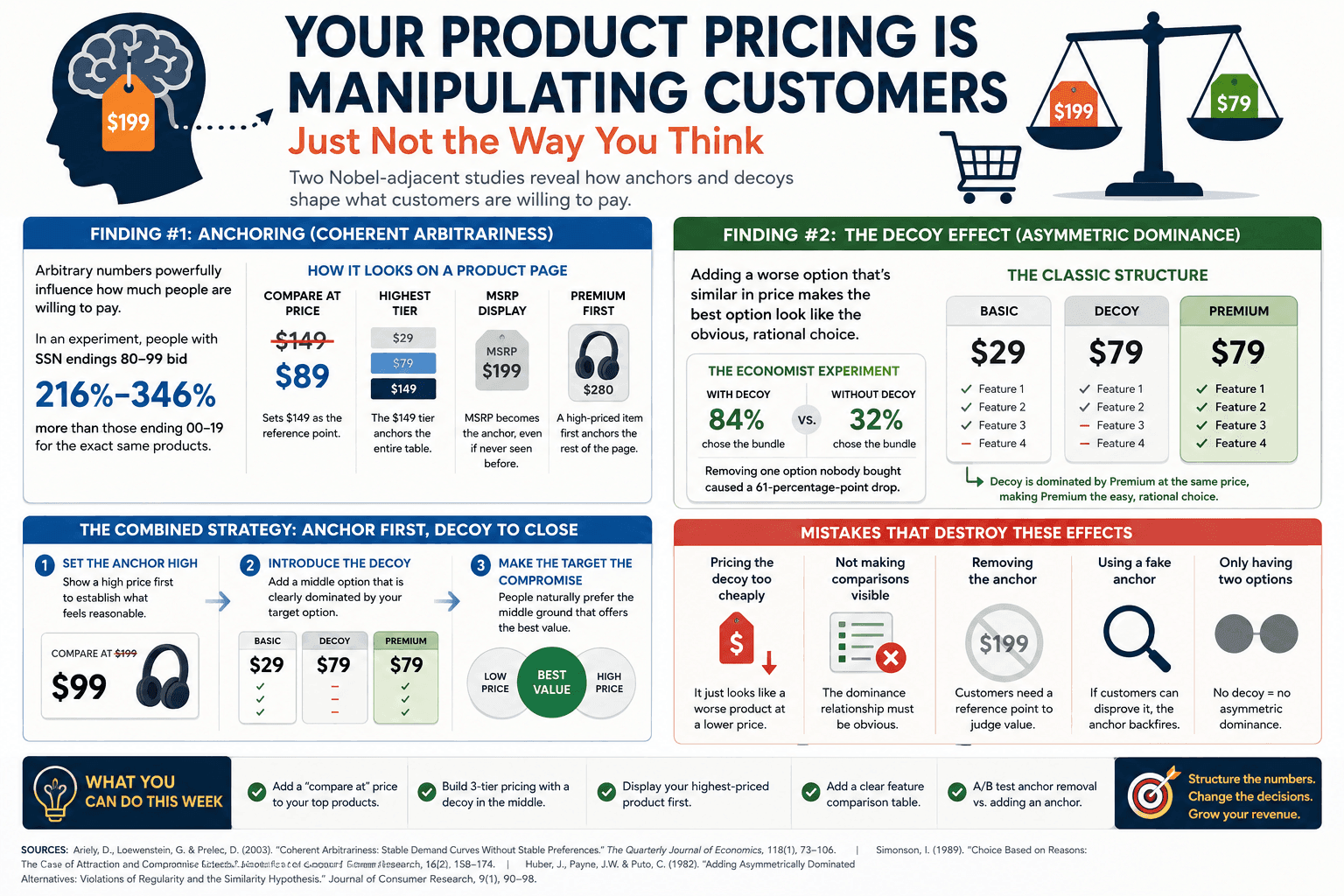
Their most famous experiment: participants wrote down the last two digits of their Social Security number, then bid on everyday products at auction—wine, computer peripherals, books, chocolates. Participants with Social Security numbers ending in 80–99 bid between 216% and 346% more than those with numbers ending in 00–19. A number with zero relevance to the product determined how much people were willing to pay for it.
What makes this more than a lab curiosity is the “coherent” part of coherent arbitrariness. The experiments showed that the anchoring effect cannot be interpreted as a rational response to information, does not decrease as a result of experience with a product, is not necessarily reduced by market forces, and is not unique to cash prices.
In plain terms: customers who've bought from you before are just as susceptible to anchoring as first-time visitors. Showing them a higher number first still works, every time.
The ecommerce implication is direct.The first price a customer sees on your page—the original price, the “compare at” figure, the highest tier in your pricing table—becomes the anchor against which everything else is evaluated. The price itself is not necessarily the anchor; rather, the anchor is the reference point that drives subsequent decision-making, which retailers can control through how they display pricing.
What anchoring looks like on a real product page
These aren't theoretical—they're anchoring mechanics in active use across ecommerce:
The “compare at” price
Showing $149 $89doesn't just communicate a discount. It sets $149 as the reference point, making $89 feel like a bargain even if the product has never actually sold for $149. The anchor is the number that was never real—when it is credible.
The highest pricing tier
On a pricing page with three tiers at $29, $79, and $149, the $149 tier functions primarily as an anchor. It makes $79 look reasonable, even if the $79 plan is where you actually want most customers to land. Many SaaS companies design their most expensive tier specifically to anchor the middle tier.
MSRP display
The manufacturer's suggested retail price on many product pages functions as the anchor that drives subsequent decision-making—the MSRP becomes the consumer's reference point even when they've never encountered it before.
The high-priced “premium” product first
Displaying your most expensive product at the top of a collection page anchors every subsequent product in the scroll. A $120 item feels moderate after a customer has already seen one priced at $280. For more tactics that lift basket size without blanket discounts, see 17 ways to increase AOV without heavy discounts.
Finding #2: Adding a worse option makes people buy the better one
The second piece of research is arguably even more directly actionable.
In 1989, Stanford professor Itamar Simonson published “Choice Based on Reasons: The Case of Attraction and Compromise Effects” in the Journal of Consumer Research—now cited over 2,500 times. It established what became known as the decoy effect (also called the asymmetric dominance effect).
The core finding: when individuals face an uncertain choice between two options, introducing a third option that is clearly inferior to one of the original two—but not clearly inferior to the other—dramatically increases preference for the option it resembles most.
The decoy doesn't win. Nobody buys it. But its presence alone shifts the market share of the target option, often dramatically.
The mechanism Simonson identified: individuals seek to justify their choices under uncertainty, especially when they may be evaluated externally. A target option becomes more attractive when its superiority over the decoy is unambiguous, making the target feel like a logical, defensible choice.
The experiment every pricing strategist knows
Dan Ariely documented a real-world pricing experiment involving The Economist's subscription options. Option A was digital only for $59. Option B was print only for $125. Option C was print and digital combined for $125. With all three options present, 84% of participants chose Option C. When Option B—the print-only option priced identically to the print-and-digital bundle—was removed, only 32% chose the print-and-digital bundle.
The print-only option at $125 was the decoy. Nobody wanted it. But its existence made the print-and-digital bundle at the same price look irrational to refuse. Removing it cut conversion on the bundle from 84% to 32%—a 61-percentage-point collapse from the absence of a single option nobody was buying.
This is the asymmetric dominance effect operating in a commercial setting, exactly as Simonson described it.
The Williams-Sonoma case: where it was first observed in retail
The Williams-Sonoma bread maker story is the most cited anchoring and decoy case study in pricing literature. When Williams-Sonoma introduced a $429 bread maker alongside their existing $279 model, sales of the $279 model nearly doubled—not because anything changed about the $279 product, but because the $429 option made it look reasonably priced by comparison.
The $429 bread maker served a dual function: it was both an anchor (making $279 feel moderate) and a decoy (being dominated by the $279 model on value-per-dollar, it justified choosing the $279 as the sensible middle ground).
How the decoy effect works structurally
The asymmetric dominance effect emerges most reliably when: the decoy is not too undesirable, the dominance relationship is easy to identify, each attribute carries roughly equal importance in the decision, and the buyer is nearly indifferent between the two main options.
That last condition—near indifference—is why the decoy effect is so powerful in ecommerce. When a customer is on the fence between your basic and premium product, the right decoy can resolve the decision in under a second without the customer consciously registering what happened.
Structure it like this:
| Option | Price | What it does |
|---|---|---|
| Basic | $29 | The entry-level choice |
| Decoy | $79 | Priced like Premium, but worse features than both |
| Premium | $79 | Dominated by nothing—looks like the obvious choice |
The decoy shares a price with the Premium tier but offers fewer features. Anyone comparing the two immediately sees Premium as the rational pick. The Basic tier stays as an anchor floor. Most buyers land on Premium—which is where you wanted them.
The combined strategy: anchor first, decoy to close
The two effects work in sequence. Anchoring sets the ceiling of what feels reasonable. The decoy then guides the customer toward your target product once they're evaluating options within that ceiling.
A practical three-step structure for a Shopify product page or pricing table:
- Step 1 — Set the anchor high.Your highest-priced option or “compare at” price should appear first or prominently. This establishes the reference frame. A customer who sees $199 first will evaluate $99 very differently than one who sees $99 first.
- Step 2 — Introduce the decoy.Create a middle option that is clearly dominated by your target option on value, but priced similarly or identically. Its job is not to sell—it's to make your target look like the obvious rational choice.
- Step 3 — Make the target product the “compromise” option.Simonson's research specifically identified a compromise effect alongside the attraction effect: people systematically prefer options that feel like the middle ground. Your target product should sit between extremes—not the cheapest, not the most expensive, but the one with the best visible value-per-dollar relative to the decoy.
Common mistakes that destroy these effects
Pricing the decoy too cheaply.If the decoy is much cheaper than the target, it doesn't create asymmetric dominance—it just looks like a worse product at a lower price, which is rational and unsurprising. The effect works when the decoy is priced similarly to the target but offers less.
Not making the comparison attributes visible.The asymmetric dominance effect only emerges when the attributes of the alternatives are numerically represented and the dominance relationship is easy to identify. If your feature comparison isn't clear, the decoy can't do its job.
Removing the anchor.J.C. Penney tried this in 2012. Their shift from a high-low pricing model with frequent promotions to everyday “fair pricing”—removing all sale price anchors—led to a significant drop in perceived value and consumer trust, contributing to a collapse in revenue. Customers didn't experience lower prices as good deals without a reference point. They just experienced lower prices.
Using a fake anchor customers can disprove.If your “compare at $149” price is something customers can Google and find the real retail price in seconds, the anchor backfires. Anchors need to feel credible to hold. Pair pricing psychology with trust signals research so framing never undermines safety.
What this means for your pricing page this week
Immediate actions based on the research:
- Add a “compare at” price to your top 5 products. Even if modest, it sets the reference frame and directly affects perceived value.
- Review your pricing tiers. If you only have two tiers, you have no decoy. Three tiers structured correctly (low, dominated-middle, target) outperform two tiers for guiding customers to your preferred price point.
- Display your highest-priced product first on collection pages. Let it anchor the scroll before customers reach the price range you actually want to sell in.
- Add a feature comparison table to pricing pages.The decoy effect requires visible attribute comparisons. If customers can't see clearly that the middle option is dominated, the effect doesn't fire.
- Test anchor removal.If you currently have no anchors at all—straight prices, no was/now formatting—A/B test adding a “compare at” field on your top product. The Ariely research suggests this alone will shift willingness to pay upward.
Stress-test margin impact with the Ecommerce Simulator before rolling tier changes site-wide, and benchmark conversion with our 2026 conversion rate benchmarks.
The bottom line
Customers do not evaluate your price in isolation. They evaluate it relative to the other numbers they've recently seen and the other options sitting next to it. This is not a flaw in human cognition—it is how human cognition works, reliably and consistently, across cultures, income levels, and product categories.
In six experiments, Ariely, Loewenstein and Prelec showed that subsequent valuations remain coherent with respect to salient differences in perceived quality or quantity—creating an entire pattern of valuations that generates an illusion of order, as if driven by stable underlying preferences. The preferences feel real to the customer. They are constructed by context.
Simonson showed that a single additional product option—one that sells nothing—can double the conversion rate of the product next to it.
Both effects are free to implement. Neither requires a discount. Neither cannibalises your margin. They require only that you structure the numbers your customer sees, in the right order, before they make a decision.
Sources: Ariely, D., Loewenstein, G. & Prelec, D. (2003). “Coherent Arbitrariness: Stable Demand Curves Without Stable Preferences.” The Quarterly Journal of Economics, 118(1), 73–106. | Simonson, I. (1989). “Choice Based on Reasons: The Case of Attraction and Compromise Effects.” Journal of Consumer Research, 16(2), 158–174. | Huber, J., Payne, J.W. & Puto, C. (1982). “Adding Asymmetrically Dominated Alternatives: Violations of Regularity and the Similarity Hypothesis.” Journal of Consumer Research, 9(1), 90–98.