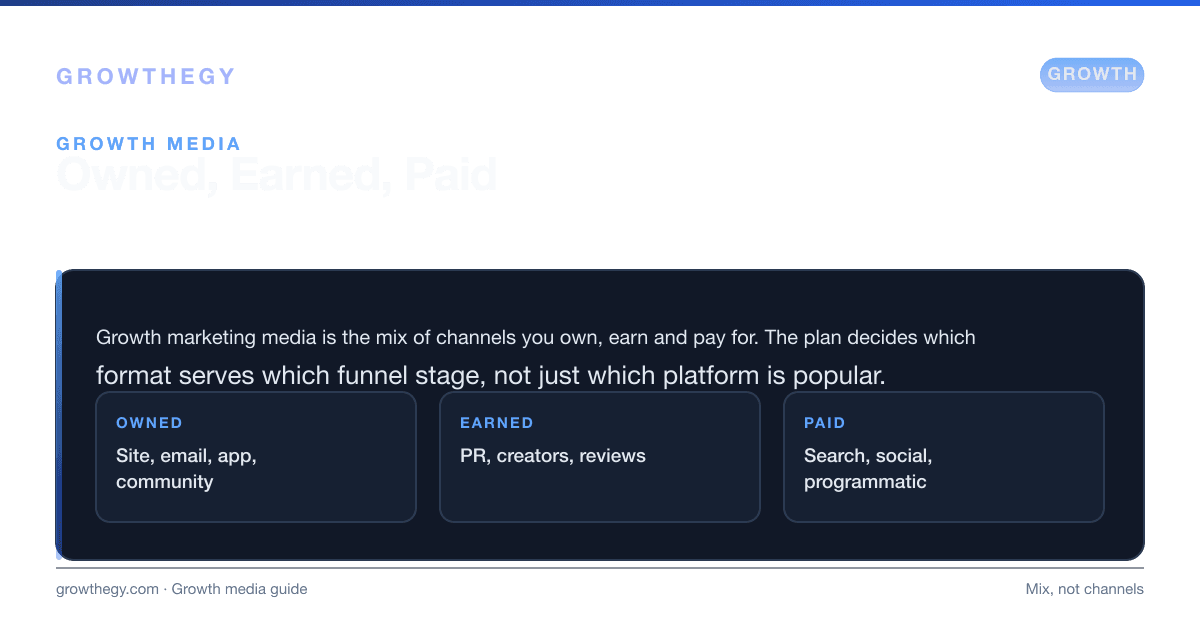
What growth marketing media is, the formats that work (owned, earned, paid), what every growth media plan needs, and how growth marketing differs from a media strategy.
Key takeaways
- Growth Marketing Media: Strategy, Formats & What It Needs — focus on one metric or lever at a time; validate with data before scaling spend.
On this topic: Ecommerce Simulator · What Is Growth Marketing? Definition, Examples & How to Start, The Ultimate Guide to Post-Purchase Experience Optimization for DTC Brands
Growth marketing focuses on experiments and full-funnel impact (acquisition, activation, retention, revenue). Media strategy often focuses on reach, frequency, and channel mix. In practice, growth media is the set of formats and channels—owned, earned, paid—that support that growth. Here's what every growth media setup typically needs and how the formats fit together in 2025.
The distinction matters because teams that confuse the two tend to optimise for the wrong things. A pure media strategy optimises for impressions and reach. A growth media strategy optimises for downstream outcomes—sign-ups, purchases, retention, LTV. Forrester Research's 2024 B2B Marketing Survey found that marketing organisations explicitly aligned to revenue metrics outperform those aligned to media metrics by 2.1× on pipeline contribution and 1.8× on customer acquisition efficiency.
Growth Marketing vs Media Strategy: Key Differences
| Dimension | Media Strategy | Growth Marketing |
|---|---|---|
| Primary goal | Reach, awareness, frequency | Acquisition, activation, retention, revenue |
| Success metric | Impressions, CPM, reach | CAC, LTV, conversion rate, churn |
| Time horizon | Campaign-based (weeks/months) | Ongoing; compound over quarters/years |
| Testing approach | Media mix modelling; brand lift studies | A/B tests, cohort experiments, conversion testing |
| Channel focus | Paid (TV, display, OOH, digital paid) | All: owned, earned, paid—tied to outcomes |
| Attribution | Modelled or survey-based | Multi-touch, cohort-based, blended |
| Audience definition | Broad demographic targeting | Behavioural, intent-based, lookalike |
Formats of Growth Media
Owned: website, blog, email, app. Earned: PR, reviews, UGC, SEO. Paid: search, social, display, video. Each format has a role; growth marketing ties them to metrics (sign-ups, revenue, LTV) rather than just reach or engagement.
Understanding the role of each format in the customer journey—and which stage of the funnel it serves—is the foundation of effective growth media planning. Here is a breakdown of each media type with 2025 performance benchmarks:
| Media Type | Format Examples | Funnel Stage | Avg. ROI Multiple | Cost Structure |
|---|---|---|---|---|
| Owned – Blog / Content | Articles, guides, tools, calculators | Awareness, consideration | 3–6× (HubSpot 2024) | Fixed (time investment) |
| Owned – Email | Newsletters, sequences, lifecycle flows | Retention, expansion | 36:1 (Litmus Email ROI 2024) | Low variable (per send) |
| Owned – App / Product | Push notifications, in-app prompts | Activation, retention | High (product-led) | Near zero marginal |
| Earned – SEO / GEO | Organic rankings, AI citations | Awareness, consideration | 5–12× over 12 months | Fixed (content creation) |
| Earned – PR | Press coverage, podcasts, speaking | Awareness, credibility | Variable; brand-building | Time + agency |
| Earned – UGC / Reviews | Customer posts, review platforms | Consideration, conversion | High (trust signal) | Near zero (orchestration cost) |
| Paid – Search (Google) | Search ads, Shopping ads | Consideration, purchase | 2–4× ROAS (Wordstream 2024) | Variable CPCs |
| Paid – Social (Meta, TikTok) | Feed, Stories, Reels, video ads | Awareness, consideration | 1.5–3× ROAS (average) | Variable CPMs |
| Paid – Video (YouTube) | Pre-roll, discovery ads | Awareness, consideration | Varies; strong for brand recall | Variable CPVs |
What Every Growth Media Setup Needs
Clear goals and a way to measure them (attribution, key events). Consistency in messaging and brand. A balance of channels so you're not over-dependent on one. And a feedback loop: test, measure, scale what works.
Specifically, every effective growth media setup should include:
- A defined North Star Metric tied to business outcomes. Not "impressions" but "qualified sign-ups" or "repeat purchases." Every channel and format should be measurable against this metric, even if indirectly.
- A reliable attribution system. This doesn't need to be perfect, but it needs to be consistent. Even simple last-click attribution with supplementary customer surveys is better than no attribution. As you scale, invest in multi-touch or MMM approaches.
- At least one owned channel with direct audience access. Email is the most resilient owned channel—you own the list, you control the send, and you're not subject to algorithm changes. SMS is the second most effective owned channel, with Klaviyo data showing 98% open rates and 10–30% CTRs for well-segmented sends.
- A content engine that generates organic reach. Whether that's a blog, a YouTube channel, a podcast, or an active LinkedIn presence, you need some form of content that generates discovery without requiring ongoing paid spend. Demand Metric research shows content marketing costs 62% less than outbound marketing and generates 3× as many leads.
- A paid channel for speed and testing. Organic channels compound over time but are slow to start. A modest paid budget allows you to test messaging, audiences, and offers quickly—then apply those learnings to organic content.
- A systematic experiment process. Growth media without experimentation is just spending. Every channel investment should be backed by a hypothesis, measured against a baseline, and reviewed after statistical significance is reached.
Channel ROI Benchmarks by Business Type
The right media mix varies significantly by business model, average order value, and sales cycle length. Here is a directional benchmark based on HubSpot 2024, Wordstream, and Litmus research:
| Business Type | Highest ROI Channel | Second Highest | Watch Out For |
|---|---|---|---|
| D2C Ecommerce | Email / SMS lifecycle | Paid social (Meta) | Over-reliance on Meta as iOS privacy continues to affect targeting |
| SaaS (self-serve) | Content / SEO + PLG | Paid search | Long payback periods if CAC targets not set by LTV segment |
| SaaS (sales-led) | Outbound + content | LinkedIn paid | High CPLs on LinkedIn; needs strong ICP targeting |
| Local / service business | Google Search + reviews | Local SEO | Review volume is a ranking factor; need systematic review generation |
| Marketplace | SEO + community | Referral programme | Both sides of marketplace need acquisition; complex attribution |
| Media / content brand | Organic content + newsletter | Social (shorts / reels) | Monetisation lag; need subscriber LTV model from day one |
Building Your Growth Media Stack in 2025
The practical steps to build or audit your growth media setup:
- Audit your current channel mix. What percentage of new customers comes from each channel? What is the CAC and LTV by channel? Which channels have the best LTV:CAC ratio?
- Identify dangerous dependencies. If any single channel accounts for more than 40–50% of your acquisition, you have concentration risk. Start building a second primary channel.
- Invest in owned media foundations. Email list, content library, SEO/GEO-optimised pages. These compound and don't disappear when you stop paying.
- Run quarterly creative and messaging refreshes on paid. Creative fatigue is the #1 cause of declining ROAS on paid social. Fresh creative every 4–6 weeks maintains performance and provides learnings.
- Build a measurement cadence. Weekly channel dashboards, monthly funnel reviews, quarterly strategy retrospectives. Without regular measurement, you're flying blind.
For more on core growth, see core growth strategies and owned media strategies. For a structured view, try our Ecommerce Simulator.