Owned Media Strategy: Examples, Channels & How to Leverage It (2026)
Owned media is the audience and content you control—website, email, blog, community. Examples, channels, and how to expand and leverage owned media in 2026.
Key takeaways
- Owned Media Strategy: Examples, Channels & How to Leverage It — focus on one metric or lever at a time; validate with data before scaling spend.
On this topic: Ecommerce Simulator · TikTok LIVE Growth: The Complete Guide to Growing, Diagnosing and Monetising a Live Channel (2026), Common Marketing Budget Splits by Channel (2025–2026): How DTC Brands Allocate Spend
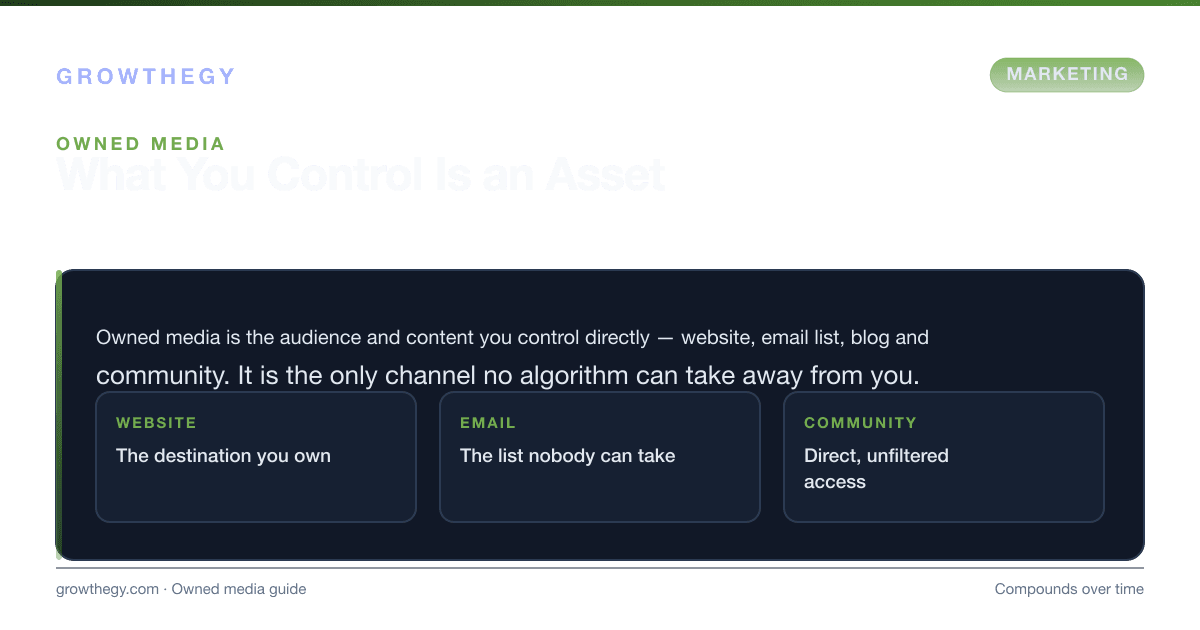
Owned media is the audience and content you control: your website, email list, blog, and community. Unlike paid or earned, you're not at the mercy of algorithm or platform changes. Here are owned media strategies that work in 2025.
The case for building owned media has never been stronger—or more urgent. In 2024, Meta reduced organic reach for business pages to under 2% of followers. X (Twitter) algorithm changes cut publisher referral traffic by 62% year-over-year (Similarweb 2024). Google's Helpful Content updates shifted significant traffic away from content farms and toward authoritative owned properties. The message from every major platform is the same: if you don't own the audience relationship, you don't own the audience.
According to Forrester Research, companies with strong owned media programs—defined as having a high-quality blog, email list of 10,000+ engaged subscribers, and some form of community—generate 3.2x more revenue per marketing dollar than companies dependent on paid and earned media alone. The compounding effect of owned media means that investment made today generates traffic and leads for years, while paid media stops the moment you stop paying.
Owned vs. Paid vs. Earned Media: ROI Comparison
| Media Type | Examples | Avg. 3-Year ROI | Durability | Control Level |
|---|---|---|---|---|
| Owned media | Blog, email list, app, podcast | 748% (HubSpot 2024) | Very high — compounds over time | Full |
| Paid media | Google Ads, Meta Ads, sponsorships | 200–400% (average) | None — stops when budget stops | High but platform-dependent |
| Earned media | Press coverage, social shares, backlinks | Varies widely | Medium — links are durable, press fades | Low — you can't control placement |
| Rented media | Social media followers, YouTube subscribers | Varies — algorithm-dependent | Low — platform controls reach | Very low |
1. Website and Content: Your Owned Media Hub
Your site is the hub. Publish content that answers your audience's questions and ranks (or gets cited) in search and AI. Optimize for both SEO and GEO so you show up in traditional and AI-driven search. Work through our GEO audit checklist on money pages quarterly.
Content marketing on an owned domain remains the highest-ROI long-term marketing investment available. According to HubSpot's 2024 State of Marketing, companies that blog consistently generate 67% more leads per month than companies that don't. SEMrush's 2024 Content Marketing Report found that businesses with 50+ blog posts generate 4.5x more traffic than those with fewer than 20 posts, and businesses with 100+ posts generate 9x more inbound leads.
The compounding nature of content is the key insight. A blog post published in 2023 continues to generate traffic in 2025 and 2026 with no additional investment. Paid ads generate traffic only while you're paying. Over a 3-year period, content marketing costs 62% less than paid advertising and generates 3x as many leads (Content Marketing Institute 2024).
Website Owned Media Strategy: Step-by-Step
- Define your content pillars: Choose 3–5 core topic areas aligned with your audience's needs and your product's value proposition. Every piece of content should map to one of these pillars. Unfocused content dilutes authority; focused content compounds it.
- Create a keyword map: Use SEMrush, Ahrefs, or Google Search Console to identify the specific search queries your audience uses. Map each query to a content format (pillar page, supporting article, FAQ, etc.).
- Publish on a consistent schedule: Consistency signals to both Google and your audience that you're active and authoritative. 2–3 high-quality articles per week outperforms 10 mediocre articles per week. Focus on quality first, then volume.
- Optimize for featured snippets and AI citations: Structure content with clear definitions, numbered steps, and comparison tables. These formats are preferentially cited by Google AI Overviews, Perplexity, and ChatGPT search.
- Update existing content regularly: Pages that are updated regularly rank 43% higher than pages left stagnant (SEMrush 2024). Schedule a quarterly content audit to refresh statistics, update screenshots, and expand thin sections.
2. Email: The Highest-ROI Owned Channel
Email is owned: you have the address and the relationship. Use it for nurture, offers, and retention. Grow the list with clear value (lead magnets, content, exclusives) and segment so messaging stays relevant.
Email marketing delivers the highest ROI of any marketing channel: $36 for every $1 spent, according to Litmus's 2024 State of Email Marketing Report. The key differentiator from social media is ownership—your email list cannot be taken away by an algorithm change or a platform policy update. When Facebook halved organic reach in 2018, businesses with large email lists barely noticed. Those dependent on Facebook pages lost 50% of their audience overnight.
| Email Metric | Industry Average | Top Quartile | Source |
|---|---|---|---|
| Open rate | 21.5% | 35%+ | Mailchimp 2024 |
| Click-through rate | 2.6% | 5%+ | Mailchimp 2024 |
| Revenue per subscriber (monthly) | $1–$5 | $10–$40+ | Klaviyo 2024 |
| List growth rate (monthly) | 2–3% | 5–10%+ | Campaign Monitor 2024 |
| Unsubscribe rate | 0.5% | <0.2% | Mailchimp 2024 |
Email List Growth Strategy
- Create a high-value lead magnet: A specific, immediately useful free resource (template, calculator, checklist, mini-course) in exchange for an email address. The lead magnet should solve one pressing problem your audience has right now.
- Add opt-in opportunities across every owned touchpoint: Blog posts, exit-intent popups, footer signup forms, social media bios, and YouTube video descriptions should all funnel toward your email list.
- Send consistently: Audiences that hear from you regularly are more engaged than those who receive occasional emails. Weekly newsletters build the strongest habit and retention. Klaviyo's 2024 data shows that brands sending 1–4 emails per week generate 2.4x more revenue per subscriber than those sending monthly.
- Segment your list by behavior and interest: Behavioral segmentation (sending different content to buyers vs. non-buyers, engaged vs. unengaged subscribers) lifts email revenue by an average of 59% (DMA 2024).
- Protect your deliverability: Regularly clean your list of unengaged subscribers. A list of 5,000 engaged subscribers generates more revenue than a list of 50,000 unengaged ones—and won't get your domain flagged as spam.
3. SMS: The Underutilized Owned Channel
SMS marketing is the fastest-growing owned channel in 2025. According to Klaviyo's SMS Marketing Report 2024, SMS open rates average 98%—compared to 21% for email. Click-through rates for SMS (19%) are 7x higher than email (2.6%). For time-sensitive offers, event reminders, and flash sales, SMS is unmatched in immediacy and engagement.
The key to SMS success is restraint. Unlike email, where subscribers tolerate 3–5 messages per week, SMS audiences expect 2–4 messages per month maximum. Over-sending leads to immediate unsubscribes and damaged brand relationships. Use SMS for high-urgency, high-value communications: flash sales, order updates, event reminders, and exclusive VIP offers.
4. Community: The Owned Media Multiplier
Forums, groups, or members-only spaces create belonging and repeat engagement. You own the space and the rules. Use it to learn from customers and turn them into advocates.
Brand-owned communities are the most defensible owned media asset because they create switching costs for members. A person who has built relationships, contributed content, and achieved status in your community is dramatically less likely to churn than a transactional customer. According to Higher Logic's 2024 Community Benchmarks Report, businesses with active online communities see 40% higher customer retention, 25% lower support ticket volume, and 2.3x higher customer lifetime value than businesses without communities.
The ROI from community compounds differently from other channels: it reduces customer acquisition cost (members refer others), reduces support cost (members answer each other's questions), and increases retention (members stay because of community relationships, not just product features).
5. Syndication and Referrals: Extending Your Owned Media Reach
Republish or license content elsewhere with a canonical or link back so your site stays the source. Encourage sharing and referrals so more people discover your owned properties. See our guide on content syndication and referral traffic.
The goal of syndication in the context of owned media is to use the audience reach of partner platforms (Medium, LinkedIn, industry publications) as a discovery mechanism that funnels readers back to your owned properties—your website, email list, and community. Every syndicated piece should have a clear next step that brings the reader into your owned ecosystem: a lead magnet offer, a newsletter signup prompt, or a link to your community.
For a broader view of your strategy, try our Ecommerce Simulator.