What are AI-powered growth diagnostics?
AI growth diagnostics — AI-powered diagnostics use models to scan metrics, text, and funnels for anomalies, segments, and hypotheses faster than manual reporting—but outputs need guardrails. Pair AI summaries with your stack data, GEO-ready content checks, and calculator-backed math so recommendations stay margin-aware and auditable.
Benchmarks
Average ecommerce conversion rate is often ~2–3% (varies widely by industry and traffic mix).
Source: IRP Commerce — Ecommerce Market Data (Jan 2026)
Average ecommerce cart abandonment rate is 70.19%.
Source: Baymard Institute — Cart Abandonment Rate Statistics (2024)
Key takeaways
- AI Growth Diagnostics for Ecommerce Brands (2026) — focus on one metric or lever at a time; validate with data before scaling spend.
- Pair reading with the Ecommerce Simulator on Growthegy to practice unit economics and decisions before you spend.
- Bookmark growthegy.com/ecommerce-simulator/ for hands-on scenarios; use the blog for deeper guides.
On this topic: Ecommerce Simulator · Common Marketing Budget Splits by Channel (2025–2026): How DTC Brands Allocate Spend, Omnichannel Attribution Modeling for Ecommerce: A Practical Guide for 2026
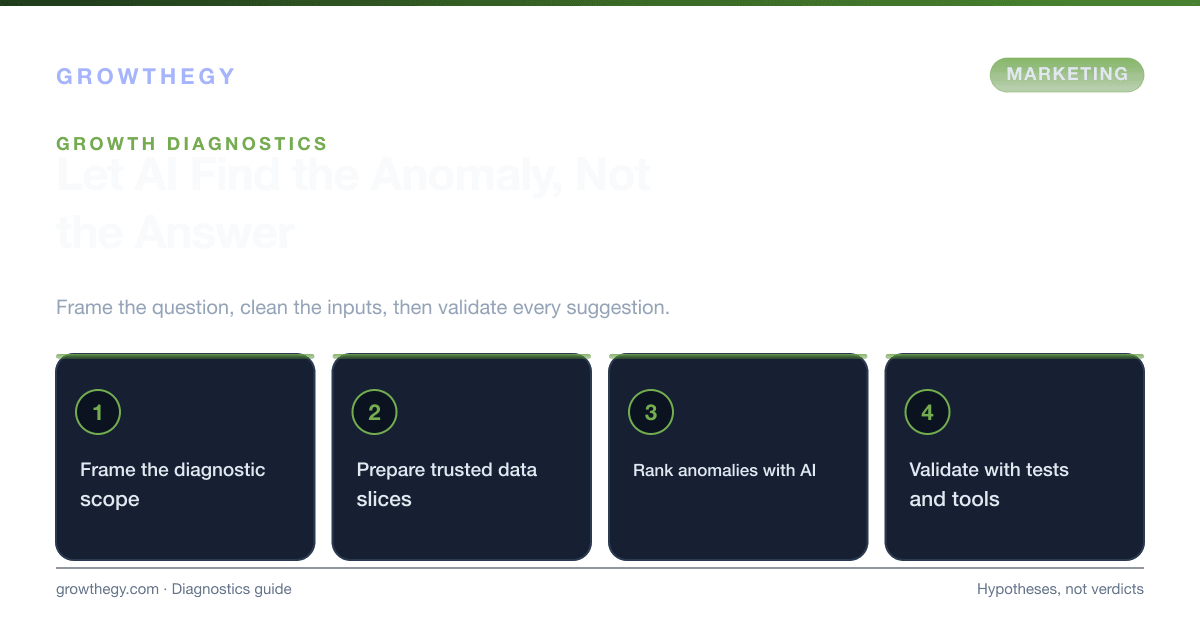
AI-powered growth diagnostics help teams compress exploration time: models can scan metrics, summarize funnels, and propose hypotheses faster than a static deck. The failure mode is trusting prose that sounds confident but ignores margin, seasonality, or broken tracking. Strong operators treat AI as a first-pass analyst—every insight still passes through data definitions, experiments, and finance-aligned tools.
1. Define the diagnostic question
One run, one scope: “Why did blended ROAS fall in April?” beats “fix my store.” Feed the question with explicit boundaries—geo, channel, product line, and date range—so outputs stay testable. Cross-link metrics to the frameworks in attribution and vertical ROAS context when the issue is mixed-channel noise.
2. Prepare clean inputs
Export consistent periods for spend, revenue, refunds, cohort retention, and onsite steps. Label known anomalies (stockouts, tracking outages, sales) so the model does not “discover” events you already understand. Ground truth beats volume: a smaller accurate slice outperforms a messy warehouse export.
3. Use AI for ranking and pattern surfacing
Ask for ranked drivers, segment cut suggestions, and anomaly timestamps—then require each claim to map to a chart or table you can reproduce. Use AI to draft experiment briefs (hypothesis, metric, duration, guardrails) but ship tests through your normal governance. For content-led discovery issues, pair quantitative cuts with the GEO guide on pages that should earn AI citations.
4. Validate with calculators and health checks
Every budget or efficiency recommendation should survive a pass through margin-aware math: Ecommerce Simulator, LTV, CAC, and the KPI library definitions your team already uses. If AI suggests “raise spend,” reconcile with payback and inventory coverage from supplier planning.
5. Operationalize: one insight, one owner, one deadline
Turn diagnostic outputs into a weekly action list with owners—otherwise AI becomes entertainment. Deepen playbooks with the GEO guide when the bottleneck is discoverability in AI-mediated search, not bid tuning alone.