TikTok LIVE Growth: The Complete Guide to Growing, Diagnosing and Monetising a Live C…
The complete 2026 guide to TikTok LIVE growth. Every metric explained, the four-lever diagnostic, gifting and commerce mechanics, and a 90-day plan for creators and brands.
Benchmarks
Average ecommerce conversion rate is often ~2–3% (varies widely by industry and traffic mix).
Source: IRP Commerce — Ecommerce Market Data (Jan 2026)
Key takeaways
- Live shopping converts at 8–12% against 2–4% for a conventional product page.
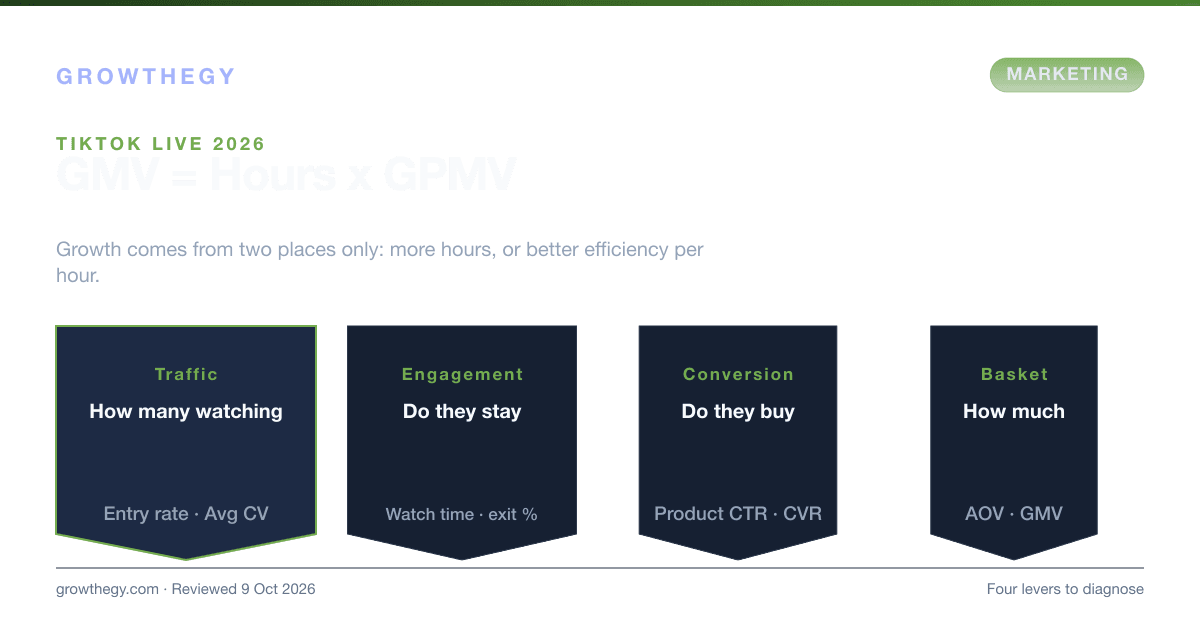
- Revenue reduces to one identity: GMV = Live Hours × GPMV, so growth comes from more hours or better efficiency.
- Gifting and live commerce are different businesses — agencies are paid on network revenue, not a share of creator gifting.
- GPMV breaks into four levers: traffic, engagement, conversion, basket. Diagnose which one is broken before buying reach.
- If your top 10 gifters produce over half your revenue, the creator has a job rather than a business.
On this topic: Ecommerce Simulator · 2026 Guide to AI-Powered Growth Diagnostics for Ecommerce Brands, Common Marketing Budget Splits by Channel (2025–2026): How DTC Brands Allocate Spend
TikTok LIVE is a live-streaming feature inside TikTok where creators broadcast in real time and earn money directly from viewers — either through virtual gifts sent during the stream, or by selling products pinned into the room through TikTok Shop. Live shopping converts at 8–12%, against 2–4% for a conventional e-commerce product page. Revenue is driven by one identity: GMV = Live Hours × GPMV, so growth comes from two places only — more hours, or better efficiency per hour. Last reviewed 9 October 2026; re-verify quarterly, because TikTok changes mechanics frequently.
This guide covers every metric, the four-lever diagnostic, gifting and commerce mechanics, the creator-network model, and a 90-day plan you can run.
What is TikTok LIVE?
It is a relationship product, not a content product: the host is present, the audience is visible, and the viewer can respond and be responded to. That difference is why live shopping converts at 8–12% against 2–4% for a standard product page.
Two things make it different from every other channel.
Distribution is earned by retention, not by followers.TikTok’s recommendation system optimises for four stated objectives — user value, long-term user value,creator value, and platform value — with heavy reliance on implicit feedback such as time spent watching. Watching to the end is a stronger signal than a like, because a like is cheap and watch time is expensive to fake. You cannot buy your way into a feed the way you can on a social graph.
The transaction happens in the room. A viewer can ask a question and get an answer mid-stream. That is the mechanism behind the conversion gap, and it is the entire commercial argument for selling inside a stream rather than a product page.
The two different businesses
This is the single most misunderstood thing about TikTok LIVE, and getting it wrong causes real structural mistakes. Live gifting and live commerce are different businesses with different hosts, different metrics and different incentives.
| LIVE Gifting | LIVE Commerce | |
|---|---|---|
| What the viewer buys | Virtual gifts | Physical products |
| What the creator earns | Diamonds | Commission, margin, or salary |
| Headline metric | DIU / gross gift revenue | GMV |
| Creator Networks get paid by | TikTok, on a tiered scale of network revenue | TikTok, on tiered scale + commerce bonuses |
| Typical content | Just chatting, gaming, music, talk | Product demo, selling, shopping |
| Dominant lever | Participation and recognition | Conversion and basket size |
The critical structural fact: creator agencies do not take a percentage of creator gifting revenue. They are paid by TikTok on a sliding scale based on the total revenue of the network they manage. That means you cannot motivate a gifting agency with a revenue-share offer — they never see that number. You motivate them with tier progression, platform resources, showcases and access.
Gifting still dominates volume. Across all of TikTok LIVE in September 2026, the most-watched non-gaming categories were Chats (4.23M peak viewers), Fashion (1.74M) and Outdoors (952,057). If you are building a commerce operation, note that commerce is the value business while gifting remains thevolume business.
How TikTok LIVE makes money
Gifting: a viewer buys TikTok Coins with real money, spends Coins on virtual gifts, gift value is credited as Diamonds, the creator converts Diamonds to cash, and TikTok takes roughly 50% — the creator nets about $0.005 per Diamond.
Commerce: a viewer taps a product pinned to the LIVE room, lands on the in-app product page, checks out inside TikTok, GMV is recorded, and the creator may also earn affiliate commission.
TikTok said in April 2025 that creators were collectively generating about $10 million per day in revenue through livestreaming, and that US creators generated $63 million in 30 days — of which 80.4% came from creators with fewer than 50,000 followers. More than 400,000 creators go live daily and over 30 million users watch TikTok livestreams every day. In 2025, more than 240 million creators went live globally, nearly double the year before.
The 80.4% figure is the one that matters strategically. It proves this is a volume-and-systems business, not a celebrity business. If the playbook were solved, that number would be lower.
At the parent-company level, estimates put advertising at roughly 60% of ByteDance revenue and live broadcasting at roughly 26%. (Sacra estimate, ByteDance-level — includes Douyin Live, so treat it as directional rather than a disclosure.)
Every metric explained
Here is the complete stack. The bolded ones are the ones that matter most.
Revenue metrics
| Metric | What it means | Why it matters |
|---|---|---|
| GMV | Gross Merchandise Value — total money made selling in the room | The headline number |
| GPMV | GMV per 1,000 viewers | Efficiency. Turns GMV into a repeatable business |
| Live Hours | Total hours streamed | Half the equation. Limited by the host’s time, not by budget |
| Orders | Number of items sold | Volume rather than value |
| AOV | Average Order Value | The basket lever. Bundles and add-ons move this |
| CVR | Conversion rate — clicks that become orders | LIVE runs 8–12%; standard e-commerce is 2–4% |
| Product CTR | Share of viewers who tap the pinned product | Usually the largest single leak in a live commerce room |
| UV Value | GMV per unique viewer | Catches rooms with traffic but no sales |
Room and audience metrics
| Metric | What it means | Why it matters |
|---|---|---|
| Avg CV | Average Concurrent Viewers — how many are watching at any moment | The honest measure of “big” |
| Peak CV | The most people at the single best moment | A vanity metric. One PK battle can inflate it |
| Go-Live UV | Unique Viewers — different people who entered | The honest audience denominator |
| Entry rate | Share of exposed viewers who enter rather than scroll past | The LIVE equivalent of click-through. Most under-weighted metric in the industry |
| Exit rate | Share who leave, usually early | High early exit means the hook is failing |
| Average Watch Time | Minutes each viewer stays | The metric most directly correlated with revenue |
| Return rate | Share of previous viewers who came back | The metric nobody volunteers, and one of the most important |
| Valid days | Days that met activity requirements — generally 30+ minutes streamed | Two LIVE per week is the practical floor. Missing them loses bonuses |
The CV versus UV distinction deserves emphasis. CV is a snapshot; UV is the total distinct audience. High UV with low CV means large numbers of people are entering and leaving quickly — a broken hook. Low UV with high CV means a small, loyal audience. Neither number alone tells you which is the better business.
Gifting metrics
| Metric | What it means | Why it matters |
|---|---|---|
| DIU | Diamonds In Use — coins spent on gifts | The gifting equivalent of GMV |
| GPM / RPM | Gift revenue per 1,000 viewers | The same number. RPM is the network term, GPM the agency term |
| Unique Gifters | How many different people spent at least once | How wide your revenue base is |
| Top-10 concentration | Share of revenue from your ten biggest gifters | Above ~50% the revenue is fragile. One person leaving collapses the month |
| Send-gift rate | Share of viewers who sent anything | The gap between watch time and send-gift rate is the host’s “ask” skill |
| ARPPU | Average revenue per paying viewer | Read with unique gifters to separate whale-driven from broad-based |
Roster and network metrics
These matter if you are managing creators rather than streaming yourself.
| Metric | What it means | Why it matters |
|---|---|---|
| Go-LIVE rate | Share of a network’s creators who streamed in a period | Drives network bonus tier |
| Avg revenue per host | The mean earner | Tells you whether your coaching worked |
| Revenue spread across roster | How concentrated the roster is | One host at 60% is a single point of failure |
| Hosts per manager | Your operational leverage | If this cannot rise, headcount scales forever |
| Coaching hours per host | Your input cost | Divide by revenue per host for your efficiency |
| Roster retention | Are hosts still hitting plan at month 6 | The real quality of your onboarding |
| Network tier | Training Camp / Accelerate / Growth | $0–40k / $40k–800k / $800k+ monthly network revenue |
The chain most people miss:Heart Me → Fan Club → member value → weekly active-fans bonus (1–2%) → diamonds. Heart Me is the only entry token into a creator’s Fan Club. Active Fan Club members send three times as many gifts and watch four times longerthan the average follower, according to TikTok’s own February 2025 documentation. That makes Heart Me the cheapest non-content lever in the platform.
The four levers: the equation that explains everything
This is the diagnostic core of the whole guide. GPMV decomposes into average concurrent viewers, concurrent-viewer-to-minutes, product click-through rate, click-to-order conversion rate, and average order value — which collapses into four levers a strategist can actually pull.
| Lever | What it means | If it’s broken, you fix |
|---|---|---|
| Traffic | How many people are watching | Pre-live promotion, time slot, co-hosting, guest spots, paid boost |
| Engagement | Whether they stay and touch the product | The hook, pacing, pinning one hero product, demonstrating it on camera |
| Conversion | Whether they buy | Price objection, social proof, bundles, answering objections in chat aloud on camera |
| Basket | How much they spend | Bundles, multi-buy prompts at fixed checkpoints, wider rotation |
The question that makes you senior rather than busy: “GMV is live hours times GPMV. GPMV only moves through traffic, engagement, conversion or basket. So which of those four is broken?”
Almost every failing room is treated as a traffic problem. It usually is not. Most rooms have 3,000 viewers and a 2% product click rate — buying more viewers into that room just dilutes the problem you are trying to solve.
How to grow: getting people into the room
Acquisition happens off-stream. The stream is where you monetise, not where you find people.
1. Fix the schedule first.TikTok’s discovery rewards first-minutes retention, watch time, real-time engagement and schedule consistency. Consistency is a ranking input, not a personal preference. Fixed days and times, announced in advance and protected like appointments, beat “stream when I feel like it” every time. End every stream by previewing the next one so viewers have a reason to return.
2. Close the short-video → LIVE loop. Almost nobody clips their best live moments back into the feed. The audience you already paid to acquire is sitting unedited and unreposted. Clip every peak moment within 24 hours, post with a clear CTA to the next LIVE, measure clip → room entry rate rather than clip views, and run a fixed weekly quota per creator.
3. Use guest and co-host rotation deliberately.TikTok removed the follower gate from guest appearances, so co-hosting is now a distribution tool rather than a favour. Co-hosting merges two rooms’ audiences and is the fastest legitimate way to lift a new creator’s concurrent viewers. Schedule it as a system — rotate your roster against itself — rather than case by case.
4. Run PK battles on a calendar. Battles drive retention and gift spikes in both rooms and produce highly clip-able content. One mechanic, three outputs: room energy, cross-pollination, feed content. Publish a schedule so viewers know when to return.
5. Build a repeat-routine feed in short video.Content that works: behind the scenes of a live session, “I made $X live, here’s the breakdown,” teasers of tonight’s pinned product, and answers to the questions people asked in the last stream.
6. Map CV by geography and hour of day.Audience maps are available and almost nobody uses them. If your audience clusters somewhere you don’t expect, your schedule is wrong.
How to retain: keeping them in the room
Entry and exit rate are the master diagnostics. If a viewer cannot tell within roughly three seconds that a room is worth staying in, nothing downstream can be fixed. Watch these before any other metric on a struggling room.
The first ninety seconds. Name every person who enters. Ask where they are watching from. React to comments fast, and remember details across streams. State what the room is doing right now — goal, product, or game — within the first few seconds. Have a visible ritual ready: a signature sound, greeting or activity.
Rituals and ladders.Gifts and engagement become behavioural when they have a ritual attached. Milestone counters, spin-the-wheel, team goals, signature dances or hand signs, and a scheduled “faction war” time all work. The critical property is that a small contribution visibly moves something — that is what converts passive viewers into participants, and what widens the revenue base.
Retention and monetisation are separate skills.Plenty of hosts hold a room brilliantly and cannot convert it. Treating “revenue” as one thing is why most coaching fails. Coach the ask on its own, as a specific, isolated behaviour.
Rotate formats inside the session. Keep the session in 60–90 minute blocks with a visible change of energy between them. Watch time decays with repetition, and a rotation makes the decay legible to the viewer.
How to sell: live commerce mechanics
Live shopping converts at 8–12%, against 2–4% for a conventional e-commerce site. In-app checkout runs 5–8%, against a 2–3% site benchmark. A 2025 GlobalData survey found that 76% of consumers who used TikTok Shop bought an item from a livestream in the prior year, and an Adobe study found 37% of respondents purchased during or after watching a live shopping stream.
The reason is the host. In a stream the product is demonstrated, objections are answered aloud, and the viewer is in a room with a person rather than on a page.
Hero SKUs and rotation. One product should drive the majority of GMV. If your revenue is spread evenly across twenty products, nobody is being told what to buy. Rotate on a fixed rhythm, with depth over breadth — a small set pitched well beats a catalogue skimmed.
The four conversion leaks, in order of how often they are the problem: nothing pinned, or something abstract pinned; the product is never shown working; objections in chat are ignored; and AOV is never attacked. A viewer cannot buy what they cannot see doing its job, and the price objection should be read aloud and answered on camera.
Handling a stockout mid-stream: acknowledge it immediately and honestly, then pivot to the next hero. Viewers respond far better to a host who handles it live than one who hides it.
How to monetise: the gifting economy
Do not ask harder. Treating a stream like a tip jar makes the room transactional and repels the people who were enjoying it. Host like a host at a party.
Change the cost of leaving. Gift-driven games convert a spectator into a decision-maker — which team, which move, which moment. Because leaving mid-round now costs them something, watch time rises. And because small gifts that steer the game matter, gifting spreads across more wallets instead of concentrating on a whale.
Make recognition specific and immediate. Thank every gifter by name within seconds, and say what their gift did: “thank you Maria, that rose just took us closer to the goal.” Celebrate first-time gifters loudly so everyone watching sees what recognition looks like.
The ladder. The single most transferable tactic in gifting, and the one most networks deploy by accident: whales get recognition, access and exclusivity; high-spenders get milestones, goal-unlocks and shoutouts; mid-tier — the real growth pool — get combos, tiered unlocks and visible contribution; casual gifting gets low-friction entry gifts and participation rituals.
If your top 10 gifters produce more than about half your revenue, the creator has a job rather than a business. You cannot manufacture whales. You can broaden the base, and that is the right goal — healthier distribution, not a bigger whale.
The cheap levers worth using immediately. Heart Me is the only entry token to a Fan Club: observed conversion runs from roughly 0.5% to 12% of unique viewers, and the variance is driven almost entirely by whether the host explains it. Explaining it three times per stream, around minutes 5, 15 and 25, moves you to the top of that range — zero production budget. The Weekly Recap arrives every Monday inside LIVE Center covering the previous week: total Diamonds, rewards percentage achieved, active Fan Club count, and top gifters by volume. Most creators open it, glance at the Diamond total and close it; each miss has a different remedy, so reading past the headline is the whole diagnostic. And valid days need thirty minutes minimum, with 61+ recommended to maximise network bonuses — two LIVE per week is the floor.
The diagnostic framework: symptom, cause, fix
This is the section to bookmark. When something is underperforming, work down the list. Diagnose before you prescribe — the most common expensive mistake in this business is buying traffic into a room that converts badly.
| Symptom | Broken lever | Root cause | First move |
|---|---|---|---|
| Low concurrent viewers | Traffic | No pre-live promotion, wrong slot, no co-host | Teaser cadence; move the slot; add a guest |
| High viewers, low sales | Engagement | Nothing pinned, no hero product, product not demo-able | Pin one product; demonstrate it on camera; script the pitch |
| High clicks, low orders | Conversion | Price objection, no trust signal, page friction | Social proof in-room; bundles; answer the objection aloud |
| High orders, low AOV | Basket | Single-item pitch only | Bundle anchor; add-on checkpoint mid-session; widen rotation |
| Good streams, no short video | The loop | No content pipeline | Clip every peak within 24 hours |
| Revenue collapses without whales | Gifting ladder | Whale-dependent, no mid-tier mechanics | Build the ladder: milestones, combos, shoutouts |
| Revenue spikes then flattens | Retention | No return rate | Fixed schedule; community rituals; preview the next session |
| High watch time, no money | Monetisation | Hosts retain well but cannot ask | Coach the ask in isolation |
| Flat for months with no change | Ceiling | Possibly a ceiling, possibly no mechanism | Ask whether this is being run as a job or a business |
| Everything flat including hours | Schedule | Not hitting valid days | Two LIVE per week is the floor |
The diagnostic that catches the most problems
Get the revenue and the audience side by side:
| Metric | Last week | This week |
|---|---|---|
| Unique viewers | 5,000 | 5,000 |
| Average CV | 200 | 200 |
| Average watch time | 4:00 | 4:00 |
| DIU | 240,000 | 120,000 |
| Top-10 gifter share | 45% | 78% |
Audience unchanged, watch time unchanged, revenue halved, and now one person is carrying 78% of it. The diagnosis is not content, not the algorithm and not the host. It is base width. If you only reviewed viewers and watch time, nothing would have looked wrong.
Which numbers lie
| Misleading | Why | Use instead |
|---|---|---|
| Peak CV | One battle inflates it | Average CV across the full session |
| Follower count | Cumulative, rewards vanity | Go-Live UV plus return rate |
| Total revenue | Hides where it came from | Revenue plus top-10 concentration |
| Session length | Duration is not quality | Watch time plus GPM |
| Total Diamonds | One whale moves it entirely | DIU plus unique gifters |
| Engagement rate | Likes are cheap | Send-gift rate and CVR |
| Any external benchmark | Different market, format, maturity | Your own top 5% in the same market |
The governing principle: an untrustworthy metric is worse than no metric, because it gets argued from.
The creator scorecard
One row per creator, refreshed weekly. This is not a dashboard — it is a sorted list of coaching actions. Track live hours, Go-Live UV, average CV, entry and exit percentages, watch time, return rate, unique gifters, top-10 share, DIU, GPM, GMV, GPMV, CVR, AOV, clips posted, coach actions and compliance flags, with each creator marked early, scaled or breakout.
1. The growth matrix — revenue against concurrent viewers. This quadrant is where you find hosts with an audience and no monetisation skill. They already have the expensive part.
2. The trend view — improving or decaying. Decay is usually a coaching problem rather than a talent problem, and it is invisible without this view.
3. The distribution view — concentration across the roster. A portfolio where one creator is 60% of revenue is a portfolio with a single point of failure.
The rule that makes a scorecard work: every column must lead to a decision. If a number does not change what anyone does this week, cut it.
Creator networks and agencies
A Creator Network is the term TikTok uses for agencies and MCNs that recruit, train, manage and grow TikTok LIVE creators. There are more than 21,000 of them globally, supporting around 4.7 million creators. Southeast Asia accounts for roughly a quarter of networks and about a third of supported creators. TikTok states that Creator Networks operate independently and that it does not endorse, sponsor or assume responsibility for their business activities.
How networks are paid. Networks are paid by TikTok on a sliding scale based on the revenue of the network they manage: Training Camp at $0–$40,000 monthly network revenue for training and platform support; Accelerate at $40,000–$800,000 for additional resources and campaign access; and Growth at $800,000+ for training, one-to-one management and direct brand introductions. TikTok has said that top-performing creator networks can make around $3 million per month.
The operating platform. Networks run on LIVE Backstage, the official operation platform: real-time performance metrics including Diamonds and active hours, viewer engagement analysis, contract management, monthly bonus and payout review, and creator scouting tools including direct messaging and referral programmes. A dedicated AI assistant, LIVE Bax, is integrated to reduce time spent on routine data analysis. What this means strategically: the reporting layer is already automated. The durable value in network management sits above it — in diagnosis, in the coaching decision, and in the escalation ladder.
Two metrics govern eligibility for bonuses and campaigns: Health Score, a Creator Network level 0–100, and the Creator Health Rating (CHR), per creator, 0–1,000. TikTok also publishes a Creator Development framework that runs in a specific order: consistent livestreaming and community safety → audience engagement → production quality → distinct content identity. Note that safety ranks second, before engagement.
Coaching creators: what actually works
The difference between managing and developing a creator is the difference between maintenance and capability building. Management is reactive — it sustains what exists. Development creates capability that did not exist.
1. Diagnose before prescribing. The data tells you something is wrong. Only watching tells you what. Arrive with a hypothesis, not a verdict.
2. Change one variable. Coaching a creator on five things changes none of them. Pick the single binding constraint from the diagnostic matrix and work it.
3. Pre-register the threshold. State what result would count as success before the test, and what would count as failure. Without this, every session produces an anecdote and the playbook never improves.
4. Separate retention coaching from monetisation coaching. They are distinct skills. Hosts who hold rooms and cannot convert them need the ask coached in isolation, with role-play.
5. Watch the room, then talk about it. The creator cannot see what you can see while they are live. That is the entire value you add.
6. Watch for burnout. It arrives as schedule drift and flattened energy in the first ten minutes, not as a complaint.
Handling a creator who resists feedback. Start by assuming you are wrong. Most of the time the manager is wrong and the creator can feel it on camera. If the data supports you and the creator has already seen it, the conversation is no longer about data; it is about whether they want to work with you. That is a legitimate answer, not a failure.
Where you do not flex: compliance and brand safety. Define the escalation ladder before you need it, and apply it identically regardless of earnings. The second you make enforcement relative to revenue, you have taught the entire roster that the rules have a price.
Timezone and geography: the most under-used lever
LIVE audiences are not geographic. The algorithm does not restrict a host to domestic viewers, and platform signals weight location below behavioural signals. A host in a small market is not limited to a small audience.
Consider an Australian creator on AEST (UTC+10, no daylight saving):
| AEST slot | Southeast Asia | United States |
|---|---|---|
| 9–11am | 7–9am SGT — SEA waking | 7–9pm ET — US evening peak |
| 1–3pm | 5–7pm SGT — SEA evening | 11am–1pm ET |
| 9–11pm | 7–9pm SGT — SEA dinner peak | 4–6am ET |
A single Australian morning slot reaches the US evening peak and Southeast Asia daytime simultaneously. For a market with a modest domestic audience, that reframes the opportunity entirely: the objective is not to monetise domestic viewers, it is to be an APAC-and-US operation that happens to be staffed locally. Map concurrent viewers and gifters by geography and hour, then schedule against the peaks of your highest-value clusters. It costs nothing and it is almost never done.
Benchmarks by market
| Market | Live commerce performance | Note |
|---|---|---|
| Southeast Asia | ~70% of TikTok Shop GMV; Indonesia ~20.2% of global GMV | Largest and fastest-growing. Indonesia is the second-largest single market globally |
| United States | ~22.2% of TikTok Shop GMV | High-AOV discovery market; only ~12% of US shoppers have bought via livestream |
| United Kingdom | Live Shopping +55% YoY; 6,000+ sessions daily; 300,000+ UK businesses selling | TikTok, July 2026 |
| Australia | TikTok Shop launched 2026 | Early-stage; the ecosystem is being built, not tuned |
| Singapore | Live viewership +150%; monthly buyers +60%; sales +70% YoY | TikTok Shop SG, Sept 2026 |
| Global | GMV ~$64.3B (2025) → projected $112.2B (2026) | +86% YoY; H1 2026 GMV $34.7B, +80% |
A note on how to use these numbers. External benchmarks describe markets you are not in. For diagnosis, always compare a creator against your own top 5% in the same market, same format and same maturity stage. A room with 3,000 viewers doing half the GPMV of a room with 1,500 is not a success with a small audience — it has a conversion problem and already has the expensive part.
Australia-specific context.TikTok’s April 2026 whitepaper forecasts Australia’s creator commercial contribution reaching US$100 billion by 2030, up roughly 1.3× from 2025 — though that figure measures the broader creator-influenced economy, not LIVE revenue. IAB Australia’s September 2026 Creator Connect research found six in ten Australian shoppers now pass through creator content before buying, and more than eight in ten under 40.
Compliance and brand safety
Handle this before you need it. In a role touching creators, knowing where the lines are is a credibility signal.
- Minors in live rooms — age-gating, guardian consent, no adult monetisation of minors
- Gambling and casino-style content — restricted severely; a clear policy breach with a defined consequence
- Regulated categories — health, finance, alcohol, gambling, adult
- Disclosure — branded content must be disclosed clearly in the stream, not only in the post
- Abusive or discriminatory chat — addressed live and visibly, because handling it on camera protects everyone in the room
- Community Guidelines apply in-room, not just on upload
The principle:apply policy identically regardless of a creator’s earnings, and define the escalation ladder before you have to use it. If enforcement is visible, consistent and pre-announced, it protects the platform and the creators in your roster at the same time.
Common mistakes
| Mistake | Why it fails | Do instead |
|---|---|---|
| Buying traffic into a room that converts badly | Pays to dilute the problem | Fix the binding constraint first |
| Reporting peak concurrent viewers | Easy to spike, hides a falling average | Average CV across the full session |
| Copying a playbook from the US market | Different maturity, format and audience | Diagnose against your own top 5% |
| Co-hosting as a favour | Inconsistent, not repeatable | Run it as a scheduled distribution system |
| Coaching five things at once | Changes none of them | One variable, one threshold, two weeks |
| Treating revenue as one thing | Retention and monetisation are separate skills | Coach the ask in isolation |
| Ignoring the Weekly Recap | Throws away the platform’s own diagnostic | Read past the Diamond total |
| Never clipping live moments | Leaves your cheapest reach uncollected | Clip every peak within 24 hours |
| Opaque compliance | Teaches the roster the rules have a price | Published ladder, applied uniformly |
Your first 90 days
Days 1–30: Diagnose. Pull 30 days of per-creator, per-session data and build the scorecard before forming any opinion. Segment the roster into early, scaled and breakout — each stage has a genuinely different binding constraint, and one playbook applied across all three fails at least two of them. For each segment, identify which of the four levers is broken, measure whale concentration, check whether the short-video loop is closed, and validate the schedule against valid days. Present three findings ranked by impact, then run one live intervention and measure it in front of your stakeholders. A proof beats a plan.
Days 31–60: Build.Tier the roster by maturity with a different coaching cadence for each. Write stage-specific playbooks in the creator’s language, not yours. Stand up the gifting ladder. Build the content loop with a fixed weekly clip quota. Run guest rotation as a scheduled system rather than ad hoc.
Days 61–90: Scale. Turn every working play into a written system with a named owner — the test is whether it survives your absence. Roll the proven playbook across the cohort that responded. Run one campaign, one creator showcase and one cross-roster event. Prove the coaching economics: management cost per creator per stage against the return. Present what failed as carefully as what worked.
Glossary
| Term | Definition |
|---|---|
| DIU | Diamonds In Use — coins viewers spent on gifts |
| GPM / RPM | Gift revenue per 1,000 viewers. Same number, two names |
| GPMV | GMV per 1,000 views |
| GMV | Gross Merchandise Value — total sales in the room |
| CV | Concurrent Viewers — how many are watching at this moment |
| Peak CV | The highest concurrent count in a session |
| Go-Live UV | Unique viewers who entered the room across a session |
| Entry rate | Share of exposed viewers who enter rather than scroll past |
| AWT | Average Watch Time |
| AOV | Average Order Value |
| CVR | Conversion rate — clicks that become orders |
| UG | Unique Gifters — distinct people who spent |
| CVT | Concurrent viewer-to-minutes |
| Heart Me | The only entry token to a creator’s Fan Club |
| Gift Box | A pre-purchased bundle of gifts deployed during a stream |
| Fan Club / Team | The subscription community layer; active members gift more and watch longer |
| Weekly Recap | Monday operational dashboard in LIVE Center |
| Valid day | A day meeting activity requirements — generally 30+ minutes streamed |
| Scaled LIVE Rewards | The rewards ladder, including the 1–2% weekly active-fans bonus |
| CHR | Creator Health Rating — per creator, 0–1,000 |
| Health Score | Creator Network level compliance metric, 0–100 |
| LIVE Backstage | TikTok’s official operating platform for Creator Networks |
| LIVE Bax | The AI assistant integrated into LIVE Backstage |
| CN / CNM | Creator Network / Creator Network Manager |
| Tiers | Training Camp · Accelerate · Growth |
| PK | The one-versus-one and team-versus-team competitive stream format |
| Multi-Guest | Multiple creators streaming in one session for cross-promotion |
| Stream Key | The credential for external streaming software; networks provide access without follower requirements |
Sources
Figures in this guide are dated because TikTok changes mechanics frequently. Re-verify quarterly.
- TikTok creator and agency figures, NYC mixer, April 2025 — via Digiday
- TikTok creator network tier scale and $3M monthly network figure — same source
- TikTok LIVE Creator Networks whitepaper and LIVE Bax — via Tech Edition, September 2026
- TikTok Shop GMV by market and year — ECDB, September 2026
- TikTok Shop H1 2026 GMV and Southeast Asia share — SocialDay, September 2026
- UK Live Shopping growth and session volume — TikTok UK, July 2026
- Singapore live viewership and buyer growth — TikTok Shop Singapore, September 2026
- Australia creator whitepaper — TikTok Newsroom, April 2026
- Australian shopper creator-influence research — IAB Australia Creator Connect, September 2026
- LIVE category peak-viewer rankings — Streams Charts, September 2026
- Fan Club gift and watch-time multipliers — TikTok LIVE, February 2025
- Live versus site conversion benchmarks — 2026 industry compilations
- 76% livestream purchase rate — GlobalData 2025 survey, via Shopify
- 37% purchase during or after live shopping — Adobe study
- LIVE revenue share of ByteDance — Sacra estimate, June 2026 (estimate, not disclosure)
This guide reflects platform mechanics as documented publicly by TikTok and published industry sources as of October 2026. Where we use estimates or third-party reporting rather than platform disclosures, we say so.