What is Average Order Value (AOV)?
Average order value (AOV) explained: definition, formula, and proven tactics to increase AOV—bundling, upsells, free shipping thresholds, and more.
Key takeaways
- What is Average Order Value (AOV)? How to Calculate and Increase It — focus on one metric or lever at a time; validate with data before scaling spend.
On this topic: Ecommerce Simulator · 17 Proven Ways to Increase Average Order Value Without Heavy Discounts (Powerful Strategies That Work!), Customer Metrics — Hub (LTV, CAC, Churn)
If you run an online store, you care about revenue per order as much as total orders. Average order value (AOV) tells you how much customers spend each time they buy. A higher AOV means more revenue without necessarily more traffic or conversions—so improving AOV is often one of the fastest levers for growth. This guide covers what AOV is, how to calculate it, and practical tactics to increase it.
According to Shopify's 2024 Commerce Report, merchants that actively optimize for AOV grow revenue 10–30% faster than those focusing solely on traffic acquisition. HubSpot's 2025 Ecommerce Benchmarks report found that a 15% improvement in AOV delivers the equivalent revenue impact of a 15% increase in site traffic—at a fraction of the cost. Yet fewer than half of online retailers have a formal AOV optimization strategy in place.
What is Average Order Value (AOV)?
Average order value (AOV)is the average amount of money a customer spends per order. It's total revenue over a period divided by the number of orders in that same period. AOV is used to understand purchasing behavior, set marketing and discount thresholds, and compare performance across channels or time periods. It's especially useful alongside conversion rate and customer lifetime value (LTV): conversion tells you how many visitors buy, LTV tells you how much a customer is worth over time, and AOV tells you how much they spend per transaction.
How to Calculate AOV
The formula is simple:
AOV = Total revenue ÷ Number of orders
Example: In a month you make $30,000 in revenue from 600 orders. AOV = $30,000 ÷ 600 = $50. You can calculate AOV for a day, week, month, or year—just keep revenue and order count for the same period. Many ecommerce platforms and analytics tools report AOV automatically; you can also compute it from your orders export or use a dedicated calculator to model how changes (e.g. higher AOV from upsells) affect revenue and profit.
Important nuance: calculate AOV separately by channel. Your AOV from Google Shopping may be very different from your AOV from email campaigns or Instagram ads. Blending them obscures which channels are driving high-value orders and which are bringing in low-value, high-return customers.
AOV Industry Benchmarks by Sector
Knowing your AOV in isolation means little without context. Here are 2024–2025 benchmarks by ecommerce category (sources: Statista 2025, Klaviyo Ecommerce Benchmark Report 2024, Shopify Data 2024):
| Ecommerce Category | Average AOV (USD) | Top Quartile AOV | Key AOV Driver |
|---|---|---|---|
| Electronics & Gadgets | $180–$350 | $500+ | Accessories bundling |
| Apparel & Fashion | $65–$120 | $200+ | Complete the look bundles |
| Health & Beauty | $55–$90 | $150+ | Subscription & subscribe-and-save |
| Home & Garden | $100–$200 | $350+ | Room sets & project bundles |
| Sports & Outdoors | $80–$160 | $280+ | Kit bundles & gear packages |
| Food & Beverage DTC | $45–$75 | $120+ | Multi-packs & variety boxes |
| Pet Supplies | $55–$90 | $160+ | Subscription auto-ship |
| Luxury / Jewelry | $250–$600 | $1,200+ | Curated collections |
If your AOV is significantly below the industry average for your category, that's a signal to investigate your product mix, checkout flow, and upsell strategy. If you're in the top quartile, the goal shifts to maintaining AOV while protecting conversion rate—over-optimizing AOV can hurt conversion if you push too aggressively.
How to Increase Average Order Value
These tactics are widely used because they work. Pick a few that fit your store and test them.
1. Bundle products
Offer "buy X and Y together" or "complete the look" bundles at a slightly lower combined price than buying separately. Bundles increase the items per order and make the higher total feel like a deal. Use clear bundle names and show the savings (e.g. "Save 15%" or "$X off when bought together").
Data from BigCommerce (2024) found that product bundles increase AOV by an average of 15–20% for stores that implement them. The key is relevance: a bundle of a laptop stand, cable organizer, and webcam feels natural; a bundle of a laptop stand and a candle does not. Build bundles based on purchase data—what do customers actually buy together?
2. Upsells and cross-sells
At checkout or on the product page, suggest a better tier (upsell) or related items (cross-sell): "Customers also bought…", "Upgrade to…", or "Frequently bought together." Keep the offer relevant and optional—one or two suggestions work better than a long list.
According to Forrester Research (2024), product recommendations drive 10–30% of ecommerce revenues. Amazon attributes 35% of its revenue to its recommendation engine. The most effective cross-sells are shown on the product page and in the cart—not at the payment step, where they introduce friction.
3. Free shipping threshold
Set a minimum order value for free shipping (e.g. "Free shipping on orders over $75"). Many customers will add an item or two to reach the threshold. Show a progress bar ("Add $X more for free shipping") so they know exactly how much to add. Make sure your margin still works at that threshold.
NRF (National Retail Federation) data from 2024 shows that 75% of consumers expect free shipping, and 58% will add items to their cart to qualify for a free shipping threshold. Set your threshold 15–25% above your current AOV to maximize the lift effect. If your AOV is $55, a $65 free-shipping threshold will nudge most customers to add one more item.
4. Product recommendations
Use "You might also like" or "Often bought with" blocks on product and cart pages. Recommendations can be rule-based (same category, same price band) or algorithm-based if you have the data. Test placement and number of recommendations to balance AOV lift and clarity.
5. Minimum order or "spend more, save more"
Incentivize a higher basket with a small discount or gift at a threshold (e.g. "Spend $100, get 10% off" or "Spend $80, get a free sample"). Communicate the incentive clearly in the cart and in marketing so customers know what to aim for.
Tiered discount structures (e.g., 5% off at $50, 10% off at $100, 15% off at $150) encourage customers to push to the next tier. Klaviyo's 2024 report found that tiered thresholds outperform flat-rate discounts by 22% in AOV lift because they create multiple incremental nudge points throughout the shopping session.
6. Subscriptions and repeat options
For products that get repurchased (consumables, refills), offer "Subscribe and save" or "Add to next order" so customers buy multiple units or commit to a schedule. That raises revenue per order and can improve retention.
Recharge's 2024 Subscription Commerce Report found that subscribers have 60–80% higher AOV than one-time buyers and 3–4x higher LTV. Even if subscriptions represent only 10–15% of your customer base, they can account for 30–40% of revenue.
Step-by-Step AOV Optimization Process
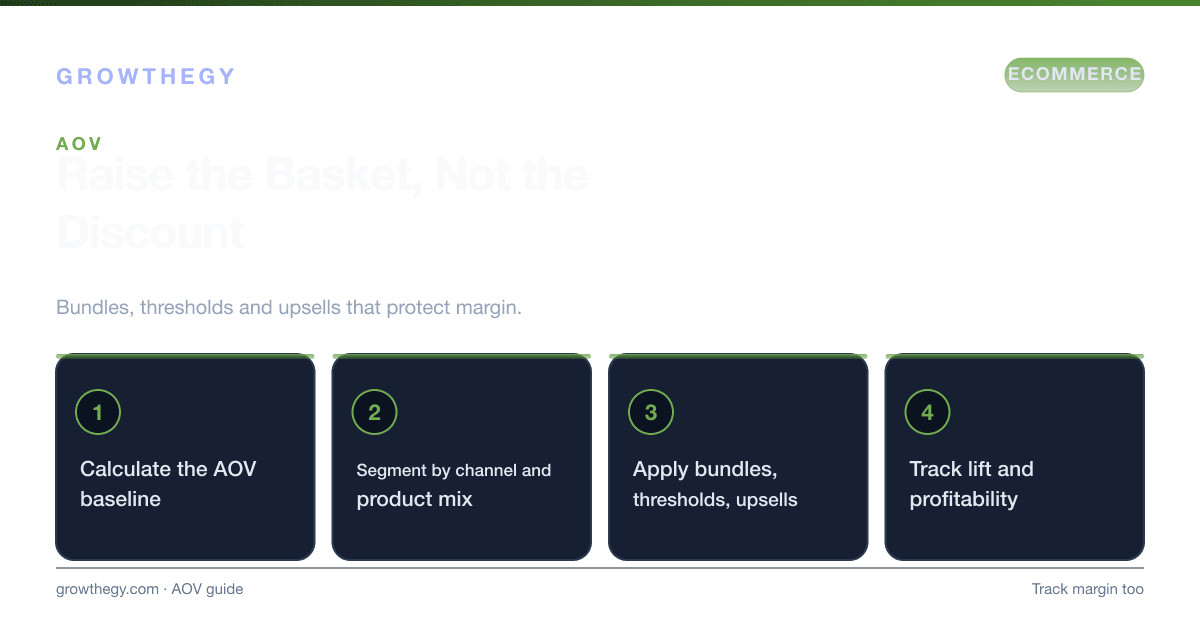
- Baseline your current AOVby channel, product category, and new vs. returning customers. Use your platform's analytics or export order data.
- Identify your AOV gap versus industry benchmarks in the table above. A gap of 20%+ suggests significant optimization opportunity.
- Analyze your order datato find natural bundle opportunities—which products are already being bought together? Use a co-purchase analysis or your platform's frequently bought together data.
- Set your free shipping threshold15–25% above your current AOV. If you don't currently offer free shipping, this is typically the fastest AOV lever available.
- Add at least one upsell or cross-sell on your top 10 product pages and in the cart. Keep suggestions to 2–3 items maximum to avoid decision paralysis.
- Implement a cart progress bar showing how close the customer is to the free shipping threshold. Research by Baymard Institute (2024) found that cart progress bars reduce checkout abandonment by 8–12%.
- Test tiered discounts or a gift-with-purchase at a spend threshold above your average AOV. Run for 2–4 weeks to get statistically significant data.
- Measure and iterate. Track AOV weekly and by segment. Monitor whether AOV increases come with margin erosion (e.g., from discounts) or margin improvement (from higher-value products).
AOV, Conversion Rate, and the Revenue Triangle
Revenue = Traffic × Conversion Rate × AOV. These three levers interact, and optimizing one in isolation can hurt the others. A too-aggressive upsell strategy can reduce conversion rate by making checkout feel pushy. A free-shipping threshold set too high may deter small orders without generating enough large ones.
| Scenario | Monthly Traffic | Conversion Rate | AOV | Monthly Revenue | Revenue Change |
|---|---|---|---|---|---|
| Baseline | 10,000 | 2.5% | $65 | $16,250 | — |
| +15% AOV only | 10,000 | 2.5% | $74.75 | $18,688 | +$2,438 (+15%) |
| +15% traffic only | 11,500 | 2.5% | $65 | $18,688 | +$2,438 (+15%) |
| +10% AOV + −2% conv. rate | 10,000 | 2.45% | $71.50 | $17,518 | +$1,268 (+7.8%) |
| +10% AOV, conv. unchanged | 10,000 | 2.5% | $71.50 | $17,875 | +$1,625 (+10%) |
The table illustrates that even a small conversion rate decrease from aggressive upselling can erode the revenue gains from higher AOV. The goal is AOV improvement that doesn't materially hurt conversion. Monitor both together whenever you run AOV optimization experiments.
Model the impact with our AOV Optimizer
Want to see how a higher AOV affects revenue and profit? Use our free AOV Optimizer to model different scenarios—change AOV, conversion rate, and traffic to see the impact on total revenue and margins. No signup required.
For related metrics and tools, see our LTV glossary entry to understand how AOV compounds into lifetime value, and our Ecommerce Simulator to evaluate the profit impact of AOV improvements.