Understanding fuel costs and ecommerce deliveries
Fuel costs — When diesel and jet fuel rise, carriers add fuel surcharges and last-mile rates climb, so merchants raise free-shipping thresholds or product prices. Fuel is a direct input to delivery economics—higher energy costs flow through surcharges, zone pricing, and carrier minimums within weeks.
Benchmarks
Average ecommerce conversion rate is often ~2–3% (varies widely by industry and traffic mix).
Source: IRP Commerce — Ecommerce Market Data (Jan 2026)
Average ecommerce cart abandonment rate is 70.19%.
Source: Baymard Institute — Cart Abandonment Rate Statistics (2024)
Key takeaways
- Fuel Costs Rise: Why Ecommerce Delivery Prices Follow: 7 Powerful Impacts You… — focus on one metric or lever at a time; validate with data before scaling spend.
- Pair reading with the Ecommerce Simulator on Growthegy to practice unit economics and decisions before you spend.
- Bookmark growthegy.com/ecommerce-simulator/ for hands-on scenarios; use the blog for deeper guides.
On this topic: Ecommerce Simulator · Meta Ads for Ecommerce: What 350 Research Papers Say Works, Conversion Rate Optimization in 2026: What Actually Works (With Receipts)
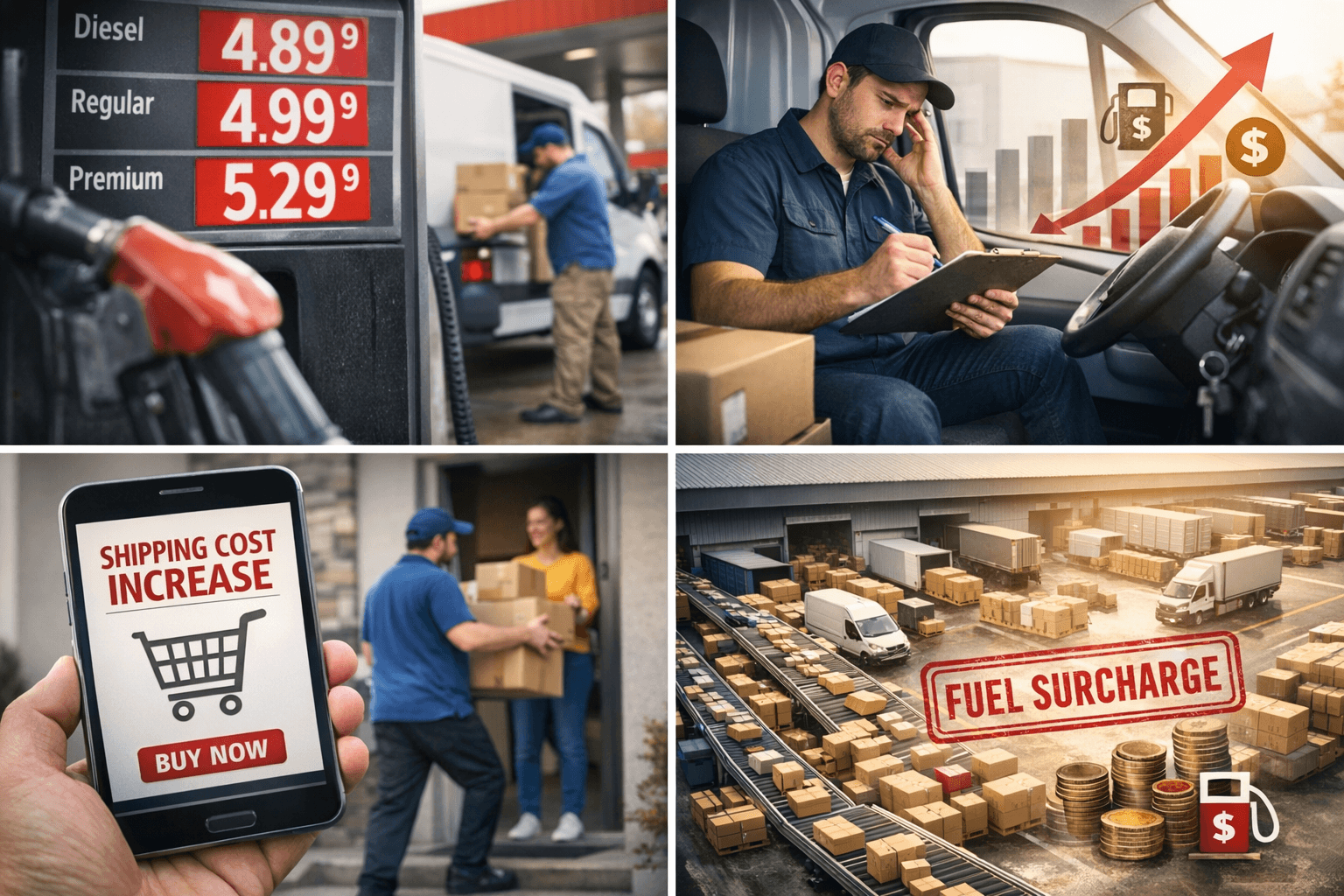
Modelling shipping and fulfillment in your unit economics helps you see when to absorb cost vs pass it through. Try our Ecommerce Simulator and Ecommerce Simulator alongside this guide.
The scale of the problem is significant. According to Deloitte's 2025 Global Logistics Report, fuel accounts for 25–35% of total last-mile delivery operating costs for road freight carriers, and up to 45% for air express networks. A 20% rise in diesel prices can therefore translate to a 5–10% increase in ground shipping rates—often within a single billing cycle, as carriers adjust fuel surcharge indices weekly or monthly.
What drives fuel price increases
Crude supply and demand, geopolitical risk, refinery capacity, seasonal demand (e.g. holidays), taxes, and currency moves all feed volatility. A shock in one oil-producing region can move global benchmarks within days.
According to the International Energy Agency (IEA) 2025 Oil Market Report, Brent crude price swings of 30–40% within a calendar year are now considered normal volatility rather than exceptional events. For logistics networks structured around fixed annual contracts, this volatility is absorbed through fuel surcharge mechanisms that pass cost changes to shippers—and ultimately to ecommerce merchants and consumers.
Types of fuel used in delivery networks
- Petrol: common in smaller vans and some last-mile fleets
- Diesel: dominant for trucks and long-haul road freight
- Aviation fuel: drives air cargo and express networks
When all three pressure upward, ecommerce feels it from international inbound to local drop-off.
Fuel Cost Impact by Delivery Network Segment
| Delivery Segment | Primary Fuel Type | Fuel % of Operating Cost | Price Sensitivity | Surcharge Pass-Through Speed |
|---|---|---|---|---|
| International air freight | Jet fuel (Jet A-1) | 30–45% | Very High | Weekly (FAF adjustments) |
| Ocean freight | Bunker fuel (HFO/VLSFO) | 15–25% | High | Monthly (BAF adjustments) |
| Long-haul road freight | Diesel | 25–35% | High | Weekly–Monthly |
| Last-mile delivery (vans) | Diesel / Petrol | 20–30% | Very High | Monthly (rate card reviews) |
| Last-mile delivery (bikes/EVs) | Electricity | 3–8% | Low | Quarterly |
| Warehouse operations | Electricity / LPG | 5–12% | Low–Medium | Annual contract renegotiation |
Source: Deloitte Global Logistics Report 2025; IATA Fuel Monitor Q1 2026
Why ecommerce deliveries depend heavily on transportation
Online shopping is movement: inbound to warehouses, transfers between nodes, then outbound to customers. No transport layer means no ecommerce at scale.
Last-mile delivery explained
Last-mile is the final leg to the customer. It is often the most expensive per package—sometimes over half of total delivery cost—because of stop density, traffic, returns handling, and failed attempts. Fuel price rises hit here hard: more kilometres per delivered unit than on trunk routes.
The McKinsey & Company 2024 Last-Mile Delivery Study found that last-mile delivery accounts for 53% of total shipping costs on average—and that this percentage rises to 65% or more for same-day or next-day delivery services in urban markets. A 15% diesel price increase can therefore add $0.50–$1.20 to the cost of a single standard parcel delivery, before carrier margin is applied.
Warehousing and distribution networks
Before last-mile, goods shuttle between DCs, sort centres, and hubs. Each leg burns fuel; when line-haul costs rise, fulfilment operators renegotiate rates or widen delivery zones and cutoffs—both of which show up in customer economics.
Direct impact of rising fuel costs on delivery prices
Increased transportation expenses
Carriers pass through fuel via surcharges or all-in rate hikes. For merchants, that means higher label costs, worse free-shipping thresholds, or subsidised shipping that erodes margin.
Pitney Bowes Parcel Shipping Index 2025 reported that major US carriers increased ground shipping base rates by an average of 5.9% in 2024, with fuel surcharges adding an additional 2–8% depending on the month and service level. For ecommerce brands shipping 10,000+ parcels per month, this represented a cost increase of $60,000–$180,000 annually on shipping alone.
Higher operational costs for delivery fleets
Beyond the pump, inflation in parts, tyres, insurance, and driver pay stacks on top of fuel. Networks may reduce service levels (e.g. slower standard) to protect unit costs.
How Fuel Surcharges Are Calculated
Understanding surcharge mechanics helps merchants anticipate cost changes and negotiate more effectively with carriers:
- Index selection: Most carriers tie surcharges to a published fuel price index—typically the US Energy Information Administration (EIA) weekly diesel retail price for US domestic shipments, or Platts Jet Fuel assessments for air freight.
- Threshold banding: Carriers define fuel price bands (e.g., $3.50–$3.74/gallon, $3.75–$3.99/gallon) with a fixed surcharge percentage for each band. As fuel moves between bands, the surcharge adjusts automatically.
- Update frequency: Ground surcharges typically update monthly; air express surcharges update weekly. This lag means merchants may face higher surcharges even after fuel prices begin declining.
- Application to base rate: The surcharge is applied as a percentage of the base shipping rate, not a flat fee—meaning heavier, higher-rate shipments pay proportionally more in surcharge dollars.
| Diesel Price (US $/gallon) | Typical Ground Surcharge % | Example: $10 Base Rate | Total Shipping Cost |
|---|---|---|---|
| Below $2.50 | 5–8% | $0.50–$0.80 | $10.50–$10.80 |
| $2.50–$3.49 | 9–13% | $0.90–$1.30 | $10.90–$11.30 |
| $3.50–$4.49 | 14–18% | $1.40–$1.80 | $11.40–$11.80 |
| $4.50–$5.49 | 19–24% | $1.90–$2.40 | $11.90–$12.40 |
| Above $5.50 | 25%+ | $2.50+ | $12.50+ |
Source: FedEx and UPS published fuel surcharge tables 2024–2025 (illustrative banding; actual rates vary by carrier and contract).
Indirect effects on ecommerce pricing
Increased product prices
Brands may lift shelf prices or shrink pack sizes when inbound freight and fulfilment inflate COGS. Customers then pay more for the item and the delivery line at checkout.
According to Adobe Digital Economy Index 2025, online product prices across major categories increased by an average of 3.2% during the 2022 energy price spike—with the highest increases in heavy goods (furniture: +7.1%, electronics: +4.3%) where inbound freight costs are a larger share of COGS.
Reduced profit margins for sellers
Smaller merchants often lack the volume to hedge or negotiate surcharges away. They either take margin pain or risk cart abandonment if they raise shipping fees—use Pricing & Bundling Simulator to stress-test pass-through vs absorption.
Role of fuel surcharges in ecommerce deliveries
What is a fuel surcharge?
A fuel surcharge is an adjustable fee tied to a fuel index, layered on base shipping so carriers can track volatility without reprinting every tariff.
How companies calculate surcharges
Common inputs: published fuel indices, average distance or zones, service level (express vs ground), and contract terms. Many programmes update weekly or monthly; express air can move faster.
Consumer impact: paying more for convenience
Reduced demand for fast shipping
When expedited options price up, more buyers pick economy or consolidate orders—changing mix for retailers optimising for conversion vs AOV.
Shopify's 2025 Commerce Trends Report found that when same-day delivery prices exceed $8, consumer selection of standard (3–5 day) delivery increases by 34% compared to when same-day is priced at $5 or below. This shift reduces carrier revenue from premium services and can create capacity imbalances in the network.
Increased delivery fees at checkout
Expect higher flat fees, higher free-shipping minimums, or paid memberships positioned as "delivery bundles." Transparency at checkout remains a trust factor.
How major ecommerce companies respond
Route optimization technology
AI-assisted routing, dynamic dispatch, and better address geocoding cut empty kilometres—partial relief when diesel rises.
UPS reported in its 2024 Annual Report that its ORION (On-Road Integrated Optimization and Navigation) route optimization system saves approximately 100 million miles driven annually—equivalent to roughly 10 million gallons of fuel saved per year. At $4/gallon, this represents $40 million in annual fuel cost avoidance, demonstrating the scale of impact that technology investment can achieve.
Investment in electric vehicles
Large carriers and marketplaces are scaling electric vans and bikes for urban last-mile to reduce exposure to oil volatility. National postal networks and dedicated logistics firms run similar programmes—none of which remove fuel risk overnight, but they diversify cost bases over time.
Amazon has committed to deploying 100,000 electric delivery vehicles (Rivian EDVs) by 2030. DHL aims for 60% of its first/last-mile deliveries to be zero-emission by 2030. These commitments represent a structural hedge against fuel price volatility at scale, though the transition cost is significant in the near term.
7 Strategies to Mitigate Fuel Cost Impact on Your Ecommerce Margin
- Negotiate carrier contracts with fuel surcharge caps. When signing or renewing carrier agreements, negotiate a maximum fuel surcharge percentage or a fixed surcharge override. High-volume shippers (500+ parcels/week) typically have leverage to cap surcharges at current levels for 6–12 months.
- Raise free-shipping thresholds to protect margin. If your free-shipping threshold is $50 and shipping costs rise by $1.50/parcel, recalculate the threshold needed to maintain your target margin. A $55–$60 threshold can absorb most of the increase while retaining the free-shipping marketing message.
- Use multi-carrier rate shopping. Parcel management platforms (Shippo, EasyPost, Pirateship) compare real-time rates across carriers. During fuel spike periods, rate differentials between carriers can be 15–25% on the same service level—automatically selecting the cheapest creates meaningful savings at volume.
- Increase average order value through bundling. Fuel cost is largely per-shipment, not per-item. If you can increase AOV by $20 through bundles or upsells, the shipping cost as a percentage of revenue decreases significantly. Use Pricing & Bundling Simulator to model the AOV impact.
- Move towards regional fulfilment. Placing inventory in regional distribution centres closer to demand reduces average shipping zone distance. Each zone reduction saves approximately $0.50–$1.50 per parcel in ground rates, compounding significantly at scale.
- Offer incentives for slower delivery options. Customers who choose standard (4–7 day) delivery over express (1–2 day) enable carrier consolidation, which reduces cost per parcel. A $5 credit on next order for choosing economy shipping can save $3–$6 in delivery cost while increasing repeat purchase probability.
- Monitor and model fuel cost impact on unit economics. Build fuel surcharge assumptions into your product profitability calculations. Use our Ecommerce Simulator to see which SKUs become unprofitable at different surcharge levels—and adjust pricing or fulfilment strategy proactively.
Mitigation Strategy Comparison
| Strategy | Implementation Difficulty | Cost | Estimated Saving per Parcel | Best For |
|---|---|---|---|---|
| Carrier contract renegotiation | Medium | Low | $0.50–$1.50 | High-volume shippers (>500/week) |
| Multi-carrier rate shopping | Low | Low (SaaS fee) | $0.30–$2.00 | All merchant sizes |
| Raise free-shipping threshold | Low | None | Protects $1–$3 margin per order | All merchant sizes |
| Regional fulfilment | High | High (warehouse cost) | $0.50–$1.50 per zone saved | Brands shipping 1,000+/week nationally |
| Bundling to increase AOV | Low–Medium | Low | Reduces shipping % of revenue by 1–3% | All merchant sizes |
| Incentivise economy delivery | Low | Low | $1–$3 (express vs economy delta) | Brands with mixed delivery speed demand |
| EV fleet investment | Very High | Very High | Long-term structural reduction | Large carriers & 3PLs only |
Sustainability and fuel costs in ecommerce
Carbon footprint considerations
Higher fuel use per parcel increases emissions intensity; buyers and regulators increasingly care, which can accelerate investment in efficiency and alternative powertrains.
According to MIT's Center for Transportation and Logistics 2024 Research, ecommerce deliveries generate approximately 2.5kg of CO₂ per parcel for standard ground delivery in urban areas—rising to 10kg+ per parcel for air express cross-border shipments. As carbon pricing mechanisms expand (EU Carbon Border Adjustment Mechanism, UK ETS), these emissions will increasingly carry a direct financial cost.
Renewable energy alternatives
Solar on warehouses, EV fleets, and low-carbon fuels for long-haul are gradual substitutes—not overnight fixes for price spikes.
Global supply chain disruptions and fuel prices
Shipping delays and congestion
Queues at ports and hubs mean more idling, repositioning, and ad hoc routing—extra fuel burn on top of index moves.
The FreightWaves SONAR 2025 data shows that port congestion events in major trade lanes increase total voyage fuel consumption by 12–18% on average, as vessels slow-steam to avoid queue positions and then accelerate to meet revised schedules. For ecommerce brands relying on ocean freight for inventory replenishment, congestion-driven fuel costs add an invisible layer to their COGS.
International freight costs
Air freight is fuel-heavy; when oil runs up, express cross-border lanes reprice fastest. Ocean is slower to pass through but still moves with bunker-linked surcharges.
Strategies businesses use to offset fuel costs
Bulk shipping and consolidation
Fewer, fuller moves cut fuel per unit—whether merging DTC parcels or inbounding in larger MOQs.
Local warehousing solutions
Placing stock closer to demand trims last-mile distance; micro-fulfilment and regional DCs are partly a fuel hedge.
Future outlook: ecommerce deliveries and fuel prices
Technological innovations
Drones, autonomous ground vehicles, and smarter forecasting may trim cost per stop over the next decade—regulation and capex cycles will gate pace.
ARK Investment Management 2025 forecasts that autonomous last-mile delivery robots could reduce delivery costs by 60–80% by 2030 in dense urban markets. While optimistic, even a 20–30% reduction in last-mile cost through technology would materially decouple ecommerce delivery pricing from oil market volatility.
Policy and regulation changes
Carbon pricing, low-emission zones, and fuel taxes can reshape network design as much as crude price itself.
The UK's Clean Air Zone framework and EU Urban Vehicle Access Regulations are already influencing carrier fleet decisions in major European cities. Merchants operating in affected zones should factor low-emission zone compliance costs into their carrier selection and delivery cost models from 2026 onward.
Conclusion
When fuel costs rise, ecommerce deliveries increase prices through direct surcharges, higher line-haul and last-mile rates, and indirect product inflation. Understanding last-mile economics, surcharges, and mitigation (routing, consolidation, regional stock) helps merchants protect margin without surprising customers. Explore more in our Ecommerce Simulator and Ecommerce Simulator.