How do you lift average order value without relying on steep discounts?
Average order value — Raise AOV by increasing perceived and delivered value—bundles, contextual upsells and cross-sells, shipping thresholds, loyalty, personalization, clearer PDPs, frictionless checkout, BNPL where it fits—while monitoring conversion and gross margin so bigger baskets stay profitable.
Benchmarks
Average ecommerce conversion rate is often ~2–3% (varies widely by industry and traffic mix).
Source: IRP Commerce — Ecommerce Market Data (Jan 2026)
Average ecommerce cart abandonment rate is 70.19%.
Source: Baymard Institute — Cart Abandonment Rate Statistics (2024)
Key takeaways
- Higher AOV lifts revenue per order without needing more traffic—when tactics stay margin-aware.
- Bundling, upsells, cross-sells, thresholds, loyalty, and UX changes compound more sustainably than heavy discounts.
- Measure AOV alongside conversion rate and gross margin so “bigger baskets” don’t hide profit leaks.
On this topic: Ecommerce Simulator · Your Product Pricing Is Manipulating Customers — Just Not the Way You Think, What is Average Order Value (AOV)? How to Calculate and Increase It
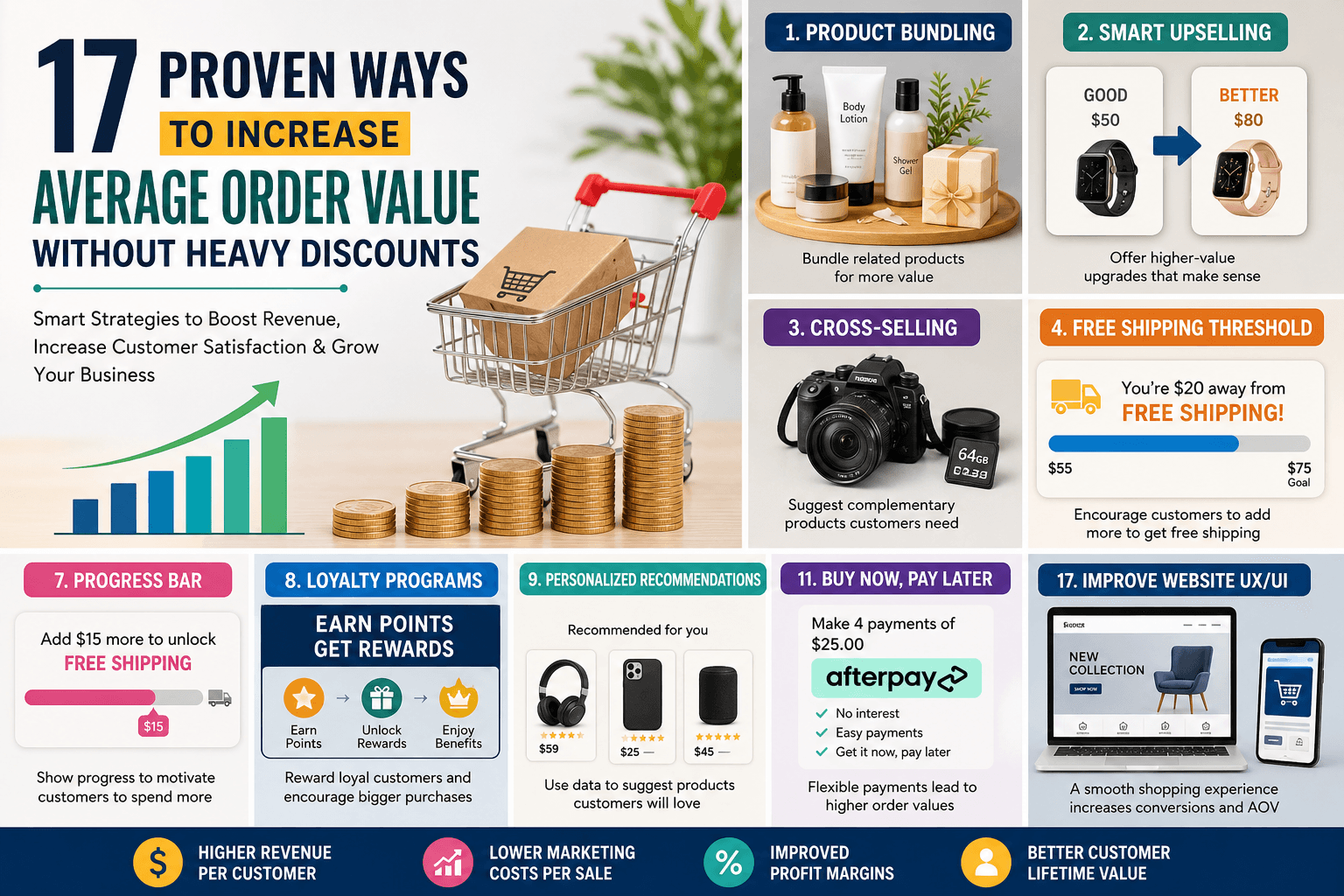
Average order value (AOV) is how much customers spend per transaction. Raising it is one of the fastest paths to more revenue without chasing more traffic—as long as you choose tactics that respect margin and trust. Pair this guide with how to calculate AOV and the AOV Optimizer so every idea is grounded in numbers.
Introduction to average order value (AOV)
What is AOV and why it matters
AOV summarizes spend per checkout. When you prioritize smarter merchandising instead of perpetual discounting, you grow revenue while keeping profitability healthier. These approaches focus on value, relevance, and low-friction buying—which is exactly what repeats well.
Benefits of increasing AOV
- Higher revenue per customer on the same order volume.
- Lower marketing cost per dollar of revenue when paid traffic converts into larger carts.
- Improved profit margins when lifts come from bundles, services, or premium options—not margin-eating promos.
- Better customer lifetime value when programs and UX encourage repeat, higher-trust purchases.
1. Use product bundling strategically
Types of product bundles
Bundling combines related products into one attractive package—think a complete skincare set instead of one-off bottles. Common formats include pure bundles (sold only together), mix-and-match sets, and frequently bought together offers. Bundles increase perceived value and encourage customers to spend more in a single decision. For interactive packaging tests, see the pricing & bundling simulator.
2. Implement smart upselling techniques
Upselling vs cross-selling
Upselling nudges shoppers toward a higher-end version of what they already want—for example, upgrading from a basic phone to a premium model with clearer benefits. Keep the price step reasonable (often roughly 20–30%) so the jump feels plausible, not predatory.
3. Cross-sell complementary products
Examples of effective cross-selling
Cross-selling suggests complementary needs: laptop → protective bag; camera → memory card. Marketplaces excel with “customers also bought” patterns because the relevance is obvious. Keep suggestions tight and helpful—noise reduces conversion.
4. Offer free shipping thresholds
Psychology behind free shipping
Many buyers resist paying shipping more than spending a bit more on product. Messaging like “Free shipping on orders over $75” nudges baskets upward—just confirm the threshold aligns with your contribution margin after shipping costs.
5. Create volume-based pricing
Tiered pricing models
Tier packs encourage bulk: buy one at full price versus three at a staged discount that still clears margin floors. The goal is order-size growth anchored in unit economics—not a race to the bottom.
6. Use limited-time offers
Urgency and scarcity tactics
Countdown timers, low-stock cues, or short windows increase motivation when they are truthful. Abuse erodes trust; responsible urgency converts without training customers to wait for endless sales.
7. Add a progress bar for cart value
Visual motivation techniques
A cart progress bar—“You’re $15 away from free shipping”—makes progress tangible. Combine with concise copy and mobile-friendly layouts so motivation doesn’t become clutter.
8. Introduce loyalty programs
Reward systems that work
Points per dollar spent, tiers, or exclusive perks encourage repeat purchases and sometimes larger carts to unlock the next reward. Model liability and breakage so the program strengthens margin over time.
9. Personalize product recommendations
AI and behavioral targeting
Strong personalization uses onsite behavior and purchase history to propose products shoppers are likely to add. For a platform-level primer, see Shopify’s overview of product recommendations. Tie recommendations to margins and fulfillment constraints—not only click-through rate.
10. Optimize product pages
High-converting product descriptions
High-performing PDPs clarify benefits, show crisp imagery/video, preempt objections with FAQs, and surface reviews. Strong pages raise conversion and make premium add-ons feel like natural choices—increasing AOV when paired with modular offers.
11. Use buy now, pay later options
Reducing purchase friction
Installment plans can soften sticker shock for legitimate premium purchases—expanding affordability without blanket percent-off promos. Ensure fees, approvals, and dispute flows match your brand promise.
12. Highlight best-sellers and premium options
Anchoring pricing strategy
Thoughtful anchoring—showing a premium reference before the standard option—can make the mid-tier feel like the smart choice. Keep ethics in view: anchoring should inform, not manipulate with dark patterns.
13. Provide value-added services
Gift wrapping, customization
Extras such as gift packaging, engraving, installation help, or extended protection plans increase order value when customers value convenience. Price them as clear line items shoppers can opt into.
14. Use exit-intent offers
Retaining potential buyers
When someone signals exit intent, respectful prompts—related items, bundles, or a soft education hook—can recover intent without hostile popups. Test impact on bounce, completion rate, and margin together.
15. Leverage social proof
Reviews and testimonials
Ratings, UGC galleries, and specific testimonials reduce perceived risk so shoppers confidently add upgrades or extra items. Prioritize authenticity and recency filters so proof stays credible.
16. Offer subscription models
Recurring revenue benefits
Subscribe-and-save or curated boxes lengthen customer relationships and stabilize demand. Subscription economics should include churn, cancellations, and fulfillment complexity—not only recurring top line.
17. Improve website UX/UI
Seamless checkout experience
Fast pages, mobile-first layouts, discoverable navigation, and a clean checkout reduce drop-off so upsells and bundles actually convert. UX is the multiplier on every other AOV tactic.
FAQs about increasing average order value
What is a good average order value?
Can I increase AOV without discounts?
Which AOV strategy usually works fastest?
Does upselling annoy customers?
How does personalization help AOV?
Are loyalty programs worth it for AOV?
Conclusion
Growing revenue does not require slashing prices. These seventeen approaches emphasize value, relevance, and experience—bundling, upselling, personalization, loyalty, and frictionless checkout among them. Start with one or two levers, measure AOV with conversion and margin, then scale what compounds.