What are ecommerce conversion rate benchmarks in 2026?
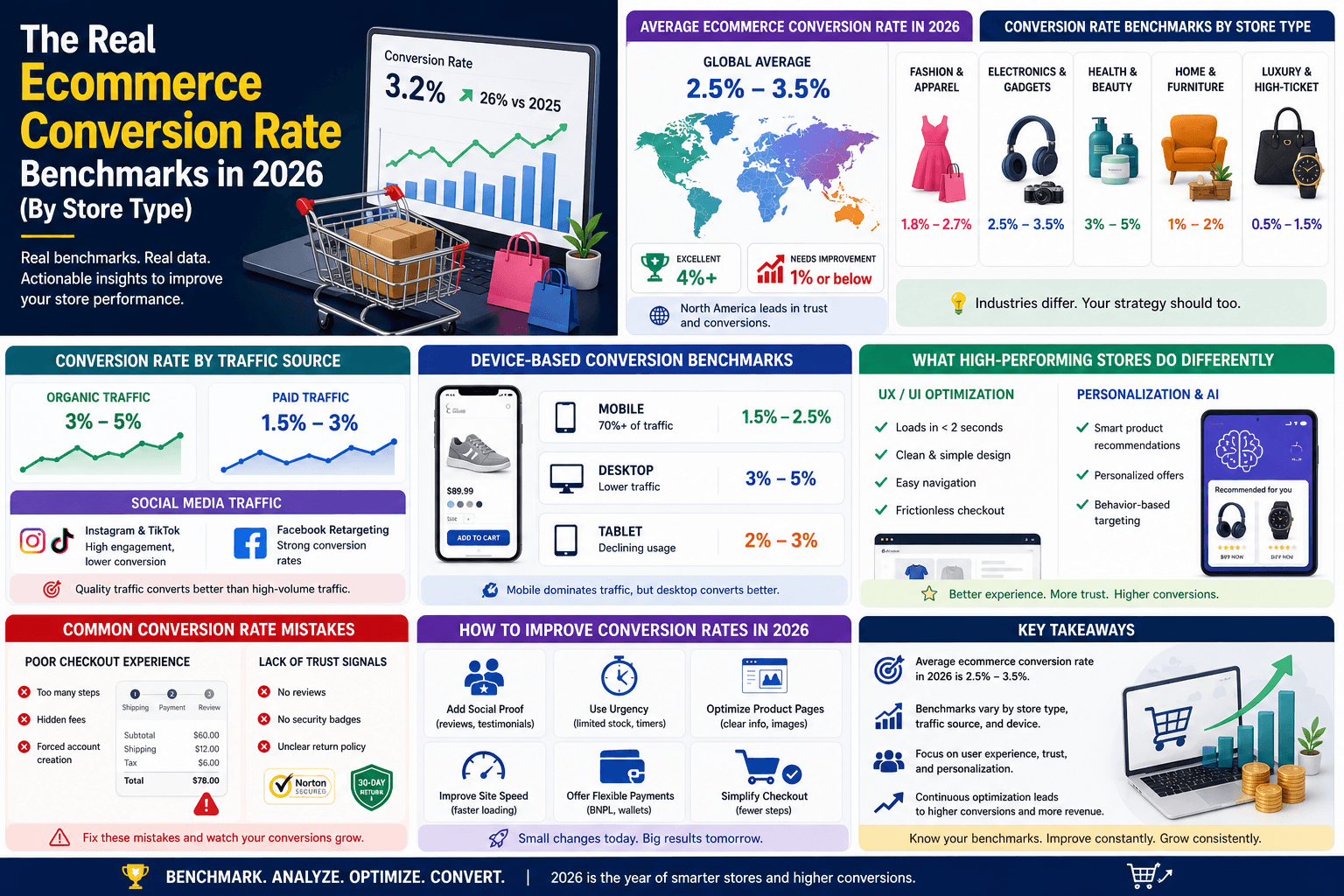
Ecommerce conversion rate — Directional bands cluster around roughly 2.5–3.5% for many storefronts—with higher performers above ~4% and weak funnels nearer 1% or below—yet vertical, ticket size, geography, device, and acquisition mix swing results more than a single headline number.
Benchmarks
Average ecommerce cart abandonment rate is 70.19%.
Source: Baymard Institute — Cart Abandonment Rate Statistics (2024)
Average ecommerce conversion rate is often ~2–3% (varies widely by industry and traffic mix).
Source: IRP Commerce — Ecommerce Market Data (Jan 2026)
Key takeaways
- Global “average” bands are only a starting point—niche, price, and traffic mix change what “good” means.
- Organic and email-style intent often converts above cold paid social; social can engage without buying until retargeting or landing pages sharpen fit.
- Mobile drives most visits in many catalogs, but desktop still wins on conversion for numerous brands until mobile UX catches up.
On this topic: Ecommerce Simulator · Online Business Lost Sales: The Complete 2026 Data Study — Why 70% of Carts Abandon, 10 AI Skills Every Ecommerce Owner Needs in 2026 (And Where to Learn Them)
A strong ecommerce conversion rate baseline helps you prioritize CRO efforts instead of debating mystery numbers. In 2026, with expensive traffic and picky buyers, benchmarking by store type, source, and device tells you whether to fix creatives, journeys, or on-site UX first. Compare your storefront to directional ranges below, then validate with the conversion benchmark checker and My Store benchmarks against your own data.
Introduction to ecommerce conversion rates
What is a conversion rate in ecommerce?
A conversion rate in ecommerce is the percentage of visitors who complete a desired action—usually a purchase. If one hundred people visit your store and three buy, your conversion rate is 3%. Understanding real ecommerce conversion rate benchmarks in 2026 (by store type and context) clarifies whether you are trailing peers with similar carts and traffic or punching above weight.
Why conversion rate matters more than ever in 2026
In 2026, earning attention is pricey: paid auctions stay competitive, creatives fatigue faster, and buyers compare endlessly.
- Lowers acquisition cost: the same sessions produce more revenue.
- Raises ROI: every click pays back better when onsite experience closes the loop.
- Protects profitability: you grow without always buying incremental reach.
Key factors influencing conversion rates
Traffic quality vs quantity
Volume means little if viewers were never going to purchase. Stores with a thousand aligned visitors routinely beat rivals with tens of thousands of mismatched impressions. High-performing sources often include nurtured email flows, deliberate SEO intent, disciplined retargeting, and creators who pre-qualify the audience.
Mobile vs desktop performance
Phones supply the majority of sessions in many storefronts, yet desktop still converts higher in plenty of verticals thanks to screen real estate, easier form completion, and fewer interruptions. Your roadmap should treat mobile speed and navigation as non-negotiable even while you harvest desktop margin.
Average ecommerce conversion rate in 2026
Global benchmark overview
Directional global bands you can use for planning conversations (not legal guarantees) sit around 2.5–3.5% for many mixed catalogs. Treat 4%+ as strong when margin and returns still work, and 1% or below as a prompt to audit funnel, offer-market fit, and trust—especially if paid traffic dominates.
Regional differences
- North America: comparatively high trust markers and mature payment rituals often support healthier conversion when traffic is domestic.
- Europe: broadly strong, with localized compliance UX (consent banners, disclosures) influencing session flow.
- Asia–Pacific: massive traffic upside with heterogeneous payment and logistics expectations—always segment before copying a single percentage target.
Conversion rate benchmarks by store type
These ranges summarize how vertical dynamics—consideration length, impulse, SKU complexity—shift performance. Tune your experiments to category psychology, not vague “industry averages.”
Fashion and apparel stores
Average band: ~1.8–2.7%. Sizing ambiguity and return anxiety drag completion, while scarcity drops and strong lifestyle creative can ignite impulse carts. Investing in clarity on fit, policy, and social proof lifts both conversion and profitability.
Electronics and gadgets
Average band: ~2.5–3.5%. Spec-heavy buyers linger on PDPs and third-party validation. Rich comparison tables, authoritative reviews, and warranty clarity outperform generic hype.
Health and beauty
Average band: ~3–5%. Routine replenishment, subscription hooks, and creator trust compress hesitation. Sampling programs and ingredient transparency continue to separate leaders from skeptics.
Home and furniture
Average band: ~1–2%. Larger tickets and logistic complexity stretch decision cycles—expect heavier assistance, financing education, and delivery clarity. Abandoned-cart workflows matter disproportionately here.
Luxury and high-ticket stores
Average band: ~0.5–1.5%. Few shoppers convert per session but order values compensate. Editorial storytelling, concierge chat, authenticated payments, and returns confidence remove friction for discretionary spend.
Conversion rate by traffic source
Organic vs paid traffic
Organic search often lands in roughly the 3–5% conversion band when intent matches catalog depth—searchers researched the problem already. Paid prospecting tends to occupy ~1.5–3% unless creative and landing pages obsess over message match. Blend both in reporting so optimism bias does not creep in.
Social media traffic performance
TikTok and Instagram excel at exploration and influencer proof, yet impulse alone rarely replaces nurtured journeys—expect engagement-first metrics upstream of purchase. Facebook and Meta retargeting, when seeded with catalogs and exclusions, routinely posts some of the strongest social conversion rates because audiences already know your brand story.
Device-based conversion benchmarks
Mobile conversion trends
Mobile can represent 70%+ of visits for trending DTC brands while converting near 1.5–2.5% in many datasets—unless you compress steps, preload wallets, and shed hero-weight assets.
Desktop vs tablet
Desktop frequently lands around 3–5% completion for comparable catalogs because navigation and payments feel effortless. Tablet usage keeps shrinking for general shopping, so invest only where analytics prove meaningful volume.
High-performing stores: what they do differently
UX and UI optimization
Top-quartile experiences layer speed, clarity, and confidence:
- Perceived load under about two seconds on key templates.
- Layouts that surface benefits, proof, and policy without overwhelming.
- Checkout paths with transparent totals, trusted payment badges, and guest purchase paths.
For checkout specifics, extend reading with checkout optimization beyond abandonment metrics.
Personalization and AI
Recommendation engines that respect inventory economics outperform static carousels, especially when coupled with contextual offers. For vendor-neutral context on tailoring experiences, review Shopify’s overview of ecommerce personalization.
Common conversion rate mistakes
Poor checkout experience
Checkout debt quietly bleeds margin:
- Too many steps or redundant data entry.
- Fees that appear only after intent peaks.
- Forced account creation before payment.
Pair structural fixes with messaging tests—see also pop-up conversion tactics that capture leads without sabotaging checkout focus.
Lack of trust signals
Missing reviews, vague return windows, or absent security seals increase anxiety on first purchase. Make policies scannable, surface UGC, and sync trust icons with the payment methods you actually support.
How to improve conversion rates in 2026
Proven CRO strategies
- Social proof everywhere: quotes, star ratings, and media logos near CTAs.
- Ethical urgency: honest inventory levels or shipping cutoffs instead of fake timers.
- Product page depth: imagery, comparison modules, and objection-handling FAQs.
- Site speed: compress media, lazy-load below the fold, monitor Core Web Vitals.
- Flexible payments: BNPL, digital wallets, and localized methods where credit access matters.
- Simplified checkout: fewer surprises, address autocomplete, and transparent delivery timelines.
Stress-test scenarios with the ecommerce simulator before scaling spend, so conversion assumptions stay honest.
FAQs about ecommerce conversion rates
What is a good ecommerce conversion rate in 2026?
Why are my conversion rates low?
Do mobile users convert less?
Which industry has the highest conversion rate?
How can I quickly improve conversions?
Does site speed affect conversion rates?
Conclusion
Mastering real ecommerce conversion rate benchmarks in 2026 (by store type) gives you a shared language with finance and growth teams: you know when paid media is fine but landing pages are not, or when catalog economics—not creatives—cap performance. Keep lifting UX, trust, and personalization in tight loops; incremental wins compound when traffic costs stay stubborn.