What studies of ChatGPT, Gemini and Perplexity citations show about page structure, access and evidence, with a readiness comparison of five ecommerce publishers.
Benchmarks
Average ecommerce conversion rate is often ~2–3% (varies widely by industry and traffic mix).
Source: IRP Commerce — Ecommerce Market Data (Jan 2026)
Average ecommerce cart abandonment rate is 70.19%.
Source: Baymard Institute — Cart Abandonment Rate Statistics (2024)
Key takeaways
- Retrieval comes first: a page can only be cited if the engine's own search found it.
- Title and best-paragraph match with the question showed the cleanest within-site effect (14.1% and 15.5% more citations per standard deviation).
- FAQ blocks, schema and page speed showed no significant within-site effect, and Google says no special markup is needed.
- Major AI bots did not render JavaScript in a December 2024 measurement, so keep main text in server HTML.
- Track citations per engine over repeated runs, and track clicks and revenue alongside them.
On this topic: Ecommerce Simulator, Free GEO audit · Ecommerce Customer Retention: What Field Experiments Reveal, Influencer Marketing and Creator Growth: What 37 Peer-Reviewed Studies Actually Found
Getting cited by AI searchdepends first on being retrieved by the engine's own search, then on matching the question and giving it evidence it can check. The best-controlled studies find that FAQ blocks, schema markup and page speed do not raise citations once you compare pages on the same site. Treat each tactic as a hypothesis and test it per engine.
Most advice on AI search is a list of tactics with a confident number attached. We wanted to go the other way. It reads the studies that measured what AI engines cite, grades how much each one can support, and then applies the same checks to four competitors and to our own pages.
Many of the studies are preprints that have not been through peer review, and the engines change often. Where the evidence is thin, we say so.
What does the research say about getting cited by AI search?
Five findings recur across the studies we read. They are listed below with the strongest design behind each, followed by the sources that carry the most weight.
- Retrieval comes first. A page can only be cited if the engine's search found it.
- Matching the question matters more than page decoration.
- Checkable evidence on the page is associated with more influence on the answer.
- Markup and formatting tricks show little or no effect once site-level differences are removed.
- Results differ by engine and shift from run to run.
| Study | Design | Scale | How much weight |
|---|---|---|---|
| Aggarwal et al., KDD 2024 | Rewrite methods tested on a benchmark | 10,000 queries | Peer-reviewed, but measures visibility inside answers where the source was already supplied |
| Puerto et al., NeurIPS 2025 | Same methods retested across six domains | About 1,900 queries, 16,000 documents | Peer-reviewed, English only |
| Chen & Koudas, 2026 | Observed citations, pages compared within the same site | 143,249 answers, 7,234 websites | Strongest observational design found; preprint; associations only |
| Zhang Kai, He Xinyue & Yao Jingang, 2026 | Descriptive analysis of cited pages | 602 prompts, 18,151 pages | Preprint; no confidence intervals; correlational |
| Kim et al., 2026 (SAGEO Arena) | Simulated search pipeline with edited documents | 2,700 queries, 171,003 documents | Preprint; one retriever and one reranker, so engines may differ |
| Vishwakarma et al., 2026 | Controlled two-source trials | 252,000 trials, six models | Listed under SIGIR 2026 on the preprint; synthetic content |
| Grossman et al., SIGIR 2026 | Google Search vs AI Overviews vs Gemini | 11,500 real queries | Peer-reviewed venue |
A 2026 survey of 45 studies reached a similar conclusion: relevance and position in the context are the most reliable levers, and no technique showed a stable cause-and-effect gain in organic discoverability across engines. Survey record.
Why does retrieval come before everything else?
Chen and Koudas followed 651 questions written for a US fiber internet provider, daily, across ChatGPT, Gemini and Perplexity. They compared pages only against other pages on the same site. In that comparison, a page whose title matched the question was cited 14.1% more often per standard deviation (95% CI 10.7% to 17.6%), and a page with a better-matching best paragraph was cited 15.5% more often. For ChatGPT, page properties explained 2.8% of the variation between pages of one site, while what the engine's own search retrieved explained 32%. Study record.
The caveat is that this is one market with questions written for one business type, and the authors report associations, not proof of cause.
The SAGEO Arena team tested the same idea from the other side. Extending the edits from body text to structural fields such as meta descriptions, headings and schema markup raised the retrieval hit rate by 22% in their simulated pipeline, and the authors concluded that body-only edits were not enough. Study record. For an ecommerce publisher the practical reading is simple: write the title and the first paragraph of each section in the words a buyer would type.
Can AI bots actually read your page?
In December 2024, Vercel and MERJ analysed server data from Vercel's network and reported that none of the major AI bots they measured rendered JavaScript. That list included OpenAI's bots, ClaudeBot and PerplexityBot. Gemini was the exception because it uses Google's own rendering. They also found that ChatGPT's bot spent 34.82% of its fetches on pages that returned a 404, against 8.22% for Googlebot. Vercel and MERJ.
That is a 2024 measurement, so check it against your own logs. The safe reading for a store is to keep the main text, headings and prices in the HTML the server sends, and to keep redirects and old URLs tidy.
Google's own guidance, last updated 10 July 2026, says structured data is not required for generative AI search and that you do not need special phrasing, chunking or AI-specific files. It recommends a good page experience and text that can be read. Google guide. In a separate study of 11,500 queries, sites that blocked Google's AI bot were significantly less likely to be retrieved by AI Overviews. Study record.
What kind of evidence on the page helps?
Zhang Kai and colleagues measured how much each fetched page shaped the answer. Pages containing numbers and statistics scored 61.55% higher on their influence measure, pages with definitions 57.33% higher and pages with comparisons 55.28% higher. Pages formatted as question and answer scored 5.74% lower, which the authors read as a sign that packaging does not replace substance. Study record. The influence score is the authors' own construct and the result is correlational.
The controlled trials agree on the direction without agreeing on the recipe. Vishwakarma and colleagues ran 252,000 two-source trials and found that topic match, a stated price and a recent date acted as gatekeepers, while formatting had no reliable effect. Study record. The original GEO paper reported that adding citations, quotations and statistics improved visibility by up to 41% on one position-weighted metric, and that keyword stuffing did not help. Aggarwal et al.
Be careful with the 41%. It is a relative gain on one metric, measured when the source was already in front of the model. When Puerto and colleagues retested the same methods on a harder setup, only 3 of 54 cases showed a significant gain. Study record. So the useful lesson is to put real, sourced numbers and plain definitions on the page because they help a reader. Adding statistics as a tactic doesn't hold up.
Which popular tactics did not hold up?
Within the same website, Chen and Koudas found no significant effect for any of the usual recommendations. FAQ blocks, summary boxes, author boxes, schema markup and page speed each looked helpful when comparing different sites (for example, FAQ blocks went with 18.1% more citations), then stopped being significant within a site. The authors attribute the difference to sites that were already cited more adopting these habits. Study record.
That doesn't make them useless. Schema helps eligibility for search features, speed helps visitors, and an author byline helps readers judge you. The evidence just doesn't support selling them as a way to get cited. We also found no independent study on page speed or on author credentials as drivers of AI citation. Several vendors publish correlations, but none that we could verify with a stated method and controls.
How do our competitors compare?
A competitor check for AI search has two parts. The first is technical readiness, which you can read from public pages in an afternoon. The second is who the engines actually cite for your buyers' questions, which needs repeated runs. We don't claim to have done that second part here.
For the first part, we read one article each from Shopify, Klaviyo, Omnisend, Baymard and Triple Whale on 21 October 2026, plus one of our own. We used the raw HTML a server returns, with no JavaScript. This shows readiness. It doesn't show whether any engine cites these pages.
| Site | Words in raw HTML | H2 headings | Tables | JSON-LD types found | llms.txt |
|---|---|---|---|---|---|
| Shopify | 5,728 | 17 | 0 | None in the HTML | Yes |
| Klaviyo | 8,570 | 9 | 0 | BlogPosting, Person, Breadcrumb | Yes |
| Omnisend | 6,173 | 10 | 7 | BlogPosting, FAQPage, Product, Person | Yes |
| Baymard | 2,337 | 4 | 0 | BlogPosting, Person | Yes |
| Triple Whale | 1,931 | 10 | 0 | Article, Person | Yes |
| Growthegy | 2,983 | 13 | 1 | Article, FAQPage, Person, Breadcrumb | Yes |
Every site serves its full article text without JavaScript and publishes an llms.txt file, so neither is an edge any more. Google says you can ignore llms.txt files for its search, so that file only matters to other services. The articles differ in length, in tables and in markup, and the research above gives no reason to think those differences explain who gets cited. The Triple Whale page was a company-history post, not a guide, and Shopify's JSON-LD may be added by scripts after the page loads, so read those two rows with care. This is one article per site, taken once.
The honest conclusion is that we have no structural gap to close against these peers. What separates sites is more likely to be the depth of what they cover and how often other sites mention them. A 2025 study of earned versus brand-owned sources found AI search leaned heavily on third-party content: for US consumer electronics queries, 92.1% of cited sources were earned media. Study record.
How to run the second part yourself
- Write 10 questions a buyer would ask before choosing you or a competitor.
- Run each question on ChatGPT, Perplexity, Gemini and Google AI Overviews, on at least three different days, with two phrasings each.
- Log which domains are cited and where yours appears.
- Compare your share with each competitor, by engine, not as one blended number.
We know of no standard academic method for this. The repeat runs are there because Grossman and colleagues found the sources retrieved by Google Search, AI Overviews and Gemini overlapped by less than 0.2 on average, and AI Overviews were less consistent across repeated runs of the same query. Study record.
What does this mean for how you measure?
Fewer clicks reach publishers when an AI summary appears. Pew Research analysed browsing data from 900 US adults in March 2025. People clicked a traditional result in 8% of visits when a summary was shown and in 15% of visits when it was not, and they clicked a link inside the summary in 1% of visits. Pew Research Center.
Track citations per engine over repeated runs, and keep tracking clicks, orders and revenue next to them. A citation is not a sale.
What should an ecommerce team do first?
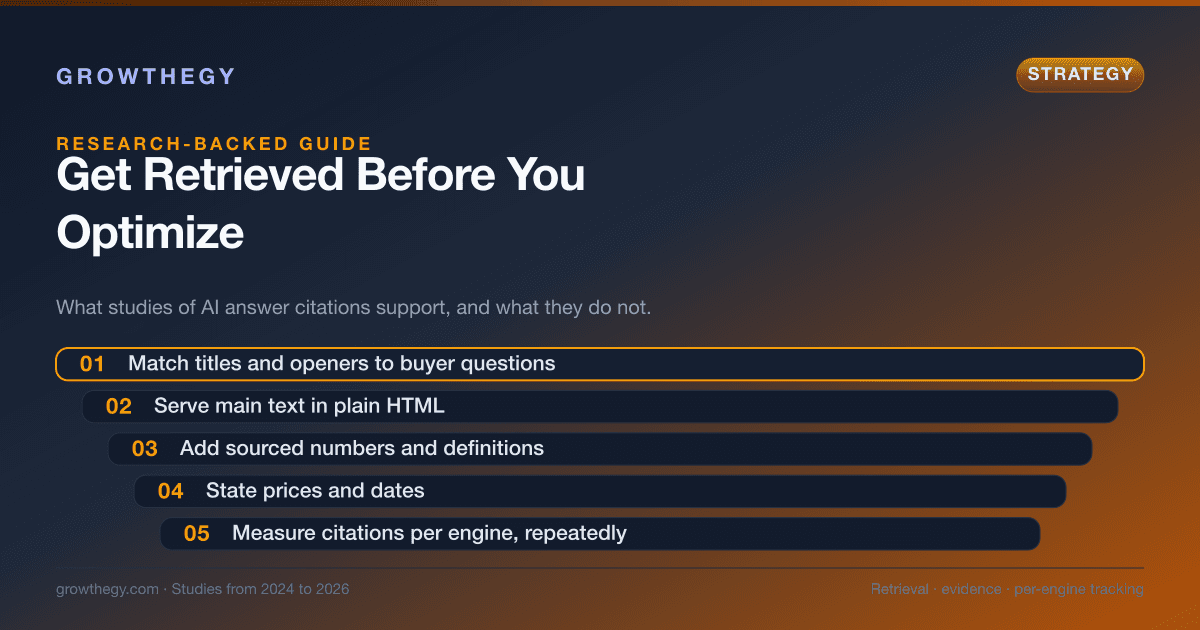
- Write titles and section openers in buyer language. Match the questions people ask.
- Put the main text in server-rendered HTML. Fix 404s and redirect chains on old URLs.
- Add sourced numbers and plain definitions where they help the reader. Show the source and year.
- State prices and dates. One controlled study found price and a recent date acted as gatekeepers, and a 2026 survey says prices and dates have a plausible advantage.
- Keep schema, FAQs and speed for users and search. Do not expect them to change AI citations by themselves.
- Run the competitor check above and repeat it every quarter.
To check a page against the technical and structural items, you can run it through our free GEO audit. It reads the page the way a bot does and reports a 0 to 100 score across five groups of checks: bot access, structure, citability, authority and schema. It asks for your email, shows the result on the page, and sends a fuller report afterwards. The score counts which features are present. It doesn't measure how likely any engine is to cite the page, and some of its checks, such as FAQ blocks and schema, are ones the research above does not link to more citations.
What this evidence cannot tell you
Most of the studies are preprints from 2025 and 2026, and several come from tool vendors or small teams. Engines change often, so a result can age within months. Several studies use English queries only, and the largest observational dataset was built around one US service category. We read the studies as published pages, so some details, such as full odds-ratio tables, were not examined. Page speed and author credentials remain untested as causes of citation.
One result holds across the stronger studies: the engine's retrieval step decides what can be cited. Make the page easy to retrieve, easy to read and worth quoting, then measure it.
Selected studies and sources
- Aggarwal et al. (2024), GEO: Generative Engine Optimization, KDD 2024. arXiv 2311.09735
- Puerto et al. (2025), C-SEO Bench: Does Conversational SEO Work?, NeurIPS 2025. arXiv 2506.11097
- Chen, Wang, Chen & Koudas (2025), Generative Engine Optimization: How to Dominate AI Search. arXiv 2509.08919
- Kim et al. (2026), SAGEO Arena, 2,700 queries and 171,003 documents. arXiv 2602.12187
- Zhang Kai, He Xinyue & Yao Jingang (2026), From Citation Selection to Citation Absorption, 602 prompts. arXiv 2604.25707
- Grossman et al. (2026), How Generative AI Disrupts Search, SIGIR 2026, 11,500 queries. arXiv 2604.27790
- Vishwakarma, Kumar & Jamidar (2026), What Gets Cited: Competitive GEO in AI Answer Engines, 252,000 trials. arXiv 2605.25517
- Critical survey of generative engine optimization, 2023 to 2026 (2026), 45 studies. arXiv 2607.14035
- Chen & Koudas (2026), What Drives AI Citations?, 143,249 answers. arXiv 2610.15033
- Vercel and MERJ (17 December 2024), report on AI bot traffic and JavaScript. Vercel blog
- Google Search Central, AI optimization guide (updated 10 July 2026). Google documentation
- Pew Research Center (22 July 2025), Google users are less likely to click on links when an AI summary appears, 900 US adults. Pew short read
Research synthesis by Moheb. Published 21 October 2026. Competitor pages read on 21 October 2026.
Check a page with the free GEO audit | Practice a decision in the Ecommerce Simulator