How do you learn ecommerce and start an online business?
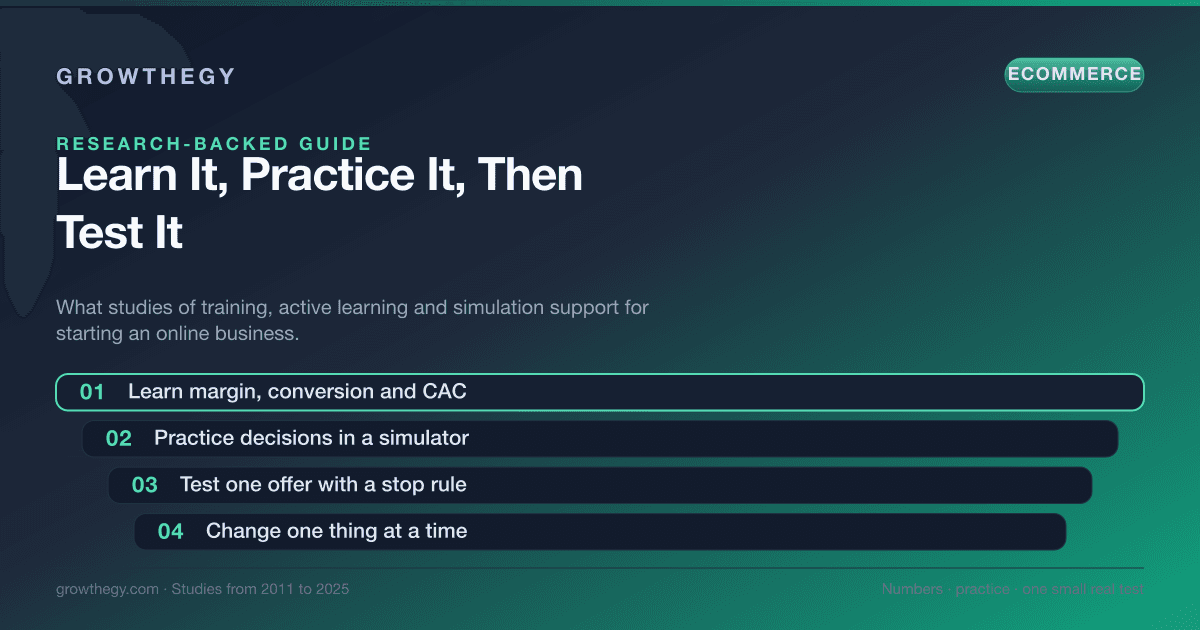
Learning ecommerce — Learn the numbers that decide survival first (margin, conversion rate, acquisition cost, break-even), practice decisions in a low-cost setting, then run one small real test with a stop rule set in advance. A 225-study meta-analysis found active learning beat lecturing, and business-training reviews show training helps people launch sooner but rarely proves a profit gain.
Benchmarks
Average ecommerce conversion rate is often ~2–3% (varies widely by industry and traffic mix).
Source: IRP Commerce — Ecommerce Market Data (Jan 2026)
Average ecommerce cart abandonment rate is 70.19%.
Source: Baymard Institute — Cart Abandonment Rate Statistics (2024)
Key takeaways
- Learn margin, conversion, order value, acquisition cost and break-even before spending on traffic.
- A 225-study meta-analysis found active learning beat lecturing: about 6% higher exam scores and 21.8% vs 33.8% failure.
- Business-training reviews find training helps people launch sooner, with little proof of a profit gain.
- Simulation games work best as a supplement: 65 studies, 6,476 trainees, with publication bias flagged.
- Practice in the Ecommerce Simulator, then run one small real test with a stop rule set in advance.
On this topic: Ecommerce Simulator · Ecommerce Simulators and Learning Tools: What Each One Actually Teaches (2026), Ecommerce Simulator Niche Baselines: What the Teaching Model Assumes (2026)
To learn ecommerce and start an online business, learn the few numbers that decide whether a store survives (margin, conversion rate, customer acquisition cost and payback), practice decisions in a cheap setting before spending real money, then run one small real test. The research supports this order. A 225-study analysis found active practice beats passive study, and business-training evaluations show training helps people launch sooner but rarely proves a profit gain.
Most advice on learning ecommerce is a list of courses and YouTube channels. Courses are fine. The harder question is what kind of learning leads to a store that makes money, and the answer comes from studies of how adults learn and what happens to people who take business training.
This guide pulls those studies together, says where each one stops being useful, and ends with a plan you can start this week. It makes no income promise, because nobody can honestly make one for a new store.
What does research say about learning to start a business?
McKenzie and Woodruff reviewed evaluations of business-training programs, mostly in developing countries. They found that owners adopt some of the practices taught, but the gains are often modest. Over the short horizons studied, training had only a modest effect on whether existing firms survived, and few studies found significant effects on profits or sales. The strongest finding was that training helps prospective owners launch new businesses sooner. Read the review.
Read that carefully. Many of the studies were underpowered and tracked people for under a year, so "no profit effect found" does not mean training does nothing. It means the evidence for a profit payoff is thin. Taking a course will probably get you moving. It won't, by itself, make your store profitable.
One randomized trial points at what kind of training might matter. Camuffo, Cordova, Gambardella and Spina taught one group of Italian startup founders to treat their idea as a hypothesis: write down what must be true, then test it before committing. A comparison group relied on intuition. The trained founders performed better and were not more likely to drop out. Summary from Bocconi University. The sample was about a hundred founders, in one country, and the products were not all ecommerce. It's one trial, but the habit it teaches is cheap to copy: decide what result would change your mind before you spend the money.
Does learning by doing beat watching and reading?
The best evidence on this is from classrooms, not stores. Freeman and colleagues analyzed 225 studies of undergraduate STEM courses. Students in courses with active learning scored about 0.47 standard deviations higher, roughly 6% on exams, and failed less often: 21.8% against 33.8% under traditional lecturing. Study on PubMed Central. The subject was science and math, so treat it as evidence about how people learn and nothing more.
Simulation games have their own meta-analysis. Sitzmann combined 65 studies with 6,476 trainees. Compared with groups that did not use a game, trainees scored about 11% higher on declarative knowledge, 14% on procedural knowledge and 9% on retention, and reported about 20% higher self-efficacy. The games worked better when they presented material actively, when trainees could replay them as often as they wanted, and when they supplemented other instruction instead of replacing it. The abstract also warns of strong evidence of publication bias, so the real effect may be smaller. Abstract.
The practical reading: a simulator is a good place to practice, and a poor place to learn everything. Pair it with real lessons and a real test.
How often do new businesses survive?
The US Bureau of Labor Statistics tracks every private-sector establishment that opens. Across cohorts it tracks, one-year survival ranged from 75.2% to 80.9%. Five-year survival ranged from 45.4% to 51.9%, and ten-year survival from 32.4% to 35.3%. BLS Business Employment Dynamics, Table 7.
These are all industries, and the count includes new locations of existing firms, so they are not an ecommerce failure rate. I couldn't find a clean one. What the table does give you is a base rate: about half of new establishments are gone within five years. The reasons vary, and I didn't find a study that isolates which skill gaps cause them. It does explain why practicing the economics before you spend money is sensible.
Which numbers should you learn first?
Start with the numbers that decide whether a sale makes or loses money. You don't need all of ecommerce on day one. You'll need these six, and each links to a plain-language definition.
| Number | The question it answers | Read more |
|---|---|---|
| Gross margin | How much is left after the product costs you? | Gross margin |
| Conversion rate | What share of visitors buy? | Conversion rate |
| Average order value | How much does a typical order bring in? | AOV |
| Customer acquisition cost | What does it cost to win one customer? | CAC |
| Break-even point | How many sales cover your fixed costs? | Break-even point |
| Lifetime value | What is a customer worth over time? | LTV |
Put together, they form your unit economics. If a customer costs more to win than they bring in, more traffic only loses money faster. For a worked version on real store data, see the LTV, CAC and payback guide.
Conversion is where beginners lose most of their traffic. Baymard Institute's aggregate of 49 studies puts the average documented cart abandonment rate at 70.19%. Baymard's list. Most visitors who start to buy do not finish, which is why checkout and trust details are worth learning early.
A four-step plan to learn ecommerce and start
- Week 1: learn the vocabulary and the platform. Work through the six numbers above. Add one platform course. Shopify Academy says it offers free education, though some of its courses are paid. Shopify Academy. If you plan to advertise, Meta says Blueprint offers free, self-paced courses. Meta Blueprint. Google Skillshop covers Google Ads and Analytics. Google Skillshop. Check each course page for current pricing before you commit.
- Weeks 2 and 3: practice decisions. Run a few full games in the Ecommerce Simulator with different business models. After each run, write down which decision hurt most and what you would do differently. This is the hypothesis habit from the Italian trial applied to a model.
- Week 4: test one real offer cheaply. Pick one product and one audience. Before you buy stock, write the result that would make you stop, for example a conversion rate or cost per sale you cannot afford. A small paid test or a landing page with a waitlist tells you more than a month of videos.
- After that: measure, then change one thing. Track margin, conversion, acquisition cost and repeat orders weekly. For ideas on what to test next, read what field experiments say about keeping customers and how to read ROAS against ROI.
Forum advice from experienced sellers tends to agree with this shape: build something small, get stuck, go back to learning, validate demand before ordering stock, and distrust cheap dropshipping margins. That is anecdote, not evidence, but it matches what the studies above suggest.
Where does the Ecommerce Simulator fit, and where does it stop?
The Growthegy Ecommerce Simulator is a turn-based model of an online store. Each turn you set marketing budget, price, channel mix and product focus, and traffic, conversion, order value, margin and cash update. Every turn produces a decision trace that explains what your choice changed. You can replay the same turn with the decision you did not make, and a forecast mode scores how accurately you predicted revenue and cash. Your data stays on your device and there is no account.
It also has real limits. It doesn't teach supply chain, shipping or fulfilment, and it doesn't teach store building, so you'll still need a development store for that. It's a model, so its numbers aren't a forecast for your business. I compare it with other tools in what each ecommerce simulator teaches, and explain the idea in what an ecommerce simulator is.
What this evidence cannot tell you
None of these studies measured people learning to run an ecommerce store. The training reviews cover mostly developing-country programs, the active-learning meta-analysis covers science classrooms, the simulation meta-analysis covers workplace training, and the survival data covers all industries. Together they support a direction, not a guarantee. If someone sells a course with a specific income figure, ask for the study. I couldn't find one for ecommerce.
Frequently asked questions
How long does it take to learn ecommerce?
No study gives a number, and I wouldn't trust one that does. You can learn the core vocabulary and run a first small test in about a month. Making a store reliably profitable takes longer and depends on your product, margin and audience.
Do I need a course to start an online business?
The evidence says training helps people launch sooner, but not that a paid course is required. Free platform training and hands-on practice cover the basics.
Is a simulator enough to learn ecommerce?
No. Simulation games are most effective as a supplement to other instruction. Use one to practice decisions, then run a small real test.
Sources
- Freeman et al. (2014), active learning in STEM, 225 studies. PubMed Central
- Sitzmann (2011), computer-based simulation games, 65 studies and 6,476 trainees, Personnel Psychology. Abstract
- McKenzie & Woodruff (2012), review of business-training evaluations, IZA discussion paper 6895. Record
- Camuffo, Cordova, Gambardella & Spina (2020), scientific approach to entrepreneurial decisions, Management Science. Bocconi summary
- US Bureau of Labor Statistics, Business Employment Dynamics, survival by opening year. Table 7
- Baymard Institute, cart abandonment rate, 49 studies. Baymard
Research synthesis by Moheb. First published 22 October 2026. Vendor course pages were checked on 22 October 2026.
Practice in the Ecommerce Simulator | Unit economics explained | Compare learning tools