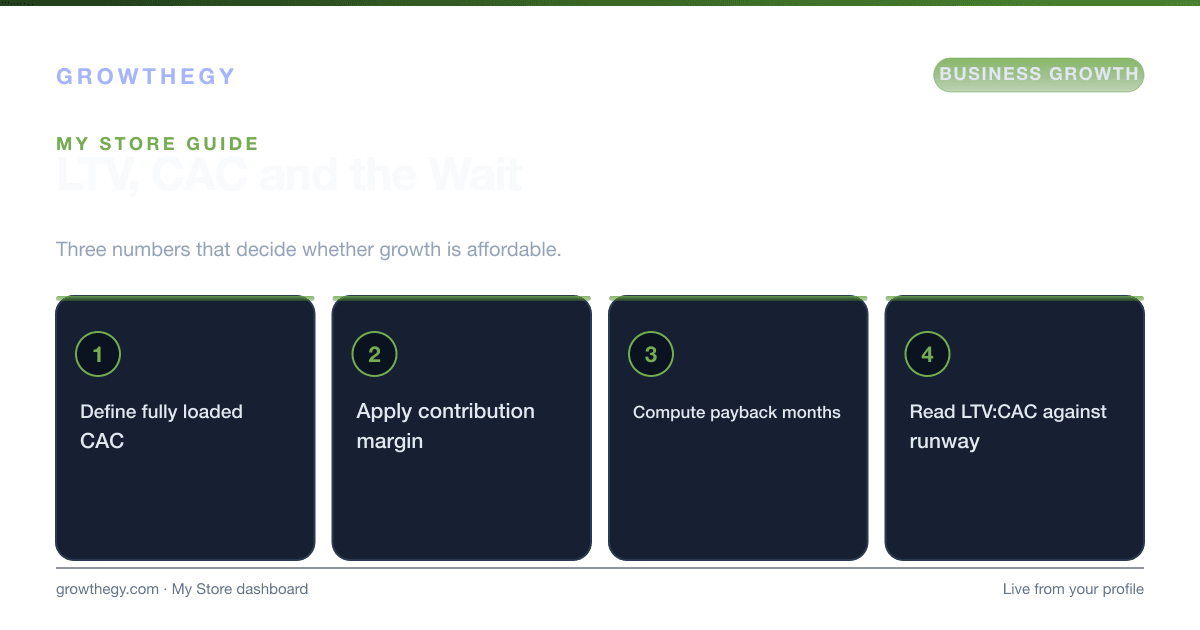
LTV, CAC, and payback for ecommerce (My Store guide)
How contribution LTV, LTV:CAC, and CAC payback work—with a live embed from your My Store profile.
Key takeaways
- Contribution LTV is average order value × orders per year × years active × contribution margin, not revenue.
- LTV:CAC compares lifetime profit with acquisition cost. Payback tells you how long that cash is tied up.
- A stress test on retention is more useful than a single LTV number, because small changes in repeat rate move LTV a lot.
- Rules of thumb such as 3:1 and 12 months are starting points. Your margin and cash position decide what is safe.
On this topic: Ecommerce Simulator · Cost of Growth: What It Is and How to Measure It, Gross margin, break-even, and ROAS (My Store guide)
Contribution LTV is the profit you expect from a customer over the relationship: average order value × orders per year × years active × contribution margin. Compare it with customer acquisition cost (CAC) to get LTV:CAC. Payback is how many months of contribution profit it takes to earn CAC back. Definitions are in the glossary for LTV, CAC, and payback period.
A worked example
The numbers are illustrative. A store sells a product with these assumptions:
- Average order value: $80
- Orders per customer per year: 2.0
- Average years active: 3
- Contribution margin after product cost, shipping, and payment fees: 45%
- CAC: $70
Over three years a customer places 6 orders. Revenue is 6 × $80 = $480. At a 45% contribution margin, contribution LTV is $216. LTV:CAC is $216 ÷ $70, or about 3.1.
Payback looks different. The first order earns $80 × 45% = $36, which does not cover the $70 CAC. After that the customer earns about $6 a month (2 orders a year ≈ 0.17 orders a month × $36). The remaining $34 takes roughly 6 months, so cash payback is about 6 months after the first purchase.
Stress-test retention
LTV is most sensitive to how often customers come back. If orders per year drop from 2.0 to 1.6, the same customer places 4.8 orders over three years, and contribution LTV falls to 4.8 × $80 × 45% = $172.80. LTV:CAC drops to about 2.5, and the payback stretches. A 20% change in repeat rate moved the ratio from comfortable to borderline, which is why a single LTV figure is risky to plan around.
Common mistakes
- Using revenue instead of contribution profit.
- Using blended CAC when paid channels cost far more than organic or referral.
- Projecting several years of retention from a few months of data.
- Ignoring returns, which reduce the revenue and profit you actually keep.
- Forgetting that payback affects cash: acquiring 100 customers at $70 means $7,000 out the door before the profit arrives.
How to use the ratio
A rule of thumb of roughly 3:1 and payback inside about a year is common, but it is a heuristic, not a law. A high-margin store with strong cash can run a lower ratio. A thin-margin store that finances growth from its own cash may need a faster payback. If the ratio looks weak, fix margin, retention, or acquisition cost before scaling spend. You can rehearse how payback changes when you tighten CAC or lift repeat purchases in the Ecommerce Simulator.
Enter your numbers once in your saved profile. The module below reads the profile saved in this browser.