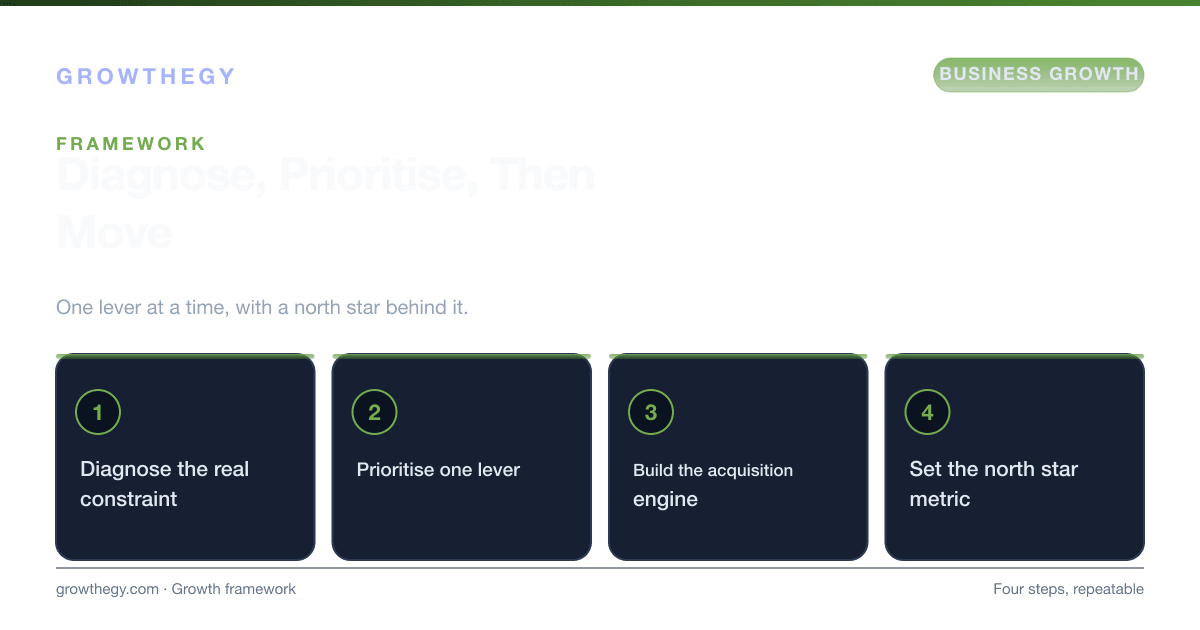
A practical growth strategy for business: diagnose, prioritize, and improve acquisition, activation, retention, and revenue.
Key takeaways
- Growth Strategy for Business: A Practical Framework — focus on one metric or lever at a time; validate with data before scaling spend.
On this topic: Ecommerce Simulator · How to Build a Data-Driven Growth Strategy for Startups (Proven Guide), Top AI Platform Skills Every Developer & Business Needs in 2026 (And Where to Find Them)
A growth strategy for business isn't a single tactic—it's a way to diagnose, prioritize, and improve how you acquire, activate, retain, and monetize customers. Here's a practical framework.
Most businesses that stall do so not because the market is too small or the product is wrong, but because they lack a systematic way to identify and address the highest-leverage opportunity in their funnel. Bain & Company's 2024 Growth Benchmarking Report found that businesses with a documented, metrics-led growth strategy are 2.4× more likely to outperform industry peers on revenue growth over a three-year period. The framework below is designed to give you that structure.
Step 1: Diagnose First
Map your funnel: where do people come from, where do they drop off, and where do you make money? Look at acquisition channels, activation (first value), retention, and revenue per user. The biggest opportunity is usually the stage with the largest leak or the highest leverage.
A diagnostic approach means being honest about your current numbers before choosing tactics. The most common mistake is assuming the problem is acquisition (not enough customers) when the real problem is activation (customers aren't experiencing value quickly enough) or retention (they leave after one or two interactions).
| Funnel Stage | Key Metric | Warning Signal | Likely Fix |
|---|---|---|---|
| Awareness / Acquisition | Traffic, leads, sign-ups | Flat or declining new visitors | Content, SEO, paid, partnerships |
| Activation | % completing a key action within first session/week | High sign-up, low day-7 engagement | Onboarding redesign, welcome sequence |
| Retention | D30 retention, churn rate, repurchase rate | High churn in first 30–90 days | Lifecycle email, loyalty, product value loops |
| Revenue | ARPU, AOV, MRR | Low upsell/cross-sell conversion | Pricing optimisation, bundles, upsell flows |
| Referral | NPS, referral rate, word-of-mouth mentions | Low NPS, no organic brand search growth | Referral programme, community, product virality |
Step 2: Prioritize One Lever
Don't try to fix everything. Pick one area—e.g. "improve activation" or "reduce churn"—and run focused experiments. Use data to decide, then double down on what works.
Prioritisation frameworks help you make this decision systematically. One widely used approach is ICE scoring (Impact × Confidence × Ease), where each initiative is scored 1–10 on each dimension and the product gives a ranking. This prevents the common bias of pursuing the most exciting idea rather than the most impactful one.
Sean Ellis, who coined the term "growth hacking," recommends a simpler filter: ask "If we could only work on one thing for the next 90 days that would most improve our growth, what would it be?" Getting your team to consensus on that question forces the prioritisation conversation that most businesses avoid.
Step 3: Build Your Acquisition Engine
Acquisition: Organic (content, SEO, GEO) and paid (ads, partnerships). Activation: Get users to value fast. Retention: Email, product habits, community. Revenue: Pricing, AOV, upsells—see our AOV optimizer for ecommerce.
A healthy acquisition engine combines multiple channels so that no single channel accounts for more than 50% of new customer volume. HubSpot's 2024 Marketing Report found that businesses with three or more acquisition channels grow 2× faster than single-channel businesses, and are significantly more resilient to algorithm changes and platform disruptions.
| Business Stage | Primary Focus | Secondary Focus | Key Metrics |
|---|---|---|---|
| Pre-product-market fit | Customer discovery, manual sales | Landing page / waitlist | Qualitative feedback, conversion rate |
| Early traction (0–$1M ARR) | Activation and retention | One or two acquisition channels | D30 retention, CAC, LTV:CAC |
| Scaling ($1M–$10M ARR) | Scalable acquisition (paid + organic) | Product-led expansion | CAC payback, NRR, organic traffic growth |
| Growth ($10M+ ARR) | Market expansion and new segments | Partnerships, enterprise, international | NRR, gross margin, CAC by segment |
Step 4: Set Your North Star Metric
A North Star Metric (NSM) is the single metric that best captures the core value your business delivers to customers and predicts long-term revenue. Examples:
- Airbnb: Nights booked
- Spotify: Time listening per user
- Slack: Messages sent per team per day
- Shopify merchants: GMV (Gross Merchandise Value)
- Ecommerce brands: Repeat purchase rate or 90-day LTV
Your NSM should be a leading indicator of revenue (not revenue itself), measurable, and something the whole team can influence. Once you have it, organise your OKRs and growth experiments around moving it.
Step 5: Build Your Experiment Rhythm
Growth strategy is only as good as your execution cadence. The most effective growth teams run on weekly experiment reviews, monthly funnel retrospectives, and quarterly strategy resets. A simple rhythm:
- Weekly: Review live experiments. Kill those without signal after statistical significance. Scale micro-winners.
- Monthly: Review full funnel metrics. Identify the single biggest constraint. Assign ownership for the next experiment sprint.
- Quarterly: Re-evaluate strategic priorities. Has the constraint moved? Which lever needs focus next quarter?
Amplitude's Product Analytics Report 2024 found that product and growth teams with a weekly experiment review cadence ship 3.5× more tests per year and generate 2× more revenue-impacting insights than teams without a structured rhythm.
Step 6: Measure and Attribute Correctly
Attribution is the hidden difficulty in growth strategy. Without reliable attribution, you can't know which channels and experiments are actually driving results. A few principles:
- Use first-touch and last-touch attribution together to understand both discovery and conversion channels.
- Invest in multi-touch attribution or Marketing Mix Modelling (MMM) as your budget scales beyond £/$ 50k/month on paid.
- Track cohort-level retention by acquisition channel to understand true LTV, not just initial conversion.
- Supplement data attribution with customer surveys asking "How did you hear about us?"—especially important as iOS privacy changes have reduced pixel-level tracking accuracy.
Step 7: Keep Iterating
Growth strategy is ongoing. Set a rhythm: review metrics, run tests, scale winners, then pick the next lever. For a structured starting point that covers each lever (LTV, pricing, profitability, ROI), use our Ecommerce Simulator.
The businesses that grow most consistently are those that treat strategy as a living document—reviewed and updated as the market, competition, and customer behaviour evolve—rather than as a static annual plan that sits untouched on a shelf.