How to Build a Data-Driven Growth Strategy for Startups (Proven Guide)
Learn how to build a data driven growth strategy for startups with proven frameworks, tools, and actionable steps to scale faster and smarter.
Benchmarks
Average ecommerce conversion rate is often ~2–3% (varies widely by industry and traffic mix).
Source: IRP Commerce — Ecommerce Market Data (Jan 2026)
Average ecommerce cart abandonment rate is 70.19%.
Source: Baymard Institute — Cart Abandonment Rate Statistics (2024)
Key takeaways
- How to Build a Data-Driven Growth Strategy for Startups (Proven Guide with 10… — focus on one metric or lever at a time; validate with data before scaling spend.
- Pair reading with the Ecommerce Simulator on Growthegy to practice unit economics and decisions before you spend.
- Bookmark growthegy.com/ecommerce-simulator/ for hands-on scenarios; use the blog for deeper guides.
On this topic: Ecommerce Simulator · Growth Strategy for Business: A Practical Framework, Top AI Platform Skills Every Developer & Business Needs in 2026 (And Where to Find Them)
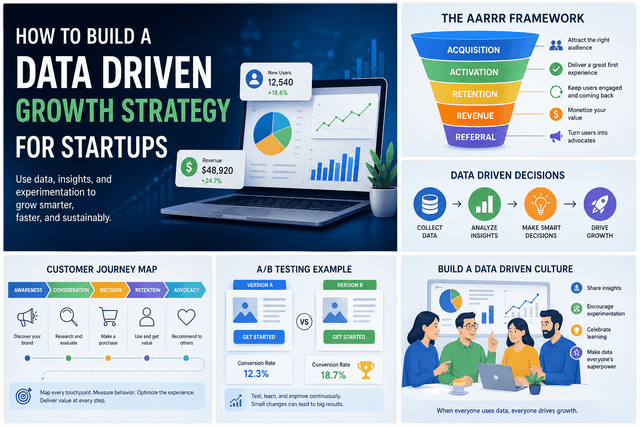
In a competitive market, guessing your way to growth is expensive. A data-driven growth strategy turns customer behavior into decisions: what to build, what to ship, and where to invest. The goal is simple: reduce wasted effort and scale what measurably works.
If you want a practical starting point for measurement and planning, use Ecommerce Simulator to find your biggest leak, then track your funnel in the Ecommerce Simulator.
What “data-driven” means in startups
Being data-driven means major decisions—from marketing campaigns to product changes—are backed by measurable outcomes. Instead of “What do we think will work?”, you ask “What does the data show is working?”
Why startups must rely on data instead of guesswork
- Limited resources: every dollar and hour needs a clear payoff.
- Fast feedback loops: data helps you learn quickly and avoid scaling the wrong thing.
- Predictability: instrumentation + experiments turn growth into a system, not a hope.
Foundations: the AARRR funnel (what to measure)
A clean way to structure growth metrics is the AARRR funnel. Measure each stage, find the biggest drop-off, then focus there until it stops being your limiting factor.
- Acquisition: how users find you
- Activation: first meaningful experience (time-to-value)
- Retention: keeping users engaged over time
- Revenue: monetization and willingness to pay
- Referral: word-of-mouth and sharing loops
Common mistakes startups make (and how to avoid them)
- Tracking vanity metrics: likes and impressions instead of activation, retention, and revenue.
- Ignoring behavior data: not instrumenting funnels, cohorts, and key events.
- Scaling too early: buying growth before you have repeatable activation/retention.
- Not testing assumptions: shipping changes without a hypothesis or measurement plan.
Step 1: set clear goals and KPIs
Define SMART growth goals
Goals should be Specific, Measurable, Achievable, Relevant, and Time-bound.
Example: Increase website conversions by 25% in 3 months.
Pick a North Star Metric (NSM)
Your North Star Metric should reflect the value users get from your product—so improving it creates long-term customer value.
- SaaS: weekly active teams, activated accounts, or “tasks completed”
- Ecommerce: contribution margin per customer, repeat purchase rate, or revenue per customer
- Marketplace: successful transactions completed
Step 2: collect the right data (quant + qual)
Quantitative vs qualitative data
- Quantitative: traffic, conversions, cohorts, revenue, churn
- Qualitative: interviews, surveys, support tickets, session recordings
Use both: numbers show what happened; qualitative explains why.
Practical tools for data collection
- Web analytics: GA4
- Product analytics: Mixpanel or Amplitude
- Behavior + UX: Hotjar (recordings/heatmaps)
- CRM: HubSpot (or your equivalent)
Step 3: build a customer-centric model (personas + journey)
Create data-backed personas
Base personas on real segments: acquisition channel, use case, company size (for B2B), pricing tier, and behavior patterns. Include pain points, desired outcomes, and what “success” looks like.
Map the customer journey
Track the key touchpoints from awareness → consideration → decision. Funnel analysis shows drop-offs; journey mapping shows what people experienced at each step.
Step 4: turn analytics into decisions
Data is only useful when it changes what you do. Build the habit of asking:
- Where do users drop off? (funnel)
- What drives conversions? (channel + landing + offer)
- What predicts retention? (cohorts + key actions)
Step 5: experiment to unlock 10× improvements
A/B testing that actually works
Test one variable at a time, keep the audience stable, and define success before you launch.
- Headlines: clarity, value, differentiation
- CTAs: wording, placement, friction
- Pricing: packaging, anchors, paywall timing
Use the loop: test → learn → improve
Growth is ongoing. Capture learnings, standardize winners (copy, onboarding steps, targeting), and keep a backlog of hypotheses tied to the funnel stage you are improving.
Step 6: scale what works (channels + automation)
Identify high-performing channels
Scale the channels that produce qualified users, not just cheap clicks. Validate with activation and retention, not only CPA.
If you run paid media, pair your tests with margin-aware tools like ROAS and break-even.
Automate growth systems
Automate the repetitive parts (lead nurturing, lifecycle messaging, reporting) so your team spends time on hypothesis quality and execution speed.
Step 7: align the whole team around data
A data-driven culture is built on shared definitions (what counts as activated?), transparency, and experiments that are visible across marketing, product, and sales.
Challenges to watch for
- Data overload: too many dashboards, not enough decisions.
- Misinterpretation: correlation mistaken for causation; seasonality ignored.
- Bad instrumentation: missing events makes “insights” unreliable.
Future trends
AI and predictive analytics
AI can surface segments, predict churn, and automate reporting—but only if your underlying tracking is accurate.
Privacy and first-party data
As privacy rules tighten, first-party data (events you collect directly) becomes a durable advantage. Invest early in clean consent flows and reliable instrumentation.
FAQs
Frequently asked questions
What is a data-driven growth strategy?
Why is data important for startups?
What tools are best for startups?
How do I choose the right metrics?
What is a North Star Metric?
How often should I analyze data?
Conclusion
Mastering how to build a data driven growth strategy for startups comes down to one habit: measure what matters, run focused experiments, and scale the winners. Growth is not luck—it is a system. Data is the engine.
If you want to turn this into a weekly operating rhythm, start with Ecommerce Simulator and keep your metrics disciplined in the Ecommerce Simulator.