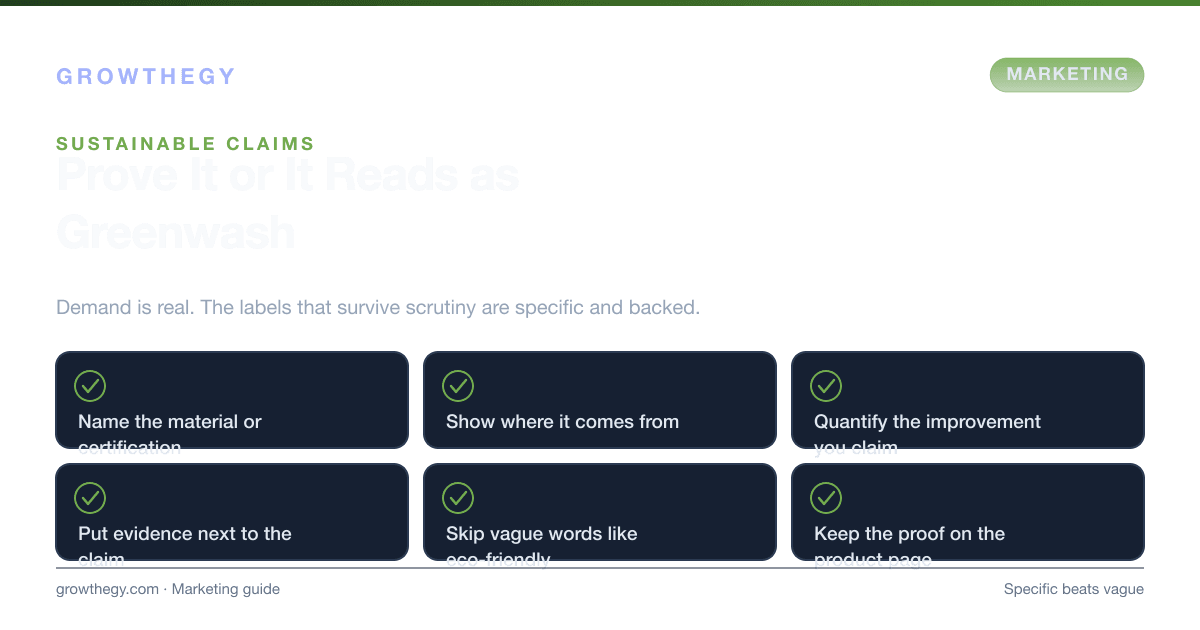
Why sustainable product labels improve sales: demand, willingness to pay, and how to use claims honestly without greenwashing your ecommerce brand.
Key takeaways
- Why Sustainable Product Labels Sell Better — focus on one metric or lever at a time; validate with data before scaling spend.
On this topic: Ecommerce Simulator · Voice Search Marketing for Local Businesses: Tips & Tactics (2026), AI-Driven Marketing 2026: Practical Playbook
Products labeled as sustainable—whether through certifications, packaging copy, or brand positioning—often see higher conversion and willingness to pay in many categories. Demand is driven by values alignment, perceived quality, and regulatory or social norms. In 2025, that trend holds; the priority is doing it in a way that is credible and specific rather than vague or misleading.
The scale of the opportunity is significant. McKinsey & Company (2023) found that products making ESG-related claims (environmental, social, governance) grew 28% cumulative over a 5-year period compared to 20% for products without such claims. A Nielsen IQ (2024) study found that 78% of consumers globally say a sustainable lifestyle is important to them—and critically, 55% are willing to pay a premium for sustainable products. That willingness is not uniform across demographics: Gen Z and Millennials lead, but older cohorts are closing the gap rapidly.
1. The Psychology Behind the Sustainability Premium
Why does a sustainability label improve sales? The psychology works at several levels simultaneously. First, there is values alignment: purchasing a labeled sustainable product allows consumers to express their identity and values through their buying choices. Research in consumer psychology calls this "moral licensing through consumption"—people feel they are making a positive contribution through an otherwise ordinary purchase.
Second, sustainability labels function as quality signals. When a brand invests in sustainable materials, ethical sourcing, or carbon offsets, consumers infer that the brand also cares about product quality. A Harvard Business School (2022) study found that sustainability-certified products received higher quality ratings from consumers even when physical quality was identical to uncertified versions.
Third, there is social proof and visibility. Buying sustainable products is increasingly a social signal, particularly for visible purchases (clothing, beverages, cars). Consumers anticipate being seen making the "right" choice, which adds social utility on top of functional utility.
2. Data on Purchase Intent and Willingness to Pay
The data is clear that sustainability labels improve purchase intent, but the premium is context-dependent. Consumers will pay more for sustainability in certain categories—food and beverage, personal care, fashion—but are more price-sensitive in others (electronics, home goods). Understanding which premium applies to your category is essential for pricing strategy.
| Product Category | % Consumers Willing to Pay Premium | Average Premium Accepted | Key Certification Types |
|---|---|---|---|
| Food & Beverage | 64% | 9–12% | Organic, Fair Trade, Rainforest Alliance |
| Personal Care / Beauty | 61% | 7–10% | Cruelty-free, vegan, B Corp |
| Fashion & Apparel | 57% | 10–18% | GOTS, Fair Wear, recycled materials |
| Home & Cleaning | 51% | 5–8% | EPA Safer Choice, EcoCert |
| Electronics | 38% | 3–5% | Energy Star, EPEAT |
| Automotive | 52% | Variable (EV preference) | Zero-emission certifications |
Sources: McKinsey & Company 2023; Nielsen IQ 2024; Boston Consulting Group 2023.
3. Why the Label Helps—Beyond Intent
Clear sustainability cues reduce uncertainty and signal that the brand has made a verifiable choice. When the claim is concrete (e.g. recycled materials, carbon footprint, ethical sourcing), it tends to perform better than generic "green" language. Transparency and proof (certifications, data) support both trust and sales.
Edelman Trust Barometer 2024 found that 63% of consumers trust third-party certifications more than brand self-declarations. This is the key reason why formal certifications (Fair Trade, B Corp, Organic) outperform generic "eco-friendly" claims in driving conversion. When you label a product as organic and that label is backed by a recognized certifying body, consumers accept it. When you simply call a product "natural" or "green" without a third-party stamp, skepticism increases.
4. The Impact of Specific Certifications on Sales
Not all sustainability labels are equal. Certifications with high consumer awareness and trust drive the most measurable sales lift. Fair Trade USA (2023) reported that Fair Trade certified products grew 12% year-over-year in the US across coffee, chocolate, and apparel categories. B Corp certification is associated with a 30% revenue premium in the UK market according to a University of Oxford (2022) study.
For brands that cannot yet attain formal certification, transparency is the next best option. Publishing supply chain data, carbon footprint disclosures, or material sourcing information builds credibility. PwC (2024) found that brands with published sustainability reports saw 18% higher Net Promoter Scores than competitors without them.
5. Avoiding Greenwashing
Overstated or unsupported claims backfire. The EU's Green Claims Directive (proposed 2023, implementing 2026) and FTC Green Guides in the US set legal standards for what sustainability claims brands can make. Greenwashing—making misleading environmental claims—is now subject to significant financial penalties in multiple markets, and consumer backlash is swift and documented.
A Kantar (2023) study found that 42% of green claims made online were exaggerated, false, or deceptive. Brands caught greenwashing see an average 8–15% stock price decline in the week following public exposure, per Bernstein Research (2023).
Focus on what you can evidence, use precise language, and align labels with actual practices. Instead of "eco-friendly packaging," say "packaging made from 85% post-consumer recycled plastic." Specificity both avoids greenwashing risk and is more persuasive to consumers because it feels verifiable.
6. Step-by-Step: How to Use Sustainability in Your Marketing
- Audit your actual sustainability credentials. What do you genuinely do? Recycled materials? Ethical factory certifications? Carbon offsetting? Start with what's true and documented.
- Choose the right certification for your category. Research which certifications your target customers recognize and trust. For food brands, organic or Fair Trade. For beauty brands, cruelty-free or B Corp. Pursuing formal certification adds third-party validation that self-certification cannot.
- Lead with specifics on packaging and in product listings. Replace vague claims ("eco-friendly") with specific, measurable ones ("made with 80% recycled materials," "1% of revenue donated to environmental nonprofits"). Specific claims convert better.
- Place sustainability claims in high-attention locations. Product detail pages, packaging front panels, and checkout confirmation emails are high-value placements. A/B test sustainability messaging against standard messaging to measure actual conversion lift for your audience.
- Share the story, not just the label. Consumers respond to narrative. A short paragraph about why your brand chose a specific material or supplier—with a photo or video—outperforms a logo sticker alone. Cone Communications (2023) found that brand stories about sustainability impact increased purchase intent by 21% compared to certification logos alone.
- Use pricing strategy to signal quality, not just cost. If you've validated willingness to pay a premium in your category, price accordingly. Underpricing a genuinely sustainable product can undermine the perceived quality signal. Use our Ecommerce Simulator to model the revenue and margin impact of a sustainability premium.
- Measure and report progress publicly. An annual sustainability report—even a simple one-page impact summary—demonstrates accountability and builds long-term trust. It also gives you ongoing PR and content opportunities.
7. Sustainability and Long-Term Business Performance
The case for sustainability extends beyond individual product sales. MSCI (2024) found that companies with strong ESG ratings had a 10-year total return of 12.9% vs 8.6% for low-ESG counterparts. Deloitte (2024) found that sustainability-focused brands were 2.5x more likely to retain customers year-over-year.
For ecommerce brands specifically, sustainable positioning supports higher customer lifetime value: customers who buy on values alignment tend to be more loyal, more likely to refer others, and less price-sensitive over time. This makes the cost of acquiring a sustainability-oriented customer worthwhile even when the first purchase margin is thinner due to higher product costs.
For product-level profitability and positioning, try our Ecommerce Simulator.