How to Analyze Product Profitability
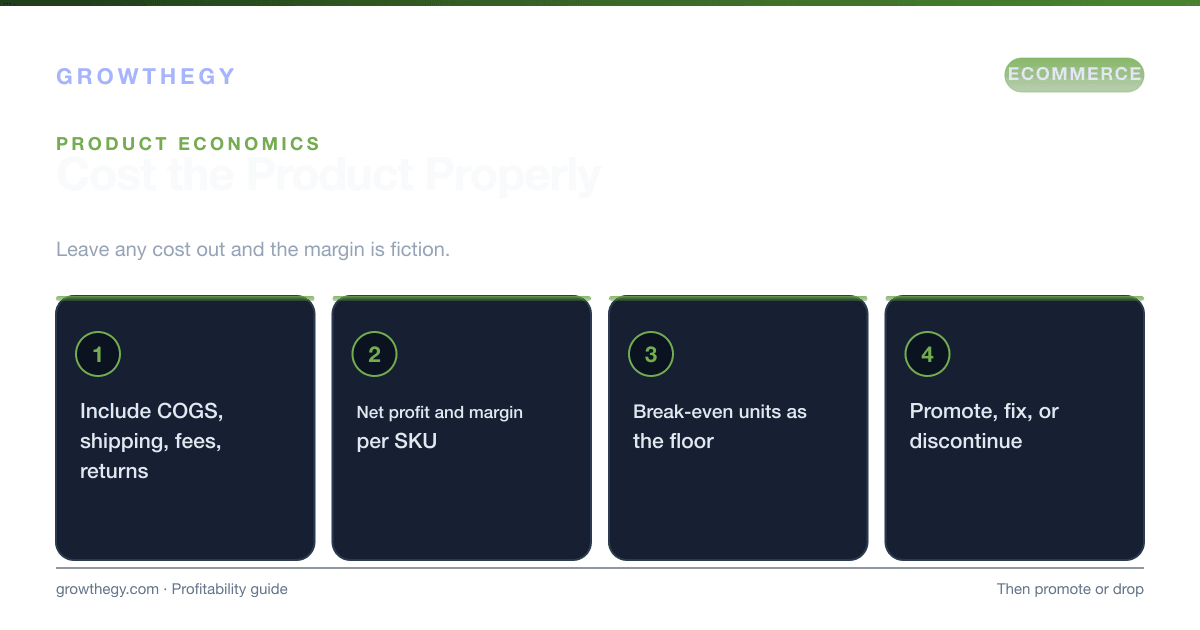
How to analyze product profitability: load variable costs, calculate margin and break-even, then decide which SKUs to promote, discount, or discontinue.
Benchmarks
Average ecommerce conversion rate is often ~2–3% (varies widely by industry and traffic mix).
Source: IRP Commerce — Ecommerce Market Data (Jan 2026)
Average ecommerce cart abandonment rate is 70.19%.
Source: Baymard Institute — Cart Abandonment Rate Statistics (2024)
Key takeaways
- How to Analyze Product Profitability (2026) — focus on one metric or lever at a time; validate with data before scaling spend.
- Pair reading with the Ecommerce Simulator on Growthegy to practice unit economics and decisions before you spend.
- Bookmark growthegy.com/ecommerce-simulator/ for hands-on scenarios; use the blog for deeper guides.
On this topic: Ecommerce Simulator · Ecommerce Operations — Hub, Ecommerce Simulators and Learning Tools: What Each One Actually Teaches (2026)
Not every product earns its keep. Analyzing product profitability helps you focus inventory, pricing, and marketing on what actually makes money. Here's a simple process and a free profitability tool to do it.
According to a McKinsey & Company study, companies that systematically prune unprofitable products and reinvest in high-margin winners can improve overall operating margins by 3–7 percentage points within 18 months. Yet research from Deloitte (2024) found that 61% of ecommerce businesses still don't have a formal process for measuring per-product profitability—they rely on gut feel and top-line revenue. If you fall into that 61%, this guide will change that.
Why Product Profitability Matters More Than Revenue
Revenue is vanity; profit is sanity. A product generating $100,000 in revenue with a 5% net margin contributes just $5,000 to your business. A product generating $30,000 with a 35% net margin contributes $10,500—more than twice as much. When you optimize for revenue alone, you can end up pouring inventory budget, ad spend, and fulfillment resources into products that are actively hurting your bottom line.
A 2025 report from Statista found that average ecommerce net margins by category range from just 2–4% in consumer electronics to 30–45% in digital goods and software. Understanding where your products sit within that spectrum—and why—is the first step toward a healthier, more resilient business.
1. Include All Costs
True profitability is revenue minus all costs: cost of goods sold (COGS), shipping, fulfillment (pick, pack, ship), and returns. Leaving any of these out overstates profit and can lead to promoting loss-making products.
Many ecommerce operators underestimate returns as a cost center. Shopify's 2024 Commerce Report found that average return rates for online apparel reach 20–30%, and processing each return costs an average of $10–$20 when you factor in labor, re-inspection, and repackaging. For a $50 item with a 25% return rate, that alone shaves 5–10% off your effective margin before you count COGS or shipping.
Use this cost capture checklist for every SKU you analyze:
- COGS — wholesale or manufacturing cost per unit
- Inbound freight — cost to get goods to your warehouse or 3PL
- Storage / warehousing — monthly fee per cubic foot multiplied by average days on shelf
- Pick and pack — labor or 3PL fee per order
- Outbound shipping — carrier cost per package (weight and zone tiered)
- Returns processing — estimated cost × return rate
- Payment processing — typically 2–3% of order value
- Allocated overhead — your share of platform fees, SaaS tools, and staff time
2. Calculate Net Profit and Margin
For each product, compute net profit per unit (revenue − all costs) and margin % (net profit ÷ revenue × 100). Compare across your catalog to spot high-margin winners and low-margin or negative-margin losers.
The contribution margin is a useful intermediate metric: it's revenue minus variable costs only (COGS, variable shipping, returns). Contribution margin tells you how much each unit contributes toward covering fixed costs (rent, salaries, platform subscriptions). Products with negative contribution margins should be dropped immediately—every sale makes things worse. Products with positive contribution margin but negative net margin are fixable; they just need more volume or cost reductions to cover their share of fixed overhead.
| Product | Revenue / Unit | Variable Costs / Unit | Contribution Margin | CM % | Fixed Cost Allocation | Net Profit / Unit | Net Margin % |
|---|---|---|---|---|---|---|---|
| Product A (winner) | $80 | $28 | $52 | 65% | $12 | $40 | 50% |
| Product B (mid-tier) | $45 | $30 | $15 | 33% | $10 | $5 | 11% |
| Product C (risky) | $25 | $22 | $3 | 12% | $8 | -$5 | -20% |
| Product D (loser) | $18 | $20 | -$2 | -11% | $6 | -$8 | -44% |
In this example, Product D has a negative contribution margin—each unit sold makes the business worse off even before fixed costs. Product C has a positive contribution margin but loses money after fixed cost allocation; it needs either a price increase or cost reduction. Products A and B are genuinely profitable, with A being a strong candidate for increased marketing spend.
3. Use Break-Even as a Floor
Break-even is the volume at which total revenue equals total cost. Products that barely break even at normal volume are risky; a dip in demand or a cost increase can push them into the red. Use break-even to decide minimum order quantities and discount limits.
The break-even formula is: Break-Even Units = Fixed Costs ÷ Contribution Margin per Unit. If a product has $5,000 in monthly fixed cost allocation and a $15 contribution margin per unit, you need to sell 334 units per month just to break even. If you're typically selling 200, the product is a consistent money-loser.
Break-even is also your discount floor. If you offer a 20% discount on a product with a 25% net margin, you're running near break-even. A 30% discount puts you underwater. Use your break-even calculation before approving promotions or responding to competitor price pressure.
4. Tier Your Products by Profitability
Once you have margin data for every SKU, group them into tiers. Most ecommerce catalogs follow a pattern similar to the Pareto principle: roughly 20% of products generate 80% of profit. The remaining 80% range from marginally profitable to actively loss-making.
| Tier | Net Margin Range | Action | Marketing Priority |
|---|---|---|---|
| Stars (High margin, high volume) | >25% | Promote aggressively, protect pricing | Top priority |
| Workhorses (Mid margin, high volume) | 10–25% | Maintain, look for cost reductions | Moderate |
| Marginal (Low margin, any volume) | 1–9% | Raise price, cut costs, or bundle | Low |
| Loss Leaders (Negative margin) | <0% | Fix immediately or discontinue | None |
5. Analyze Profitability by Channel and Customer Segment
The same product can be profitable on your DTC website and unprofitable on a marketplace like Amazon once you factor in platform fees (typically 8–15% of revenue), shipping requirements, and returns policies. According to Jungle Scout's 2025 State of the Amazon Seller report, 36% of Amazon sellers have margins below 10%—often because they're not accounting for all fees when setting prices.
Break profitability down by:
- Sales channel — DTC website vs. Amazon vs. wholesale vs. retail
- Customer segment — first-time buyers vs. repeat customers (repeat buyers often have lower acquisition cost, improving effective margin)
- Geography — international shipping costs can flip a profitable domestic product into a loss on overseas orders
- Order size — do large orders improve margin through shipping efficiency, or do they trigger free shipping at too low a threshold?
6. Industry Benchmarks by Category
| Ecommerce Category | Typical Gross Margin | Typical Net Margin | Source |
|---|---|---|---|
| Apparel & Fashion | 40–60% | 8–15% | NYU Stern 2025 |
| Consumer Electronics | 10–20% | 2–5% | IBISWorld 2025 |
| Health & Beauty | 50–70% | 10–20% | Statista 2025 |
| Home & Garden | 30–50% | 5–12% | IBISWorld 2025 |
| Food & Beverage DTC | 25–40% | 3–10% | Shopify 2024 |
| Digital Products / Software | 70–90% | 20–45% | SaaS Capital 2025 |
| Sporting Goods | 30–50% | 5–15% | McKinsey 2024 |
Use these benchmarks to calibrate expectations. If your health and beauty products are netting 3% when the industry norm is 10–20%, something is wrong—either your costs are too high, your prices are too low, or your channel mix is unfavorable. If your apparel margins are 35%, that's a signal to investigate whether cost reductions are achievable before assuming you're at the industry ceiling.
7. Act on the Results
High-margin products: promote more, consider price increases, bundle with slower movers. Low-margin or loss-making products: cut costs, raise prices, improve quality, or discontinue. Our Ecommerce Simulator does the math for you; for more profitability tools (LTV, pricing, etc.), see the Ecommerce Simulator.
Here is a concrete action framework for each tier:
- Stars (margin >25%):Increase ad spend and push these products to the top of your category pages, email campaigns, and social ads. Test modest price increases—research from Price Intelligently (2024) shows that a 1% price increase delivers an average 11% profit improvement for high-margin products when demand is inelastic. Bundle Stars with Marginals to raise the overall order value and improve the Marginal's blended margin.
- Workhorses (10–25%): These are the backbone of your business. Focus on supply chain efficiency: renegotiate COGS with suppliers at volume, optimize packaging to reduce shipping weight, and audit 3PL fees. A 2% reduction in fulfillment cost on a product you sell 1,000 units per month compounds significantly.
- Marginals (1–9%):Before dropping these, run a price-increase test of 5–10%. If conversion doesn't materially drop, you've found free margin. If it does, look at cost—can you source cheaper, ship lighter, or reduce returns with better product descriptions or sizing guides? A 2023 study by Baymard Institute found that 24% of returns for apparel are due to inaccurate product descriptions; fixing those can reduce return costs by 10–15%.
- Loss Leaders with negative contribution margin:These should be discontinued unless they serve a clear strategic purpose (e.g., a loss leader that reliably upsells to high-margin products). Quantify that upsell value before keeping them. If there's no credible path to profitability, SKU rationalization is the right move. Research from Harvard Business Review found that companies removing unprofitable SKUs see an average 3–5% improvement in gross margin within six months.
Step-by-Step: How to Run a Product Profitability Analysis
- Export your order data for the last 90 days from Shopify, WooCommerce, or your platform. Include SKU, units sold, and revenue per SKU.
- Gather cost data: Get COGS from your supplier invoices or purchase orders. Estimate fulfillment cost per unit from your 3PL or carrier rates. Calculate average return rate per SKU from your returns data.
- Build a profitability table with columns: Revenue, COGS, Fulfillment, Returns, Payment Processing, Allocated Overhead, Net Profit, Net Margin %.
- Calculate contribution margin (Revenue − Variable Costs) and net margin (Revenue − All Costs) for each SKU.
- Tier your products into Stars, Workhorses, Marginals, and Loss Leaders using the framework above.
- Calculate break-even volume for each Marginal and Loss Leader to understand how far you are from profitability.
- Set a review cadence—quarterly at minimum, monthly for fast-moving catalogs—to update margins as costs and prices change.
- Use the data to drive decisions: ad spend allocation, inventory buys, promotional calendars, and SKU rationalization all should be informed by margin tier.
Common Mistakes in Product Profitability Analysis
Even teams that do run profitability analyses often make these errors:
- Using gross margin instead of net margin — Gross margin excludes fulfillment, returns, and overhead. It can be 40% while net margin is 5%.
- Ignoring seasonality — A product may be highly profitable in Q4 and a loss-maker in Q2. Annualizing without seasonal segmentation misleads resource allocation.
- Not accounting for returns in the cost base — Returns are a significant cost in apparel and electronics and should be modeled per SKU, not as a blended store-wide number.
- Allocating overhead equally across all SKUs — A complex, high-touch product that requires customer support calls warrants a higher overhead allocation than a simple, self-explanatory product.
- Failing to re-run the analysis after cost changes — Carrier rate increases, supplier price changes, or new platform fees can shift a profitable product to marginal overnight. Review quarterly at minimum.
Using the Free Product Profitability Analyzer
Our Ecommerce Simulator lets you enter revenue, COGS, shipping, fulfillment, and return rate for each product and instantly see net profit per unit, contribution margin, and break-even volume. You can compare up to 10 products side by side and identify which to promote, which to fix, and which to drop—without building a spreadsheet from scratch. No signup required.
For a broader set of unit economics and growth tools—LTV calculator, pricing simulator, ROI calculator, and more—visit the Ecommerce Simulator.