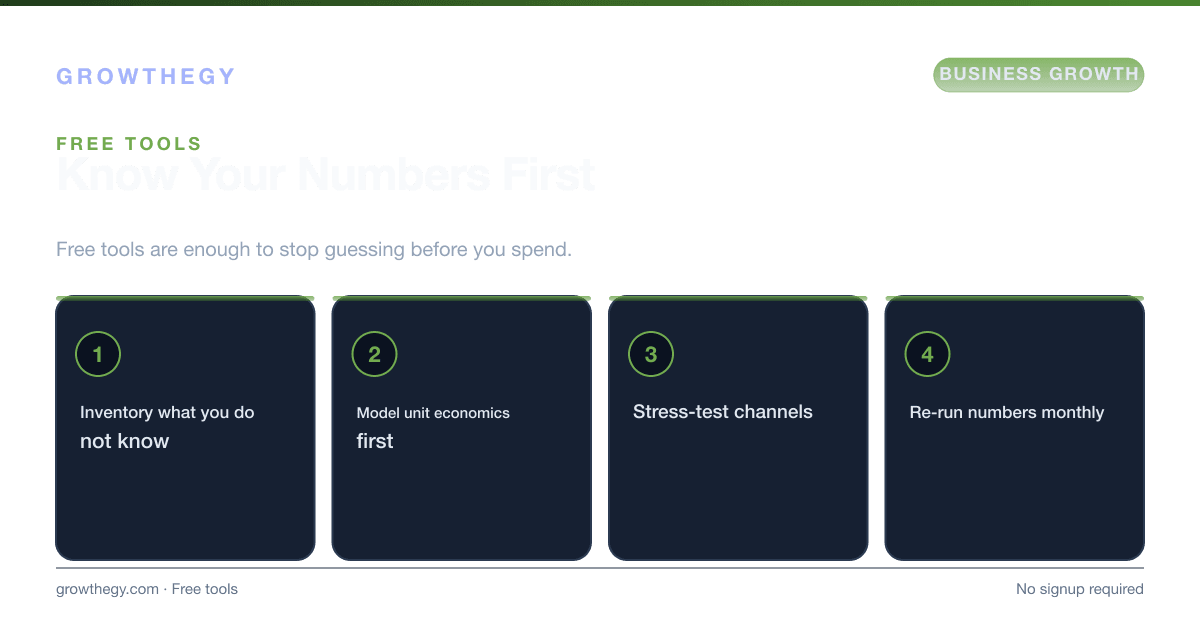
A roundup of free tools to grow your online business in 2026: profitability, LTV, pricing, break-even, ROI, and external SEO and marketing tools. No signup required.
Benchmarks
Average ecommerce conversion rate is often ~2–3% (varies widely by industry and traffic mix).
Source: IRP Commerce — Ecommerce Market Data (Jan 2026)
Average ecommerce cart abandonment rate is 70.19%.
Source: Baymard Institute — Cart Abandonment Rate Statistics (2024)
Key takeaways
- Free Tools to Grow Your Online Business in 2026 — focus on one metric or lever at a time; validate with data before scaling spend.
- Pair reading with the Ecommerce Simulator on Growthegy to practice unit economics and decisions before you spend.
- Bookmark growthegy.com/ecommerce-simulator/ for hands-on scenarios; use the blog for deeper guides.
On this topic: Ecommerce Simulator · Top AI Platform Skills Every Developer & Business Needs in 2026 (And Where to Find Them), How to Build a Data-Driven Growth Strategy for Startups (Proven Guide)
Growing an online business doesn't have to mean expensive software from day one. Here are free tools you can use in 2026 to measure profitability, set pricing, understand cost of growth, and improve conversion—plus a short list of external tools for SEO and marketing.
According to a 2024 survey by Clutch, 64% of small business owners cite "too expensive" as the primary barrier to adopting growth software. Yet the same survey found that businesses using even basic analytics and financial planning tools grow revenue 2.3x faster than those that don't. The good news: the gap between free and paid tools has narrowed dramatically in 2025–2026. Many best-in-class calculators, simulators, and benchmarking tools are now available at zero cost—including the suite of tools at Growthegy.
Why Free Tools Matter More Than Ever in 2026
The ecommerce landscape is more competitive than ever. Shopify data from 2025 shows over 5 million active stores globally, up from 3.75 million in 2023. Customer acquisition costs have risen 60% over the last five years (Statista 2025). In this environment, making better decisions faster—with lower overhead—is a genuine competitive advantage. Free tools let you build financial literacy, test assumptions, and model scenarios without committing to software subscriptions before you have the revenue to justify them.
Profitability and cost of growth
The Product Profitability Analyzer lets you compare products by margin and break-even so you know which to promote or drop. The Ecommerce Simulator gives you customer lifetime value, LTV:CAC ratio, and payback period. The Ecommerce Simulator turns ad spend, conversions, and AOV into revenue, profit, and ROI %. Together they form a simple cost growth tool set.
Pricing and break-even
Use the Pricing & Bundling Simulator to model price and bundle changes before you launch. The Break-Even Calculator tells you how many units you need to sell to cover fixed costs. Both are free with no signup.
Conversion and copy
Compare your conversion rate and cart abandonment rate to benchmarks and get tips. For messaging, try the Ecommerce Strategy Generator, Ecommerce Growth AI for ranked growth ideas, and Ecommerce Simulator for a structured strategy and rollout plan.
Complete Free Tool Directory for 2026
Here is a categorized overview of the most useful free tools available to online business owners in 2026, including both Growthegy tools and best-in-class external options:
| Category | Tool | What It Does | Best For | Signup Required? |
|---|---|---|---|---|
| Profitability | Product Profitability Analyzer (Growthegy) | Compares products by margin, net profit, and break-even | Ecommerce stores with 2+ products | No |
| Customer Value | LTV Calculator (Growthegy) | Calculates LTV, LTV:CAC ratio, payback period | DTC brands & subscription businesses | No |
| Advertising | ROAS Calculator (Growthegy) | Return on ad spend by channel | Paid media teams | No |
| Advertising | ROI Calculator (Growthegy) | Margin-aware ROI on ad spend | Any business running paid ads | No |
| Pricing | Pricing & Bundling Simulator (Growthegy) | Models price changes and bundle pricing impact | Pre-launch or relaunch pricing decisions | No |
| Break-Even | Break-Even Calculator (Growthegy) | Units needed to cover fixed costs | New product launches | No |
| Conversion | Conversion Rate Benchmark Checker (Growthegy) | Compare your CVR to industry benchmarks | CRO diagnosis | No |
| SEO | Google Search Console | Search performance, indexing, and keyword data | All online businesses | Google account |
| SEO | Ubersuggest (free tier) | Keyword research, competitor analysis | Content and SEO strategy | Limited free use |
| Analytics | Google Analytics 4 | Traffic, behavior, and ecommerce event tracking | All online businesses | Google account |
| Site Speed | Google PageSpeed Insights | Core Web Vitals, performance score, fix suggestions | All online businesses | No |
| Design | Canva (free tier) | Graphics, social media assets, presentations | Small teams without designers | Yes (free) |
| Email Marketing | Mailchimp (free tier, up to 500 contacts) | Email campaigns, automations, landing pages | Early-stage businesses | Yes (free) |
| Heatmaps | Microsoft Clarity | Free heatmaps and session recordings | CRO and UX improvement | Yes (free) |
Step-by-Step: How to Build Your Free Tool Stack in 2026
- Start with analytics and tracking. Install Google Analytics 4 and connect Google Search Console. These two tools give you the data foundation everything else depends on. Without traffic and behavior data, all other tools lack context.
- Measure your unit economics. Use the Ecommerce Simulator to calculate net margin per SKU. Use the Ecommerce Simulator to understand how much a customer is worth over time. These two numbers—margin per product and lifetime value per customer—are the most important financial metrics in ecommerce.
- Audit your ad spend efficiency. If you run paid ads, use the Ecommerce Simulator to evaluate return on ad spend by channel. Use the Ecommerce Simulator to layer in margin and understand true profit, not just revenue generated.
- Fix your site speed. Run your homepage, product page, and checkout through Google PageSpeed Insights. A 2024 Google study found that a 1-second improvement in mobile load time increases conversions by 27%. Target a Largest Contentful Paint (LCP) under 2.5 seconds.
- Benchmark your conversion rate. Use the Ecommerce Simulatorto see how you compare to industry norms. Average ecommerce conversion rates run 1.5–3.5% (Statista 2025); top performers exceed 5%. If you're below average, install Microsoft Clarity to watch session recordings and identify friction points.
- Sharpen your messaging. Use the Ecommerce Simulator for positioning, headline ideas, and a structured rollout plan you can reuse on your homepage and in ads. Strong positioning reduces bounce rate and improves conversion.
- Model pricing decisions before you launch. Use the Pricing & Bundling Simulator to test price increases, bundle pricing, and discount scenarios before going live. The Ecommerce Simulator tells you the minimum volume each price point requires to be profitable.
- Build a content and SEO foundation. Use Google Search Console to identify which queries are already driving traffic, then create content that targets those terms. Use Ubersuggest (free tier) to find related keywords and competitor content gaps. A 2025 HubSpot study found that businesses publishing 2+ blog posts per week generate 3.5x more traffic than those publishing less frequently.
Comparing Free vs. Paid Tool Categories
| Tool Category | Free Option Quality | Paid Upgrade Worthwhile When… | Estimated Monthly Revenue Threshold |
|---|---|---|---|
| Analytics (GA4) | Excellent | Need BigQuery integration or attribution modeling | $500K+/year |
| SEO (Search Console) | Excellent | Need advanced competitor tracking or link building tools | $50K+/year |
| Email Marketing (Mailchimp free) | Good for <500 contacts | List exceeds 500 or need advanced segmentation | $5K+/month |
| Heatmaps (Clarity) | Excellent | Need A/B testing or integrated session replay + analytics | $20K+/month |
| CRO calculators (Growthegy) | Excellent | Need custom integrations or automated reporting | Always free |
| Design (Canva free) | Very Good | Need brand kits, background removal, or team collaboration | $10K+/month |
The ROI of Free Tool Adoption
Using free tools correctly isn't just about saving money—it's about making better decisions faster. Consider what a 10% improvement in each of these areas is worth for a store doing $20,000/month in revenue:
- 10% improvement in net margin (via profitability analysis) = $2,000/month more profit
- 10% increase in AOV (via pricing tools and bundling) = $2,000/month more revenue
- 10% improvement in conversion rate (via benchmark tools and CRO) = $2,000/month more revenue
- 10% reduction in CAC (via ROI/ROAS tools and better channel selection) = better growth efficiency and faster payback period
Compounded, these improvements—each achievable with free tools and clear execution—can double revenue within 12–18 months according to modeled projections from Growthegy's planning frameworks.
All tools and external toolbox
For the full list of our Ecommerce Simulator—including the Ecommerce Simulator, Ecommerce Simulator, and GEO guides—see our Ecommerce Simulator. For curated external tools (Google Keyword Planner, PageSpeed Insights, Ubersuggest, Canva, and more), see our Ecommerce Simulator. Use them with our Ecommerce Simulator and Growth Plan to get the most out of your strategy.