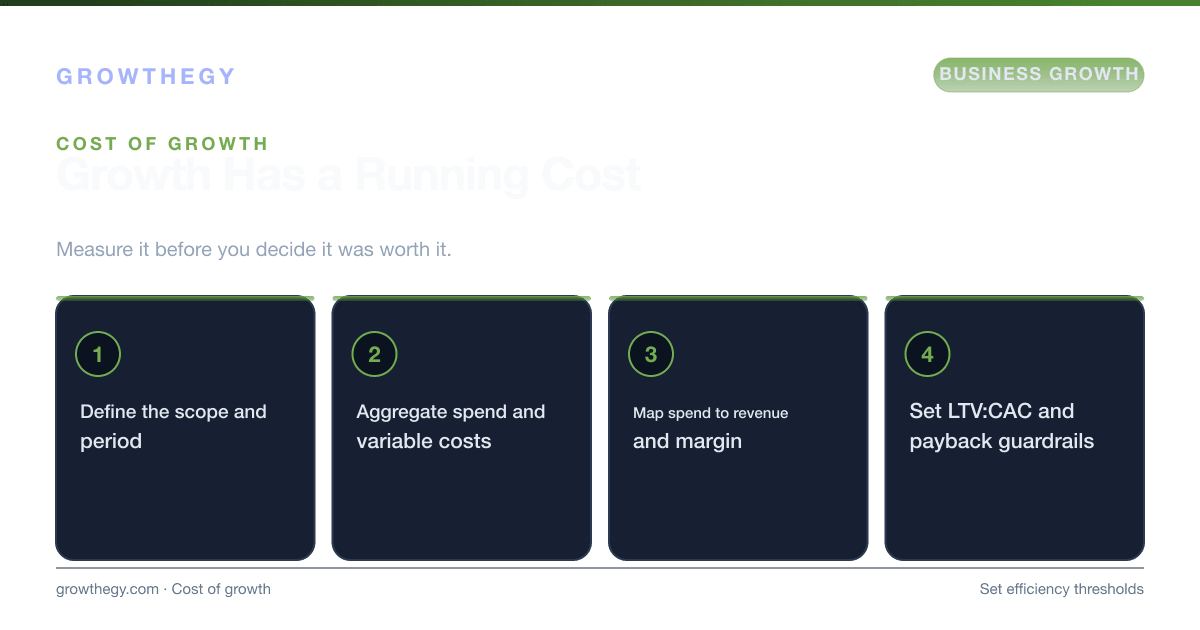
Understand cost of growth and how to measure it with LTV, CAC, product profitability, and pricing. Free tools and a simple framework.
Benchmarks
Average ecommerce conversion rate is often ~2–3% (varies widely by industry and traffic mix).
Source: IRP Commerce — Ecommerce Market Data (Jan 2026)
Average ecommerce cart abandonment rate is 70.19%.
Source: Baymard Institute — Cart Abandonment Rate Statistics (2024)
Key takeaways
- Cost of Growth: What It Is and How to Measure It — focus on one metric or lever at a time; validate with data before scaling spend.
- Pair reading with the Ecommerce Simulator on Growthegy to practice unit economics and decisions before you spend.
- Bookmark growthegy.com/ecommerce-simulator/ for hands-on scenarios; use the blog for deeper guides.
On this topic: Ecommerce Simulator · LTV, CAC, and payback for ecommerce (My Store guide), Top AI Platform Skills Every Developer & Business Needs in 2026 (And Where to Find Them)
Cost of growth is what you spend to acquire and retain customers and to add or improve products. If that cost is too high relative to the value those customers or products create, growth isn't sustainable. Here's how to think about it and how to measure it with a simple cost growth tool set.
The challenge with cost of growth is that it's not a single number—it's a composite of customer acquisition cost (CAC), product-level margin, and operational overhead that increases as you scale. Bain & Company (2024) found that 70% of companies that achieve rapid revenue growth fail to generate proportional profit growth, primarily because their cost of growth rises faster than their revenue. Understanding the components of growth cost—and measuring each one—is what separates sustainable scaling from growth that eventually collapses under its own cost structure.
1. What Is Cost of Growth? A Clear Definition
Cost of growth can be defined as: the total incremental expenditure required to generate one unit of additional sustainable revenue or customer value. It includes:
- Customer Acquisition Cost (CAC): The fully-loaded cost of acquiring one new customer, including all sales and marketing spend divided by new customers in the same period.
- Customer Retention Cost: Costs associated with keeping existing customers—loyalty programs, customer service, email marketing, re-engagement campaigns.
- Product Development and Improvement Cost: The cost of adding new products or improving existing ones to maintain or grow customer spend.
- Operational Scaling Cost: Incremental costs in fulfillment, customer service, and technology that rise as the business grows—sometimes faster than revenue if not managed carefully.
2. The Core Formula: CAC and How to Calculate It
The fundamental metric for cost of growth at the customer level is Customer Acquisition Cost (CAC):
CAC = Total Sales & Marketing Spend ÷ Number of New Customers Acquired
For example: if you spend $10,000 on marketing in a month and acquire 100 new customers, your CAC is $100. But this simple formula hides important nuance. Fully-loaded CAC should include:
- Paid advertising spend (Google Ads, Meta, TikTok, etc.)
- Content and SEO investment (staff time, freelancers, tools)
- Sales team salaries and commissions
- CRM and marketing automation software costs
- Agency fees and creative production costs
Profitwell (2024) found that companies that exclude operational costs from CAC understate their true acquisition cost by 35–45% on average. This leads to overspending on acquisition relative to the margin available.
3. LTV:CAC Ratio and Why It Matters
The cost of acquiring a customer (CAC) should be lower than the value that customer will generate over time (LTV). A common rule of thumb is LTV:CAC ≥ 3:1 and payback period under 12 months. Use our Ecommerce Simulator to compute LTV, LTV:CAC, and payback so you can see whether your acquisition cost is in a healthy range.
| LTV:CAC Ratio | What It Means | Recommended Action |
|---|---|---|
| Below 1:1 | Losing money on every customer acquired | Stop scaling paid acquisition immediately; fix product-market fit |
| 1:1 – 2:1 | Breaking even or thin margin; unsustainable at scale | Reduce CAC through organic channels; increase LTV through retention |
| 2:1 – 3:1 | Marginally healthy; limited scaling headroom | Optimize before scaling; target improvement in 1–2 levers |
| 3:1 – 5:1 | Healthy; ready to scale with discipline | Scale acquisition with monitoring; invest in retention |
| Above 5:1 | Strong unit economics; potential underinvestment in growth | Consider increasing acquisition spend; evaluate growth opportunities |
Sources: Profitwell (2024); SaaStr (2024); Bain & Company (2023).
4. CAC Benchmarks by Industry
| Industry | Average CAC | Average LTV | Typical LTV:CAC | Payback Period |
|---|---|---|---|---|
| SaaS (B2B) | $400–$1,500 | $2,000–$10,000 | 3–7x | 12–18 months |
| Ecommerce (fashion/beauty) | $30–$80 | $150–$400 | 3–6x | 3–9 months |
| Ecommerce (electronics) | $50–$120 | $200–$500 | 2–4x | 6–12 months |
| Lead generation / Services | $150–$800 | $1,000–$5,000 | 3–8x | 3–12 months |
| Food & Beverage (DTC) | $20–$60 | $100–$350 | 3–7x | 2–6 months |
| Financial Services | $200–$1,000 | $1,500–$10,000+ | 4–10x | 6–24 months |
Sources: Profitwell (2024); HubSpot State of Marketing (2025); Statista (2025).
5. Product-Level Profitability
Growth that comes from products that lose money (after COGS, shipping, fulfillment, returns) increases total cost without enough upside. The Ecommerce Simulator shows net profit and margin per product so you can grow with products that actually contribute profit.
Product-level cost of growth analysis asks: "Is the growth we're driving coming from profitable products or loss-making ones?" Scaling ad spend on a product with negative unit economics accelerates losses rather than building value. This is one of the most common and costly mistakes in ecommerce scaling.
A practical rule: before increasing ad spend on any product, verify it has at minimum a 15% net margin after all variable costs. Below that threshold, CAC payback periods extend dangerously as margins compress under volume. Rehearse margin and CAC trade-offs in the Ecommerce Simulator before scaling.
6. Pricing and Bundles
Price and bundle changes directly affect margin and the cost of delivering value. The Ecommerce Simulator lets you model price and bundle scenarios before you launch, so you can grow revenue without eroding profitability.
One of the most effective ways to reduce the effective cost of growth is to increase average order value (AOV) and customer lifetime value (LTV) without proportionally increasing acquisition spend. Bundling is a powerful tool here: a bundle that adds $20 to AOV with $5 in additional COGS improves margin per transaction by $15. If your CAC remains constant, a higher AOV bundle means a lower effective cost of acquiring that unit of revenue.
7. Step-by-Step: How to Measure Your Cost of Growth
- Calculate your fully-loaded CAC. Pull all sales and marketing spend for the past 3 months (including staff time, not just ad spend). Divide by new customers acquired in the same period. Use this as your baseline CAC.
- Calculate your customer LTV. Use our Ecommerce Simulator: enter your average order value, purchase frequency per year, and average customer lifespan. The tool computes LTV and your LTV:CAC ratio.
- Run a product profitability audit. For your top 10 products by revenue, use the Ecommerce Simulator to determine net margin per product. Flag any product below 15% net margin for review.
- Model your CAC payback period. Payback period = CAC ÷ (monthly gross margin per customer). If payback exceeds 12 months, you're carrying significant risk from customer churn before payback is reached.
- Identify the highest-impact lever to reduce cost of growth. Is the issue high CAC (fix targeting, switch channels, invest in SEO/organic)? Low LTV (improve retention, add subscription, increase AOV)? Thin product margins (renegotiate COGS, raise prices, cut low-margin products)?
- Model pricing and bundle scenarios. Use the Ecommerce Simulator to test whether a price increase or a product bundle could improve your per-transaction margin without requiring a change in acquisition strategy.
- Set a monthly cost-of-growth review cadence. Track CAC, LTV:CAC, and net margin per product monthly. Growth is only healthy when these metrics move in the right direction as you scale—not just revenue.
8. Strategies to Reduce Cost of Growth
Once you've measured your cost of growth, the goal is to reduce it over time while maintaining or accelerating revenue growth. The most effective strategies:
- Invest in organic channels (SEO, content, community): Organic traffic reduces CAC over time. While it takes 6–12 months to compound, the long-term effect is significant. HubSpot (2025) found that businesses relying primarily on organic channels have a CAC 61% lower than those relying primarily on paid channels.
- Build a referral or word-of-mouth program: Referred customers typically have a CAC near zero and a 16–25% higher LTV than non-referred customers (Wharton School, 2024). A structured referral program can be one of the highest-ROI investments for reducing cost of growth.
- Improve repeat purchase rate: Increasing the percentage of customers who make a second purchase within 90 days is one of the most direct ways to raise LTV without increasing CAC. Email sequences, loyalty programs, and personalized reorder reminders all contribute to this.
- Optimize your product mix toward higher-margin SKUs: Marketing spend invested in promoting high-margin products generates more profit per dollar than the same spend on low-margin products. Prioritize your highest-margin products in paid campaigns and merchandising.
- Reduce customer acquisition cost through better targeting: Improving ad creative, audience segmentation, and landing page conversion rates all reduce the cost of acquiring each new customer. A/B test continuously and allocate budget to what's working.
9. Bringing It Together
Cost of growth is not a single number—it's the combination of acquisition cost (CAC vs LTV), product cost (profitability per SKU), and pricing (margins and bundles). Use the tools above together; for the full set of free profitability tools and more, see our Ecommerce Simulator.
A business with healthy unit economics (LTV:CAC above 3:1, net product margins above 15%, CAC payback under 12 months) can scale with confidence. One without these foundations will find that growth amplifies its problems rather than solving them. The cost of measuring these metrics is zero—use the free tools and measure before you scale.
Key Takeaways
- Cost of growth is the sum of CAC, retention costs, product costs, and operational scaling costs—not just your ad spend.
- LTV:CAC ratio is the single most important indicator of whether your growth is sustainable: target 3:1 or above.
- Product-level margin analysis is essential before scaling ad spend—growing unprofitable products faster increases losses.
- CAC payback period under 12 months is the standard for ecommerce and consumer brands; above 18 months indicates a structural cost problem.
- The fastest ways to reduce cost of growth are organic channel investment, referral programs, and improving repeat purchase rates—all of which increase LTV relative to CAC.