Research-backed ecommerce monetization: what field experiments and meta-analyses show about price endings, shipping rules, return policy, bundles, recommendations and buy now pay later.
Key takeaways
- Judge every monetization change on contribution per visitor after returns, fees and discounts, against a holdout.
- Just-below prices raised purchases only slightly across 69 studies (g = 0.13), and publication bias may shrink it further.
- Threshold free shipping reduced purchase incidence but not order value in one randomized test, and raised strategic returns.
- Charging for returns was followed by 75% to 100% lower spending over two years in two longitudinal field studies.
- Bundles were seen often and bought rarely: 503 purchases from 356,368 views in one retailer test.
On this topic: Ecommerce Simulator · Ecommerce Customer Retention: What Field Experiments Reveal, Influencer Marketing and Creator Growth: What 37 Peer-Reviewed Studies Actually Found
Ecommerce monetization is the set of decisions that turn a visit into profit: price presentation, shipping rules, return policy, bundles and payment options. The field evidence says most of these levers have modest, context-dependent effects, and some backfire. The reliable method is to test one lever at a time, then judge it on contribution after returns and fees, not on conversion alone.
We started with Google Scholar searches for "ecommerce monetization" limited to papers published since 2022, 2025 and 2026. The results were mostly about platforms: data products, creator income, app revenue models and agent-mediated commerce. Very little of it helps a store owner decide on a price or a shipping rule. The studies that do help sit under other names: price endings, shipping fee schedules, return policy, bundling and recommendations.
This guide uses those studies. For each lever it says what was measured, what the result was, how far to trust it, and what to test. Where the only evidence is a vendor's own report, we say that too.
How should you judge a monetization change?
Judge every change on contribution per visitor after discounts, returns, payment fees and shipping you pay, compared with a holdout group that didn't see the change. Conversion rate alone can rise while profit falls. Our retention evidence guide covers discounts, free shipping and customer lifetime value in more depth, so this guide concentrates on the other levers.
Do prices ending in .99 raise sales?
Troll and colleagues pooled 69 studies (362 effect sizes, 40,541 participants) in a preregistered meta-analysis. Just-below prices such as $9.99 raised purchase decisions by a small amount (Hedges' g = 0.13, 95% CI 0.01 to 0.25). They improved the price image more (g = 0.28) and had no effect on perceived quality (g = 0.00). The authors also report that effects were highly heterogeneous, that many individual results were not significant, and that corrections for publication bias suggest smaller and sometimes nonsignificant true effects. Journal of Consumer Psychology, 2024.
What to test: run $X.99 against $X.00 on a few products with steady traffic and compare revenue per visitor, not clicks. Expect a small difference. If your brand sells on premium positioning, check that the change does not make the store feel discount-led, which this meta-analysis didn't test.
How should you set shipping fees and free-shipping thresholds?
Lepthien and Clement randomly assigned visitors of one online shop to one of seven shipping fee structures, varying minimum order sizes, fees and free-shipping thresholds, and tracked purchases and returns. Threshold-based free shipping reduced the share of visitors who bought but not the value of the order, and it led to more strategic returns, meaning customers returned more items. Shipping fees had a positive effect on purchase value before and after returns. Minimum order values showed no negative effects on purchase incidence or value. Marketing Letters, 2019. We could read the abstract only, so we can't report exact fee levels or effect sizes, and the result comes from a single shop.
What to test: if you run a free-shipping threshold, measure net revenue after returns, not order value at checkout. A threshold can inflate baskets that partly come back.
Is it better to hide shipping costs until checkout?
In a field experiment with more than 34,000 consumers at a large German cinema's online shop, Dertwinkel-Kalt, Köster and Sutter compared shrouded surcharges, separately listed surcharges and an all-in price. People started purchases more often when surcharges were shrouded or partitioned, and they also dropped out more often when the full price appeared at checkout. Overall demand did not depend on how the price was presented. The authors attribute this to low cancellation costs online. CESifo working paper 7475, 2019. This is a ticketing setting, so apply it to physical goods with care.
What to test: show the total, including shipping, as early as you can. Hiding it just moves drop-off to the last step, and the study found no net gain in demand.
Do generous returns pay for themselves?
Bower and Maxham followed customers of online retailers in two longitudinal field studies over four years, using surveys and actual spending data. Depending on how much blame fell on the customer, those who paid for their own return cut their spending at that retailer by 75% to 100% by the end of two years. Customers whose returns were free spent 158% to 457% of what they had spent before the return. Journal of Marketing, 2012. This was a longitudinal field study, not a randomized trial, and we could not see its sample sizes in the abstract, so customers who return items may differ from those who do not. Read it as strong evidence that charging for returns can cost future sales, not as a promise of what free returns will add.
A meta-analysis by Janakiraman, Syrdal and Freling looked at how return policy leniency affects purchases and returns. We couldn't access its abstract, so we rely on the University of Texas at Dallas summary. It reports that lenient policies increased purchases, that they also increased returns by a smaller amount, that time leniency reduced returns, and that scope leniency, such as allowing sale items back, increased them. Journal of Retailing, 2016; university summary.
What to test: keep return windows generous in time, be selective on scope, and track the return rate and net contribution for the group that gets the easier policy.
Do product bundles work?
Kumar, Eckles and Aral ran a two-month field experiment at a large US online retailer in 2018. Users who searched for a product were randomly shown one of four types of discounted bundle. Across 9,728 bundles, 164,469 users saw 356,368 bundle views. Of those views, 1.5% led to a click, 0.8% to an add-to-cart and 0.1% (503) to a purchase. The authors found that embedding-based measures of how products relate predicted which bundles got added to carts. They measured add-to-cart and purchase, not profit. arXiv working paper, 2020.
The honest reading is that bundle offers are seen often and bought rarely, and that choosing the right pairing matters more than having a bundle. What to test: start with two or three complementary pairs from your own order data, show the discount, and compare margin per session with and without the bundle.
What do recommendations and cross-sells add?
Jannach and Jugovac reviewed published field tests of recommender systems and the business measures they used. The reported gains vary widely: a 3.6% sales increase in a mobile games marketplace, a 6% revenue improvement for one eBay method over a baseline, and a near-500% increase in one eBay measure during a test that lasted only one week and may not have reached production. In an online bookstore, removing recommendations for a month cut revenue by 17%, though seasonal effects could be involved. The authors stress that many results are hard to compare and that the business effect is less clear than academic accuracy scores suggest. ACM Transactions on Management Information Systems, 2019.
What to test: add one recommendation slot on the product or cart page, hold back a share of visitors, and judge it on revenue and margin per session.
Does buy now, pay later raise revenue?
The only controlled test we found is from a payments vendor. In an A/B test of more than 150,000 payment sessions, Stripe reported that businesses saw up to a 14% increase in revenue when a buy-now-pay-later option was shown, with higher conversion and order values, and that more than two-thirds of that volume was net-new. Stripe ran the test, sells these products, and doesn't publish sample sizes per arm, significance or the time period. "Up to" is a maximum, not an average. Stripe, June 2024.
What to test:treat it as a hypothesis. Turn it on for half of sessions, compare revenue per session, and subtract the provider's fees from the result. We found no independent peer-reviewed field test, so don't assume the headline number carries over.
What should a store test first?
Run one test at a time. Each one needs enough traffic to detect a small change, which for several of these levers is small.
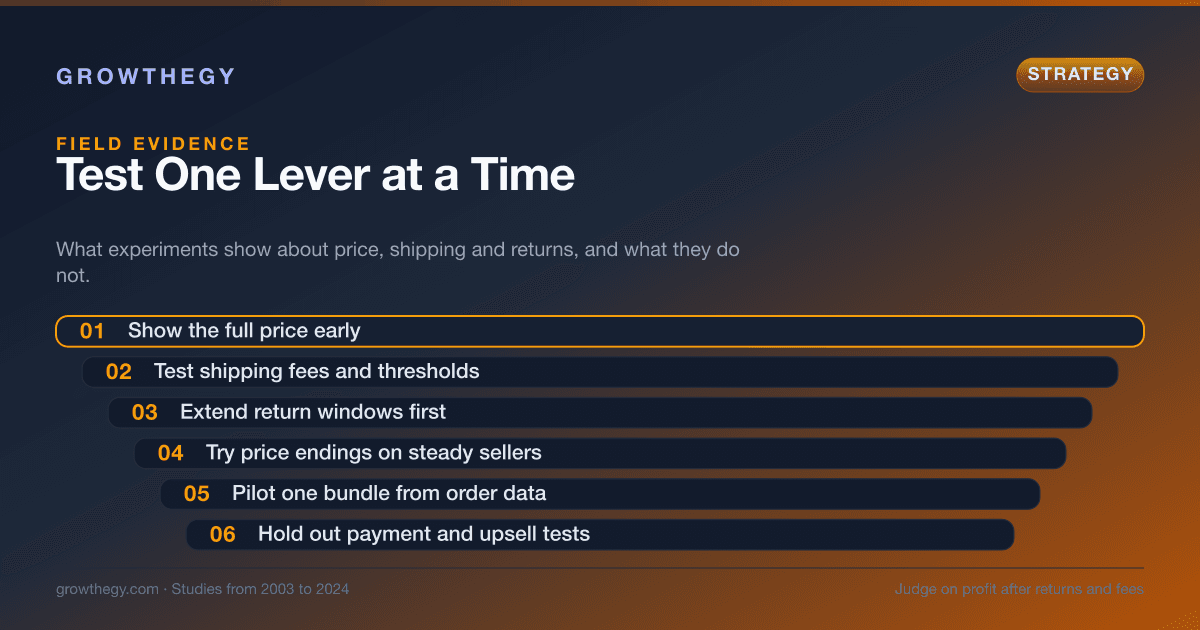
- Weeks 1 to 2: show the full price early. Put shipping and fees on the product or cart page and watch checkout drop-off.
- Weeks 3 to 6: shipping rules. Test a threshold or a fee against your current rule. Judge on revenue after returns.
- Weeks 7 to 10: return policy. Extend the window before widening scope. Track return rate and net contribution.
- Weeks 11 to 14: price endings and one bundle. Use steady sellers. Expect small effects and judge on margin.
- Then: payment options and recommendations. Use a holdout and subtract fees.
Before you spend traffic on a test, model what a change does to your unit economics. The Ecommerce Simulator models conversion, margin, payment fees and shipping costs, so you can see which lever moves profit most before you run a test.
What this evidence cannot tell you
The studies cover different settings: a cinema ticket shop, a European online shop, US retailers and a review of recommender tests. Several results are observational or from a single company, two abstracts were the only text available to us, and one result is a vendor's own report. Effects can differ by category, price level and country. We found no peer-reviewed field test on subscription pricing or on dynamic pricing for a typical online store, so we won't make claims about them.
One idea runs through the stronger studies: a lever that raises conversion can still lower profit once returns, fees and discounts are counted. Test one change, keep a holdout, and decide on contribution.
Selected studies and sources
- Troll, Frankenbach, Friese & Loschelder (2024), meta-analysis of just-below vs round prices, 69 studies, Journal of Consumer Psychology. DOI: 10.1002/jcpy.1353
- Lepthien & Clement (2019), shipping fee schedules and return behavior, randomized field experiment, Marketing Letters. DOI: 10.1007/s11002-019-09486-8
- Dertwinkel-Kalt, Köster & Sutter (2019), shrouding and partitioning of prices, more than 34,000 consumers. CESifo working paper 7475
- Bower & Maxham (2012), return shipping policies of online retailers, Journal of Marketing. DOI: 10.1509/jm.10.0419
- Janakiraman, Syrdal & Freling (2016), return policy leniency meta-analysis, Journal of Retailing. DOI: 10.1016/j.jretai.2015.11.002
- Kumar, Eckles & Aral (2020), scalable bundling via dense product embeddings, 164,469 users. arXiv 2002.00100
- Jannach & Jugovac (2019), measuring the business value of recommender systems, ACM Transactions on Management Information Systems. DOI: 10.1145/3370082
- Stripe (18 June 2024), buy now, pay later A/B test, more than 150,000 sessions (vendor report). Stripe blog
Research synthesis by Moheb. Published 30 October 2026.
Practice a decision in the Ecommerce Simulator | Read the retention evidence guide