What are the best courses to learn ecommerce?
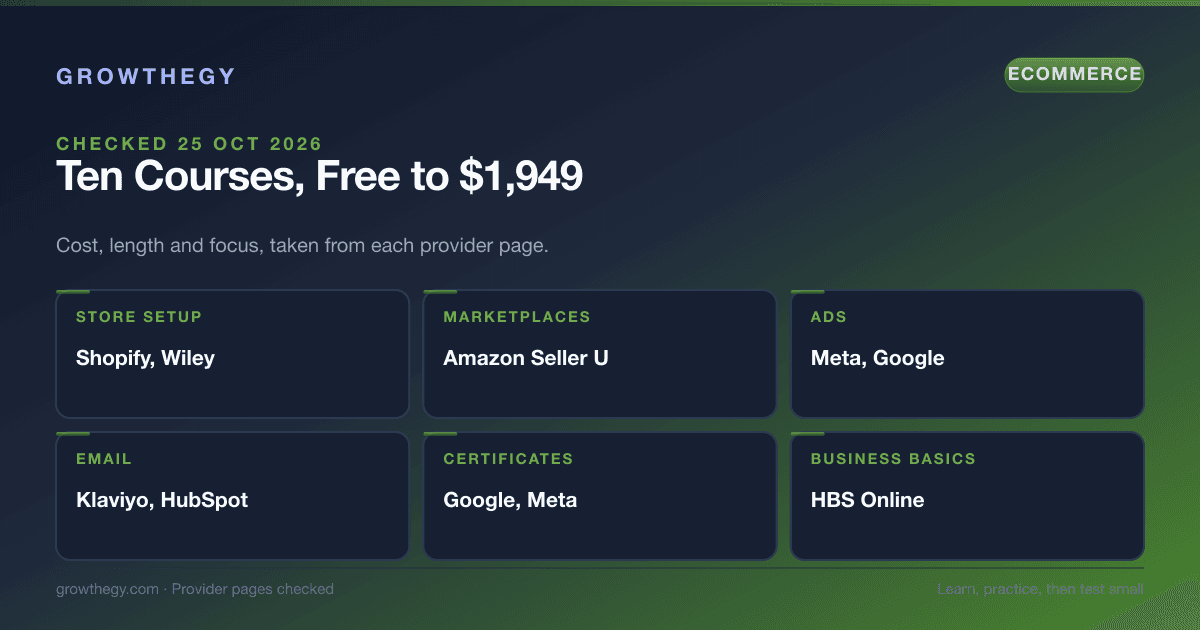
Ecommerce courses — Start with free platform training from Shopify, Amazon, Meta and Klaviyo, add one structured program such as the Google Digital Marketing & E-commerce Professional Certificate, and practice before real spending. Ten courses are listed with cost and length from provider pages checked 22 to 25 October 2026.
Key takeaways
- Ten courses, in a suggested order, with cost, length and focus taken from provider pages checked 22 to 25 October 2026.
- Five of the ten describe themselves as free; the Google certificate is $49 a month on Coursera and Harvard Business School Online is $1,949.
- Several provider pages contradict themselves on price or hours, and the post flags each one.
- Business-training research shows training helps people launch sooner but rarely proves a profit gain.
- Practice each lesson in the Ecommerce Simulator before spending real money.
On this topic: Ecommerce Simulator · Top 10 YouTube Videos to Learn Online Sales (Checked October 2026), How to Learn Ecommerce and Start an Online Business: What the Research Says (2026)
The best courses to learn ecommercestart with free platform training from Shopify, Amazon, Meta and Klaviyo, add one structured program such as the Google Digital Marketing & E-commerce Professional Certificate, and finish with a practice step before real spending. This list has ten, checked on provider pages between 22 and 25 October 2026. Prices come from each provider's own page and can change.
There are thousands of ecommerce courses, and many of the best-known ones are free. This list sticks to providers you can check yourself: platforms that sell the tools and universities or companies with a public course page. It leaves out personal coaching programs, because their results claims can't be checked.
How were these courses chosen?
I opened each provider's own page and recorded its cost wording, length, level and what it says it teaches. A course made the list when it met these tests:
- It has a public page with its own description, so you can check what you're signing up for.
- It teaches a skill used in selling online, such as store setup, ads, email or marketplaces.
- It comes from the platform, a major company or a university, not from a creator selling an income promise.
- The provider states its price, or the page makes it clear when it doesn't.
I haven't taken these courses. Everything below is what the provider's page says, and where a page contradicts itself I say so. The order is a suggested path, not a ranking. No study I found ranks ecommerce courses by results.
What are the 10 best courses to learn ecommerce?
| # | Course | Provider | Cost, per its page | Best for |
|---|---|---|---|---|
| 1 | Shopify Academy | Shopify | Many courses free, some paid | Store setup |
| 2 | Google Digital Marketing & E-commerce Professional Certificate | Google on Coursera | $49 a month after a 7-day trial | Structured overview |
| 3 | Shopify For Dummies Specialization | Wiley on Coursera | Page gives conflicting wording | Running a Shopify store |
| 4 | Amazon Seller University | Amazon | Free, no seller account needed | Marketplace selling |
| 5 | Meta Blueprint | Meta | Free, self-paced courses | Facebook and Instagram ads |
| 6 | Google Skillshop | Page states no price | Google Ads and Analytics | |
| 7 | Klaviyo Academy | Klaviyo | Free courses and certificates | Email and SMS |
| 8 | HubSpot Academy | HubSpot | Described as 100% free | Marketing basics |
| 9 | Meta Social Media Marketing Professional Certificate | Meta on Coursera | Included with Coursera Plus | Social and paid social |
| 10 | Entrepreneurship Essentials | Harvard Business School Online | $1,949 | Business fundamentals |
1. Shopify Academy
Shopify's own education site says it offers free education, and many courses are tagged free while at least one, CRO Implementation and Testing, is tagged as a paid course. The catalog covers store basics, themes and apps, checkout, point of sale, shipping, payments, marketing, SEO and conversion rate optimization. It teaches Shopify, which is why it comes first if you plan to build there. See the catalog. When your store setup is done, try the margin and pricing decisions on a model store in the Ecommerce Simulator before you buy stock.
2. Google Digital Marketing & E-commerce Professional Certificate
This is the most structured option here. Google's page on Coursera lists eight courses, including email marketing, marketing analytics, building and managing ecommerce stores, and customer loyalty. It is beginner level and needs no degree. Coursera says about six months at ten hours a week and a price of $49 a month after a 7-day free trial, with most learners finishing for under $300. The page rates it 4.8 from 51,514 reviews and shows 1,557,401 learners enrolled. One inconsistency: the page says over 190 hours, but the eight listed courses add up to 120. See the program. Use the Ecommerce Simulator alongside the loyalty and analytics courses to see how retention and conversion choices change profit.
3. Shopify For Dummies Specialization
Wiley's three-course specialization is based on the book Shopify For Dummies by Paul Waddy. It covers setting up a store, managing customers and experience, and marketing and optimization. The page lists 17 hours across the three courses and a four-week estimate at ten hours a week, which doesn't match. Its price wording also conflicts: the button says "Enroll for free" and the FAQ says you cannot take it for free, so check before you enroll. See the specialization. After the marketing course, run the same promotion decisions in the Ecommerce Simulator and compare profit, not just revenue.
4. Amazon Seller University
Amazon describes Seller University as a free educational resource, and says you can now use it without a selling account. It has videos and downloadable guides across more than 125 topics, in more than 15 languages. Selling on Amazon has its own fees, including a $39.99 a month professional selling account, which Amazon lists separately from the training. See Seller University. Before you commit to inventory, use the Ecommerce Simulator to see how a thin marketplace margin behaves when fees and ad costs rise.
5. Meta Blueprint
Meta describes Blueprint as free, self-paced online training for Facebook, Instagram, Messenger and WhatsApp, with courses, webinars, videos and optional certifications. The page doesn't state what certifications cost. See Blueprint. Take it when you're ready to buy ads, and rehearse a channel split in the Ecommerce Simulator first.
6. Google Skillshop
Skillshop hosts courses and certifications for Google Ads, including Search, Display, Video and Shopping, and for Google Analytics. Its page says nothing about price, so confirm cost on the course page you pick. It doesn't mention Google Merchant Center. See Skillshop. Analytics is the course to take once you have traffic. Until then, learn what the numbers mean by watching conversion and ad cost change in the Ecommerce Simulator.
7. Klaviyo Academy
Klaviyo says its Academy offers free courses, quick guides, live trainings and certificates. Its practitioner certificate takes about 5 hours 13 minutes, and there are certificates for service, deliverability and developers. Pricing for one-to-one live training isn't stated. It's built around Klaviyo's own product, so it fits stores that use it. See the Academy. Customer retention is where email pays off, and you can test retention choices in the Ecommerce Simulator. For evidence on cadence and discounts, read what field experiments say about retention.
8. HubSpot Academy
HubSpot's page says its Academy is 100% free and online. It lists inbound marketing (3 hours), email marketing software (4 hours), social media marketing (5 hours) and digital marketing (3 hours), among others. I found no ecommerce course on the pages I opened, but the catalog has 1,179 items and I didn't search all of them. See the Academy. It's a good source for general marketing, and a quick way to apply it is the marketing decisions in the Ecommerce Simulator.
9. Meta Social Media Marketing Professional Certificate
A six-course program from Meta on Coursera, listed at 82 hours across the courses and about five months. It covers social media management, advertising in Meta Ads Manager, measurement and a capstone. The page shows 4.8 from 23,193 reviews and 637,058 learners, and says the first attempt at the Meta Digital Marketing Associate exam is free with one free retake. It doesn't mention ecommerce. See the certificate. Practice what you learn about ad budgets in the Ecommerce Simulator.
10. Entrepreneurship Essentials, Harvard Business School Online
The one expensive option, at $1,949 on its page, with 24 to 32 hours across four modules and 90 days of access. It covers evaluating ideas, sizing a market, estimating willingness to pay, running experiments, early-stage finance and raising capital. It's about business generally, not ecommerce, and the page doesn't mention unit economics. Choose it only if you want the wider business foundation. See the course. A free way to practice the unit-economics side is the Ecommerce Simulator.
Do courses actually help you start an online business?
The evidence is more modest than the marketing. A review of business-training evaluations by McKenzie and Woodruff found that training helps prospective owners launch businesses sooner, owners adopt some taught practices with modest gains, and few studies found significant effects on profits or sales. A meta-analysis of 65 simulation-game studies found games worked best as a supplement to other instruction. Both are summarized, with sources, in our guide on how to learn ecommerce and start an online business. In short: a course will probably get you moving, and practice is what tests whether you can run the numbers.
How should you combine these courses?
- Start with free platform training (courses 1, 4, 5 or 7, depending on where you'll sell).
- If you want structure and a credential, add the Google certificate (course 2). Check the price on Coursera first.
- After each module, run a few turns in the Ecommerce Simulator and apply one lesson.
- Then run one small real test with a stop rule written before you spend.
The simulator is a model of a store. Each turn you set marketing budget, price, channel mix and product focus, and traffic, conversion, order value, margin and cash update. It doesn't teach store building, fulfilment or supply chain, which is what the platform courses above cover. We compare it with other tools in what each ecommerce simulator teaches. If you'd rather learn from videos first, see our top 10 YouTube videos to learn online sales.
What this list cannot tell you
I haven't taken any of these courses, and I have no data on how well they work for ecommerce. Prices, course lengths and even course names change, and several pages contradict themselves, which I flagged where I saw it. Check each page before paying. Treat the list as a map, not a promise.
Frequently asked questions
What is the best free course to learn ecommerce?
It depends on where you'll sell. Shopify Academy suits a Shopify store, Amazon Seller University suits marketplace selling, Meta Blueprint suits Facebook and Instagram ads and Klaviyo Academy suits email. All four describe themselves as free, though Shopify Academy also lists some paid courses.
Is the Google Digital Marketing & E-commerce certificate worth it?
It's a broad, beginner-level overview from Google with eight courses and a shareable certificate, priced at $49 a month on Coursera. No study I found shows it improves store results, so judge it by whether you'll finish and use what it teaches.
Do I need to pay for an ecommerce course to start?
No. Several platform courses are free, and the research on business training shows training helps people launch sooner but doesn't prove a profit gain. Practice and a small real test matter more than the price of the course.
Sources
Every course page above was opened between 22 and 25 October 2026, and prices, lengths and ratings come from those pages. The training research is covered, with sources, in our guide to learning ecommerce.
Research and curation by Moheb. First published 25 October 2026. Course pages checked 22 to 25 October 2026.
Practice in the Ecommerce Simulator | How to learn ecommerce | Top 10 YouTube videos