How to Make Money From SEO in the AI Era (2026 Guide)
Practical guide to making money from SEO in 2025 with AI search and answer engines.
Benchmarks
Users clicked a traditional search result in 8% of visits when a Google AI summary appeared, versus 15% of visits without one (Pew, 900 US adults, March 2025).
Source: Pew Research Center — Google users are less likely to click on links when an AI summary appears in the results (2025)
Key takeaways
- How to Make Money From SEO in the AI Era: A Practical Guide — focus on one metric or lever at a time; validate with data before scaling spend.
On this topic: Ecommerce Simulator · Why My Site Is Not Getting SEO Clicks (And How to Fix It), Bounce Rate in Ecommerce: What the Science Says — and How SEO, GEO & AEO Fix It
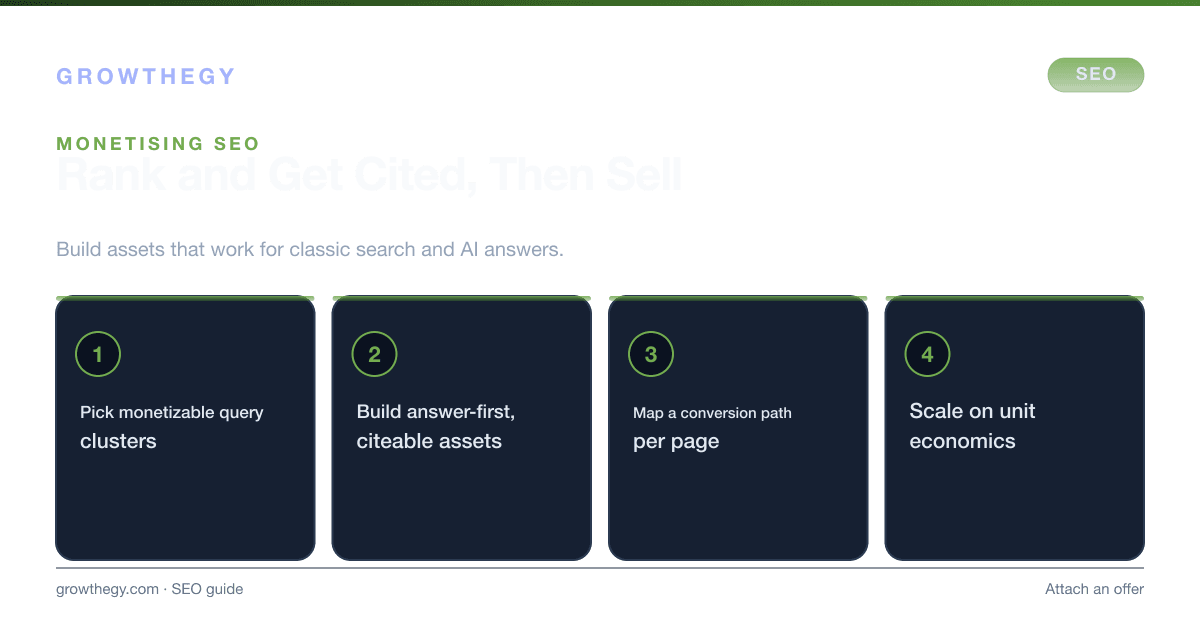
Making money from SEO in the AI era still comes down to attracting qualified traffic and converting it—via affiliate links, ads, products, or leads. The shift is that more queries are answered in-place (AI Overviews, ChatGPT, Gemini), so you need both traditional rankings and visibility in generative answers (GEO). That means clear, cite-worthy content and a monetization strategy that doesn't depend only on raw click-through from the SERP.
According to BrightEdge 2024, AI Overviews appear in roughly 42% of all Google searches. Meanwhile, SparkToro 2024 found that zero-click searches now account for nearly 60% of all Google queries, meaning search is delivering answers directly without sending traffic to a website. Despite this, organic search still drives more traffic to websites than any other channel—HubSpot 2025 reports that SEO generates 1,000%+ more traffic than organic social media. The opportunity is still enormous; you just need to adapt your monetization strategy to the new landscape.
1. Affiliate SEO: The Most Durable Model
Affiliate marketing paired with SEO is one of the most scalable ways to earn online. You create content that ranks for purchase-intent queries, embed affiliate links, and earn a commission on each sale. According to Statista 2024, the affiliate marketing industry is worth over $17 billion globally and growing at roughly 10% annually.
In the AI era, affiliate SEO works best when your content adds genuine comparison value—detailed reviews, side-by-side specs, real test results—rather than thin listicles. AI Overviews are less likely to replace content that synthesizes hands-on experience, which is the kind of content affiliate sites should be publishing anyway.
High-performing affiliate niches in 2025 include personal finance, software-as-a-service (SaaS) tools, health and wellness, and home improvement—all categories where purchase research is extensive and commissions are meaningful (often 20–50% for SaaS products).
2. Niche Sites: Traffic + Multiple Revenue Streams
A niche site targets a specific topic area with depth, building authority over time. Revenue typically comes from a combination of affiliate commissions, display advertising (via Mediavine, Raptive/AdThrive, or Google AdSense), sponsored content, and digital products.
Mediavine requires a minimum of 50,000 monthly sessions; at that threshold, RPMs (revenue per thousand impressions) range from $15–$45 depending on niche. A site generating 100,000 sessions per month can realistically earn $1,500–$4,500 per month from ads alone, before affiliate income.
The key insight for niche sites in 2025: Google's Helpful Content updates have reduced traffic for thin, AI-written sites while rewarding sites with demonstrable expertise and firsthand experience. Building a genuine niche resource—with data, original research, or community involvement—is both better for users and more resilient to algorithm changes.
3. Monetization Channels That Work With SEO
Affiliate marketing, display ads (AdSense, etc.), digital products, and lead gen all pair with organic traffic. In 2025, diversify so that if some traffic moves to AI answers, you still have referral, email, or product revenue from the audience you've built.
| Monetization Model | Best For | Typical Earnings Range | Effort to Start | AI Search Risk |
|---|---|---|---|---|
| Affiliate marketing | Product review sites, comparison content | $500–$50,000+/month | Medium (content creation) | Medium – informational queries more affected |
| Display ads (AdSense/Mediavine) | High-traffic informational sites | $15–$45 RPM | Low (auto-placed ads) | High – AI Overviews reduce informational clicks |
| Digital products (courses, ebooks) | Expertise-based content creators | $1,000–$100,000+/launch | High (product creation) | Low – brand authority protects this |
| Lead generation | Local services, B2B, high-ticket niches | $5–$500+ per lead | Medium | Low – transactional intent still clicks |
| Sponsored content / brand deals | Authority sites and niche influencers | $500–$10,000 per post | Low (once traffic established) | Very Low – not dependent on search clicks |
| Email list monetization | Any site building subscriber base | $1–$3 per subscriber/month | Medium (list building) | Very Low – email is owned traffic |
4. Adapting to AI Search: Generative Engine Optimization (GEO)
Optimize for being cited: answer questions directly, use structure and data, and maintain E-E-A-T. Our GEO guide and GEO audit checklist help. Practice unit economics and traffic scenarios in the Ecommerce Simulator.
GEO (Generative Engine Optimization) is the practice of structuring your content so that AI systems—ChatGPT, Google Gemini, Perplexity, Claude—cite your site as a source when generating answers. A study by Columbia University and IIT Delhi (2024) found that certain content strategies could increase citation frequency in AI-generated responses by up to 40%. Key tactics include: citing statistics with sources, structuring content with clear headings and definitions, using authoritative language, and maintaining consistent publishing cadence.
For sites that get cited in AI answers, the benefit is brand visibility even when no click occurs—and a click often follows when users want to verify or go deeper. This makes GEO a traffic-multiplier strategy on top of your SEO foundation.
5. Step-by-Step: Building an SEO Income Stream in 2025
- Choose your niche and monetization model first. Before writing a single piece of content, decide whether you'll monetize with affiliate commissions, ads, a digital product, or leads. This shapes your content strategy. High-commission affiliate niches (SaaS, finance, health) justify the investment in deep content even at lower traffic volumes.
- Build topical authority with a content cluster. Google and AI systems both reward sites that cover a topic comprehensively. Create a pillar page (a comprehensive 3,000–5,000-word guide) and cluster pages (supporting articles covering subtopics). Link them together. Semrush 2024 reports that sites with topical authority clusters rank 3x more pages in top-10 positions compared to sites with scattered, unrelated content.
- Optimize for E-E-A-T (Experience, Expertise, Authoritativeness, Trustworthiness). Google's quality rater guidelines emphasize firsthand experience. Add author bios, cite your sources, show real results, and include data. This is also what makes your content cite-worthy for AI systems.
- Capture email from day one. SEO traffic is borrowed; your email list is owned. Use a pop-up or inline opt-in to convert readers into subscribers. Even a list of 1,000 engaged subscribers can generate meaningful revenue via affiliate promotions or product launches—independent of search traffic fluctuations.
- Track and diversify revenue. Use Google Analytics 4 to separate SEO-driven revenue from email, direct, and social channels. If AI Overviews reduce clicks on informational posts, that traffic may shift to branded searches or email. Knowing your channel mix helps you invest where returns are highest.
- Layer in digital products as you grow. Once you have 5,000+ monthly visitors and an email list, a digital product (ebook, mini-course, template pack) can generate $1,000–$10,000 in a single launch week. Unlike ad revenue, product revenue scales with audience trust, not just traffic volume.
- Run the GEO checklist on key content pages. Use the GEO audit checklist to see where pages fall short on cite-ready structure before you overhaul copy. Prioritize your highest-traffic or highest-affiliate-commission URLs first.
6. Traffic Data: What AI Search Has Actually Changed
The data on AI's impact on SEO traffic is nuanced. Semrush (2025) analyzed 847,000 keywords and found that queries triggering AI Overviews saw an average CTR decline of 8.9% for results in positions 1–3. However, queries where AI Overviews were absent saw CTR remain stable or improve. This means the impact is concentrated on high-volume informational queries—exactly where display-ad monetization is most common.
The implication: if your SEO strategy is built primarily on informational content monetized with display ads, 2025 and beyond will be challenging. But if you monetize with affiliate links (which capture purchase-intent queries that AI Overviews rarely fully answer) or digital products (which require a purchase relationship), the impact is lower.
Perplexity disclosed in late 2024 that it serves over 15 million daily active users. ChatGPT crossed 100 million weekly active users in early 2024 (OpenAI). These platforms don't replace Google for most searches yet, but they are capturing a growing share of research queries—and if they cite your content, that's a visibility opportunity even without a direct click.
Key Takeaways
- SEO remains one of the highest-ROI traffic sources—organic search drives 53% of all website traffic (BrightEdge 2024).
- AI search reduces clicks on informational queries; protect revenue by diversifying into affiliate, lead gen, or products.
- GEO (getting cited in AI answers) is the 2025 extension of traditional SEO and compounds visibility over time.
- Email list building converts SEO traffic into an owned asset that survives algorithm changes.
- Niche sites with topical authority and genuine expertise outperform thin content sites under every recent Google algorithm update.