How to start an online business with AI: what a randomized trial, a 758-consultant experiment and a 5,179-agent study show, five AI startups with their reported numbers, and a 30-day plan.
Key takeaways
- In a 640-entrepreneur trial, a GPT-4 mentor had no average effect: strong businesses gained about 15%, weak ones lost about 8%.
- AI sped up tasks inside its ability by 25.1% in a 758-consultant study, and cut correctness by 19% on a task outside it.
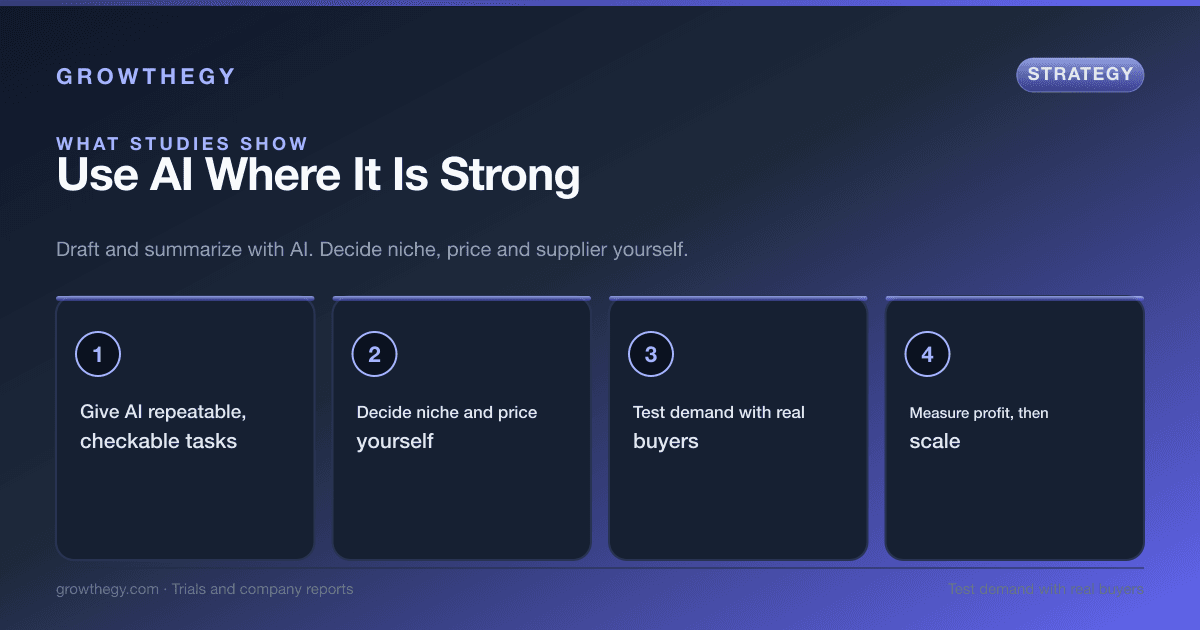
- Use AI for repeatable, checkable work and keep niche, price and supplier decisions with a person.
- Five AI startups show fast growth from small teams, but they sell AI and their figures are mostly company-reported.
- No controlled study yet follows new stores launched with AI, so validate demand with real buyers.
On this topic: Ecommerce Simulator · Ecommerce Monetization: What Field Evidence Says About Pricing, Shipping and Returns, Ecommerce Customer Retention: What Field Experiments Reveal
Starting an online business with AI works best when you give AI the tasks it handles well and keep the judgment calls yourself.In a randomized trial of 640 Kenyan entrepreneurs, a GPT-4 business mentor had no average effect: stronger businesses gained about 15%, and weaker ones lost about 8%. Five well-known AI startups show how fast a small team can grow, but they sell AI itself, so their numbers don't transfer to a typical store.
We ran a Google Scholar Labs search for "how to start a business with help of AI" and then looked for controlled studies and verifiable company numbers. Scholar Labs returned ten papers. From their summaries, they are mostly frameworks, literature reviews and case studies: adoption roadmaps for startups, lists of AI tools, and classifications of AI business models. None of the ten summaries reports a controlled test of whether AI helps a new business succeed. That gap is why this guide leans on three experiments from other settings and on public company figures, and says clearly where each one stops being useful.
What do controlled studies say about AI and new businesses?
Only one experiment we found put an AI business adviser in front of real small-business owners and measured revenue and profit. The other two measured how AI changes the quality and speed of work inside a job. Read together, they give you a rule for where to use AI.
AI as a business mentor: 640 entrepreneurs in Kenya
Otis, Clarke, Delecourt, Holtz and Koning randomly assigned 640 Kenyan entrepreneurs to a standard business guide or to a GPT-4 business mentor on WhatsApp. They measured revenue and profit. The authors could not reject the hypothesis of no average effect. The average hid a split: high performers at the start gained just over 15% from the AI's advice, while low performers did about 8% worse. In the logs, both groups asked the mentor for help, but the low performers asked about harder business problems. The authors conclude that the tasks people hand to AI shape who benefits. Working paper, February 2024; published in Management Science.
Caveats: one country, one AI tool, one study period, and a sample of existing businesses rather than people launching from scratch. Sources report the low-performer drop as roughly 8% to 10%, so treat it as "about 8%".
Where AI helps and where it hurts: 758 consultants
Dell'Acqua and colleagues ran a preregistered experiment with 758 consultants at Boston Consulting Group. On 18 realistic tasks inside what AI could do, people using GPT-4 completed 12.2% more tasks, finished 25.1% faster and produced better quality. On one complex managerial task chosen to be outside AI's ability, people using AI were 19% less likely to produce a correct answer than people without it. The authors call this a "jagged frontier": AI can help with one task and hurt on another that looks just as hard. HBS Working Paper 24-013, listed as published in Organization Science (March to April 2026).
AI for routine work: 5,179 support agents
Brynjolfsson, Li and Raymond introduced an AI assistant in stages to 5,179 customer-support agents. In the NBER working paper, issues resolved per hour rose about 14% on average and 34% for novice and low-skilled workers, with minimal gains for experienced ones. The published version in the Quarterly Journal of Economics uses a slightly different sample and reports a 15% average gain, and says the most experienced workers saw small gains in speed and small declines in quality. NBER 31161; QJE, 2025. This was a large company with scripted tasks, so it says little about a new store, but it shows that repeatable, text-heavy work is where AI has the cleanest record.
What rule follows from these studies?
This is our reading, not a result any single paper states. Use AI for work that is repeatable, easy to check and low in consequence: drafting product descriptions and emails, summarizing customer feedback, answering common support questions, building first drafts of pages and reports. Keep a human in charge of work that is open-ended, costly to get wrong, or needs real-world information the AI doesn't have: choosing a niche, setting prices and margins, picking suppliers, deciding what to stop doing. The Kenya result is the warning: AI advice on the hardest problems was where weaker businesses lost ground.
Which startups grew fast with AI, and what are their numbers?
Five companies come up in nearly every "start a business with AI" story. All five build AI products or run on them, and their figures are mostly company-reported, so read the table as examples of what is possible, not as a forecast for a new business.
| Startup | What it does | Reported numbers | Source and caveat |
|---|---|---|---|
| Base44 | Builds apps from plain-language chat | Founded by Maor Shlomo, bought by Wix in summer 2025; run rate of $100 million ARR by March 2026 and about $150 million by May; founder proceeds above $150 million including milestone payments | Ctech, Aug 2026, Globes, May 2026. Reported by Wix; gross margin was near break-even early in 2026 and Wix posted a $76.4 million net loss in Q2 |
| Lovable | AI app and website builder | Over $100 million ARR eight months after launch with 45 employees (July 2025); 146 employees at $400 million ARR (February 2026) | TechCrunch, Jul 2025, AIChief summary of TechCrunch and Business Insider. Company-reported |
| Gamma | AI presentations and documents | Over $100 million ARR; profitable for over two years; 50-person team; $23 million initial funding; 70 million users (Nov 2025) | Company press release, Nov 2025. Also raised $68 million at a $2.1 billion valuation |
| Cursor (Anysphere) | AI code editor | Reported annualized revenue above $1 billion; $2.3 billion round at a $29.3 billion valuation (Nov 2025) | Wikipedia summary of press reports. Headcount reports conflict, so we give none |
| Photo AI (Pieter Levels) | AI photo generation app | About $100,000 to $105,000 a month in 2026; run by one person, no outside funding | Founder-posted, repeated by a secondary write-up. Higher figures online are unconfirmed |
How should you read this table?
- These are survivors. The studies above include everyone who tried. A list of famous winners can't tell you the share of AI-assisted businesses that fail.
- They sell AI, not stores. Their customers pay for AI itself. A shop selling physical goods faces suppliers, shipping, returns and ad costs, which none of these numbers include.
- Revenue isn't profit. Base44's gross margin was close to break-even early in 2026 because of computing costs, and Wix expected about 60% in the second half. Gamma is the one here that states a profitability claim.
- Small teams still grow. Gamma reached $100 million with 50 people, and Lovable with 45 at that milestone. Headcounts grow quickly afterward, as Lovable's 146 shows.
How should you start an online business with AI?
The plan below applies the studies. It's a working method, not a guarantee.
- Days 1 to 7: use AI to research, and use people to decide. Have AI summarize competitor pages, reviews and forum questions into a list of problems. Then pick one niche yourself and talk to five real buyers. The Kenya study suggests that the hardest, most uncertain choices are where AI advice can mislead.
- Days 8 to 14: draft with AI, check by hand. Let AI write first drafts of product pages, emails and FAQs. Verify every number, claim and policy yourself. Inside the frontier, AI sped up work by about a quarter in the BCG study, but outside it, it cut accuracy.
- Days 15 to 21: test demand with real money or real sign-ups. Sell a small batch, take pre-orders or run a small ad test. Nothing AI produces replaces a customer paying you.
- Days 22 to 30: measure profit per order, not traffic. Count product cost, shipping, payment fees, ads and returns. Our guide to learning ecommerce lists the numbers to learn first, and the Ecommerce Simulator lets you practice those decisions with no real money at risk.
- After day 30: automate what works. Add AI to repeatable work such as support replies and content drafts, as in the support-agent study, and keep testing one change at a time. See our monetization evidence guide for what to test on price, shipping and returns.
Which mistakes do the studies warn about?
- Asking AI to run the whole strategy. Weaker businesses in the Kenya study did worse after asking for help on harder problems.
- Trusting fluent answers on hard questions. The BCG consultants using AI were less accurate on the task outside the frontier.
- Copying the winners' numbers. Base44, Lovable and Gamma sell AI tools, so their margins and growth don't apply to a store selling products.
- Measuring speed instead of profit. Faster output helps only if the product sells at a margin.
What this evidence cannot tell you
Only one of the experiments involved running a business, and it covered existing Kenyan small businesses over a single study period. The others studied employees at one consulting firm and one support center. We found no controlled study that follows people launching a new online store with AI from day one. The ten Scholar Labs papers are mostly conceptual. The startup figures are company-reported or relayed by press, and we could not read some primary pages directly, which is why the table names each source. Treat this as a method for deciding where to use AI, not as proof that AI makes a new business more likely to succeed.
Selected studies and sources
- Otis, Clarke, Delecourt, Holtz & Koning, "The Uneven Impact of Generative AI on Entrepreneurial Performance", 640 Kenyan entrepreneurs, Management Science. DOI: 10.1287/mnsc.2024.06909
- Dell'Acqua et al., "Navigating the Jagged Technological Frontier", 758 consultants, HBS Working Paper 24-013. HBS record
- Brynjolfsson, Li & Raymond, "Generative AI at Work", Quarterly Journal of Economics 140(2), 2025. DOI: 10.1093/qje/qjae044
- Google Scholar Labs search, "how to start a business with help of ai", ten results reviewed from summaries (conceptual and review papers, 2021 to 2026)
- Company and press sources for Base44, Lovable, Gamma, Cursor and Photo AI, linked in the table above
Research synthesis by Moheb. Published 1 November 2026.
Practice a decision in the Ecommerce Simulator | Read how to learn ecommerce